Walk into our shop on August 12 at 11 AM. Outside it’s 110°F. Inside the customer’s BMW X5 it’s about the same — the AC has been blowing warm air for three days and the family vacation to Mt. Charleston is tomorrow. It is a very common summer scenario in Las Vegas.
The diagnosis tree below is the exact one our technicians follow. It saves you from being upsold (a $1,400 compressor when all you needed was a $189 refrigerant leak repair) and from being undersold (a $129 “just charge it” recharge that fails three weeks later because the actual leak was never found).
The five things that cause “AC blows hot”
In order of frequency at our shop:
- Low refrigerant from a leak (about 60% of all “no cold air” cases)
- Electrical fault — compressor clutch not engaging (about 15%)
- Bad compressor — internally failed, seized, or with broken reed valves (about 12%)
- Blocked expansion valve / orifice tube / receiver-drier (about 8%)
- Airflow problem — clogged cabin filter, failed blower motor, blend-door actuator stuck (about 5%)
The diagnostic process narrows from #1 to #5. Let’s walk it.
Test 1 — refrigerant pressure check (the first 5 minutes)
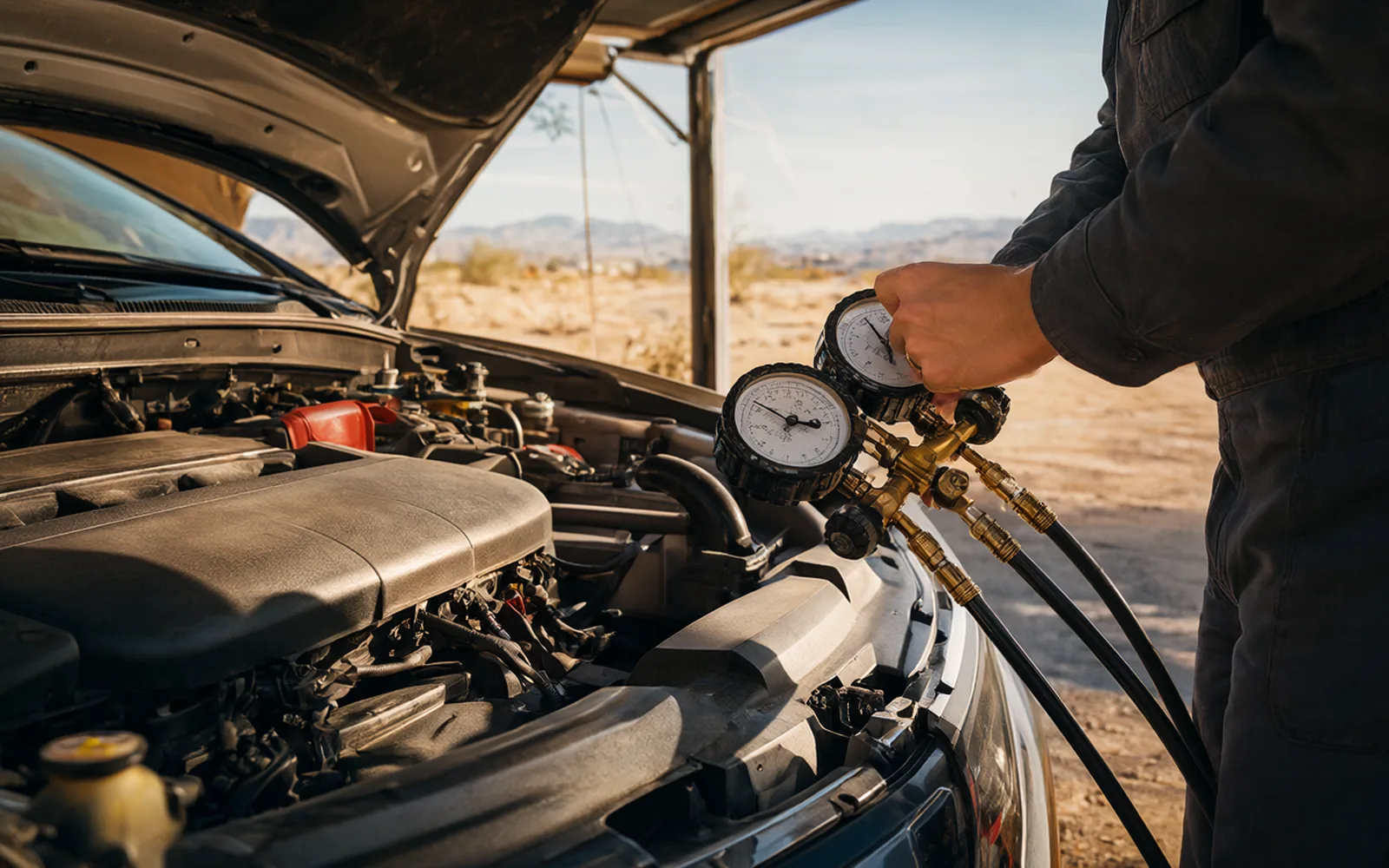
Our $77.77 A/C inspection starts here. With the engine off and the system static (sitting at ambient), we hook up manifold gauges and read static pressure on both the high and low sides.
On a healthy system in 95°F Vegas heat, you expect to see static pressure around 100-120 PSI on both gauges. Below about 50 PSI, the low-pressure cutoff switch will refuse to let the compressor engage at all — protecting the compressor from running dry.
- Static pressure 100+ PSI on both sides: refrigerant charge is okay (probably). Move to Test 2.
- Static pressure low, even on both sides: refrigerant has leaked out. Need to find the leak before recharging — UV dye + electronic sniffer locates the source.
- Static pressure zero: complete refrigerant loss. Usually a hose, a service port valve, or a condenser puncture from a road rock.
Common leak points on Vegas-driven cars:
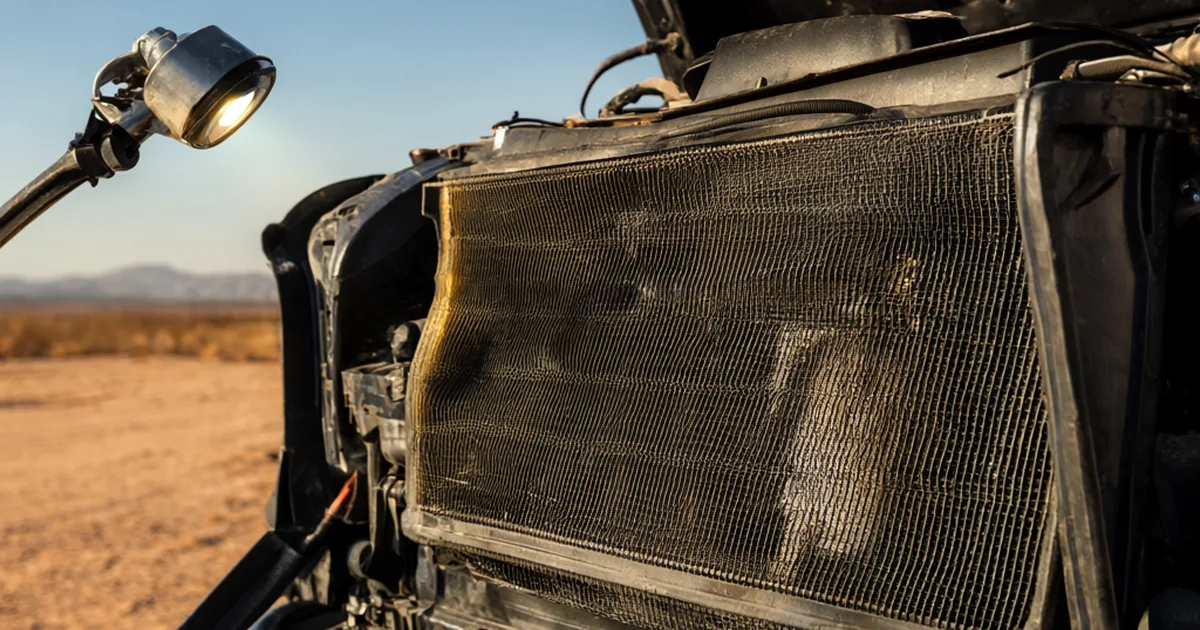
- Front condenser (especially on cars driven on the 95 or 215 where rock chips are common)
- Compressor shaft seal (heat + UV degrades the rubber)
- O-ring seals at hose fittings (the #1 cause of slow leaks after 8+ years of Vegas sun)
- Evaporator core (rare but expensive — buried in the dashboard)
Test 2 — clutch engagement under the hood (next 2 minutes)
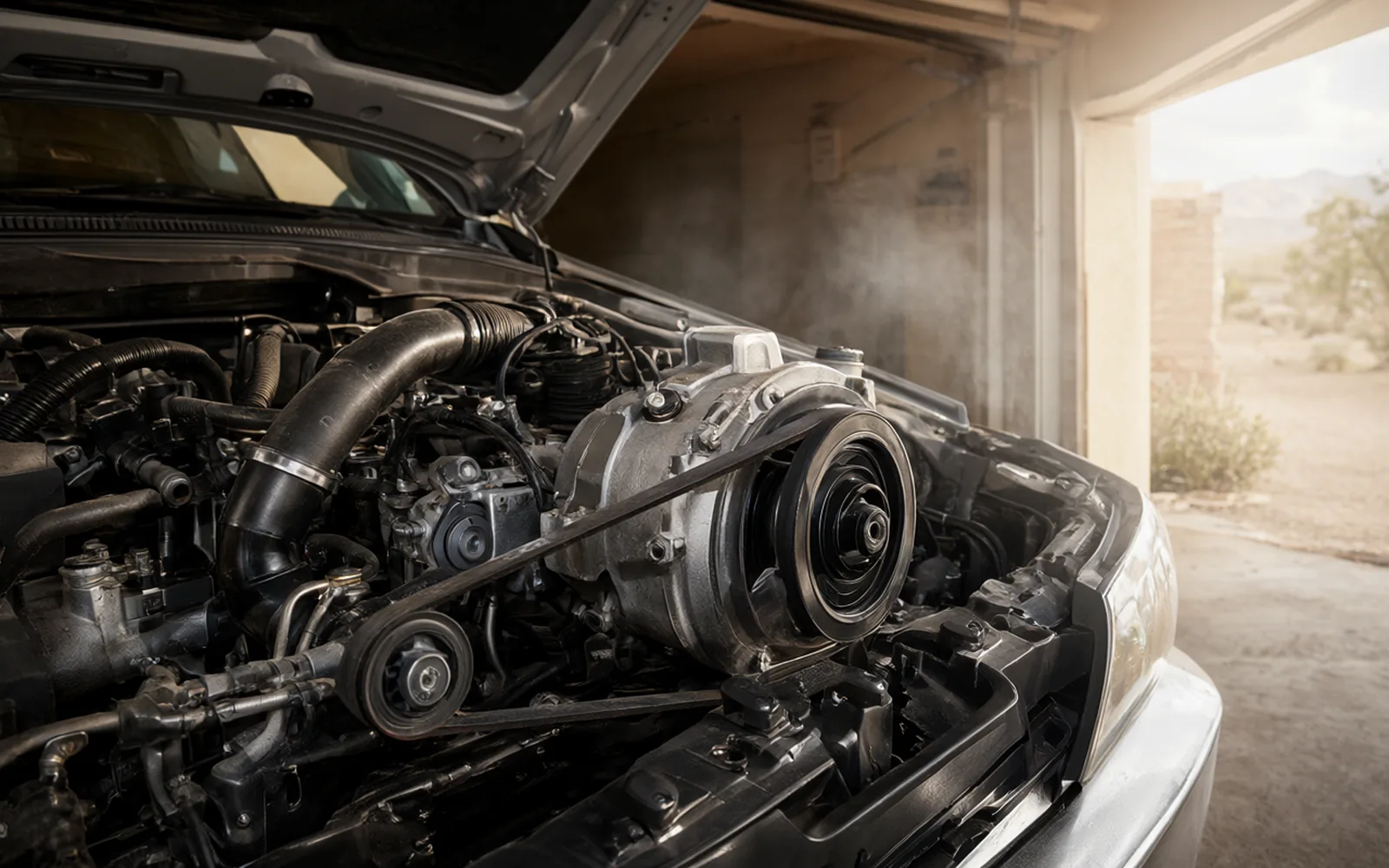
Engine running, AC set to max-cold and max-fan. Open the hood and look at the AC compressor.
The compressor has a clutch at the front pulley. With AC on:
- Clutch engaging in cycles (3-5 seconds on, 1-2 seconds off): normal operation. Good sign — AC system is working, problem may be inside the cabin.
- Clutch fully engaged and not cycling: compressor running continuously, which means it can’t build pressure. Often indicates internal compressor wear or restricted system flow.
- Clutch never engages: electrical problem, or system is so low on refrigerant the pressure switch is refusing to allow engagement.
If the clutch never engages, we check (in order):
- AC clutch relay (often a $15 swap from a known-good relay socket)
- AC fuse
- Low-pressure switch reading (refrigerant level)
- Clutch coil resistance (multimeter at the connector — should be 3-5 ohms)
- Compressor control signal from the climate control module (scan tool — XENTRY for Mercedes, ISTA for BMW, ODIS for Audi/VW)
Test 3 — manifold gauges during operation (5-10 minutes)
This is where experience separates a real AC tech from someone who just hooks up a recharge can.
With the system running and at thermal stability:
- Healthy R-1234yf system (2017+ cars): low side 30-45 PSI, high side 200-275 PSI in 95°F ambient
- Healthy R-134a system (pre-2017): low side 30-40 PSI, high side 200-250 PSI
Reading the pattern:
- Low side high, high side low: bad compressor (internal pump worn out)
- Low side low, high side normal: expansion valve restricted, or low charge
- Both sides high: poor condenser airflow (fan not running, condenser fins blocked by dirt/dust — common in Vegas), or overcharged system
- Both sides low: low refrigerant charge, or major leak
This 2-minute gauge reading prevents thousands of dollars in wrong-direction repairs.
Test 4 — airflow, cabin filter, blower, blend door
If the AC system is working (compressor engaging, gauges reading correctly) but the vents still blow weak or warm air, the problem is on the cabin side.
- Cabin filter — in Vegas dust, cabin filters can be 60% clogged at 12 months. Check yours. Replacement is $39-$79.
- Blower motor — if the fan is weak on all speed settings, the blower motor or its resistor pack is failing. $189-$389 typical repair.
- Blend door actuator stuck on heat — common on BMW E60/E90 (the actuator gears strip), Mercedes W204 and W205 (popular failure), and Audi B8/B9. Symptom: AC system works perfectly, but the dashboard mixes hot air with cold air, or only blows from defrost vents. $289-$529 to fix.
- Recirculation flap stuck on fresh-air: pulling 110°F outside air into a car the AC can’t keep up with. $189-$329 to repair.
Cost matrix — what each repair actually costs
| Repair | Cost range |
|---|---|
| A/C inspection (full diagnosis with gauges) | $77.77 |
| Refrigerant top-off (no leak found, system was simply low) | $89-$129 |
| Leak repair + full evacuate/recharge (most common) | $249-$790 |
| Expansion valve / TXV replacement | $389-$790 |
| AC compressor replacement (full assembly with new dryer) | $1,290-$2,400 |
| Condenser replacement | $590-$1,290 |
| Evaporator core replacement (dash-out labor) | $1,800-$3,200 |
| Cabin filter replacement | $39-$79 |
| Blend door actuator replacement | $289-$529 |
For deeper symptom-based diagnosis, see car AC not blowing cold.
Why “just charge it” without finding the leak fails in Vegas
Vegas is the worst climate in the country for AC system longevity. The UV degrades rubber seals. The 110°F summer heat plus 30°F winter mornings cycle the rubber. The dust eats condenser fins. The result: every O-ring in every connection point is a future leak.
When a shop just charges the system without doing a proper leak trace, here’s what happens:
- System is recharged to 28-32 oz of refrigerant
- Slow leak resumes at the same rate (often through an O-ring or compressor shaft seal)
- In 2-6 weeks, refrigerant level drops below the low-pressure cutoff
- AC stops cooling again
- Customer comes back angry, and the shop has to do it all over for free, or worse, the customer feels burned
Our process: dye trace, UV inspection, electronic sniffer, find the leak, fix the leak, then recharge. Costs more upfront, holds for years.
Should I drive with no AC or have it towed?
In most cases, drive it in. A non-functional AC system does not damage the rest of the car. Exception: if the AC compressor has seized internally (rare but happens), the clutch may not be able to fully disengage, and the seized compressor can throw the serpentine belt or damage other accessory pulleys. Signs of a seized compressor:
- Loud squealing or screeching from the engine bay
- Burning rubber smell
- Belt visibly wobbling or smoking
If any of those are happening, have it towed. We can recommend a flatbed service.
Mini FAQ
How much refrigerant does my car take? Look on the AC label under the hood (usually on the radiator support or the firewall). It’s printed in either ounces or grams. Most modern cars take 16-32 oz. Putting in more than spec is harmful — overcharged systems run hot and damage compressors.
Can I use AC Pro store charge cans? We strongly recommend against it. Three reasons: (1) the can has no idea how much is already in your system, so you risk overcharge; (2) the “stop leak” additive in many cans contaminates the system and can permanently damage your compressor and recovery machines; (3) you mask the actual leak instead of fixing it. We’ve seen $2,000 compressor failures directly caused by stop-leak additives.
Does running the AC use more gas? Yes, slightly — typically 1-2 MPG penalty depending on the vehicle and how aggressively the compressor cycles. In 110°F Vegas summers, this is a non-issue. Driving with windows down at highway speeds usually costs more in aerodynamic drag than running the AC. For local stop-and-go in Henderson or Summerlin, there’s a measurable AC fuel cost, but it’s small.
If your AC is blowing warm right now, don’t wait. Vegas summers are punishing, and a small refrigerant leak today is often a $1,500 compressor replacement next month if the system runs dry and the compressor seizes from lack of lubrication (refrigerant carries the compressor oil).
Call (725) 322-7768 or book an AC inspection. $77.77 gets you a full diagnosis with manifold gauges, leak trace, and a clear written estimate.