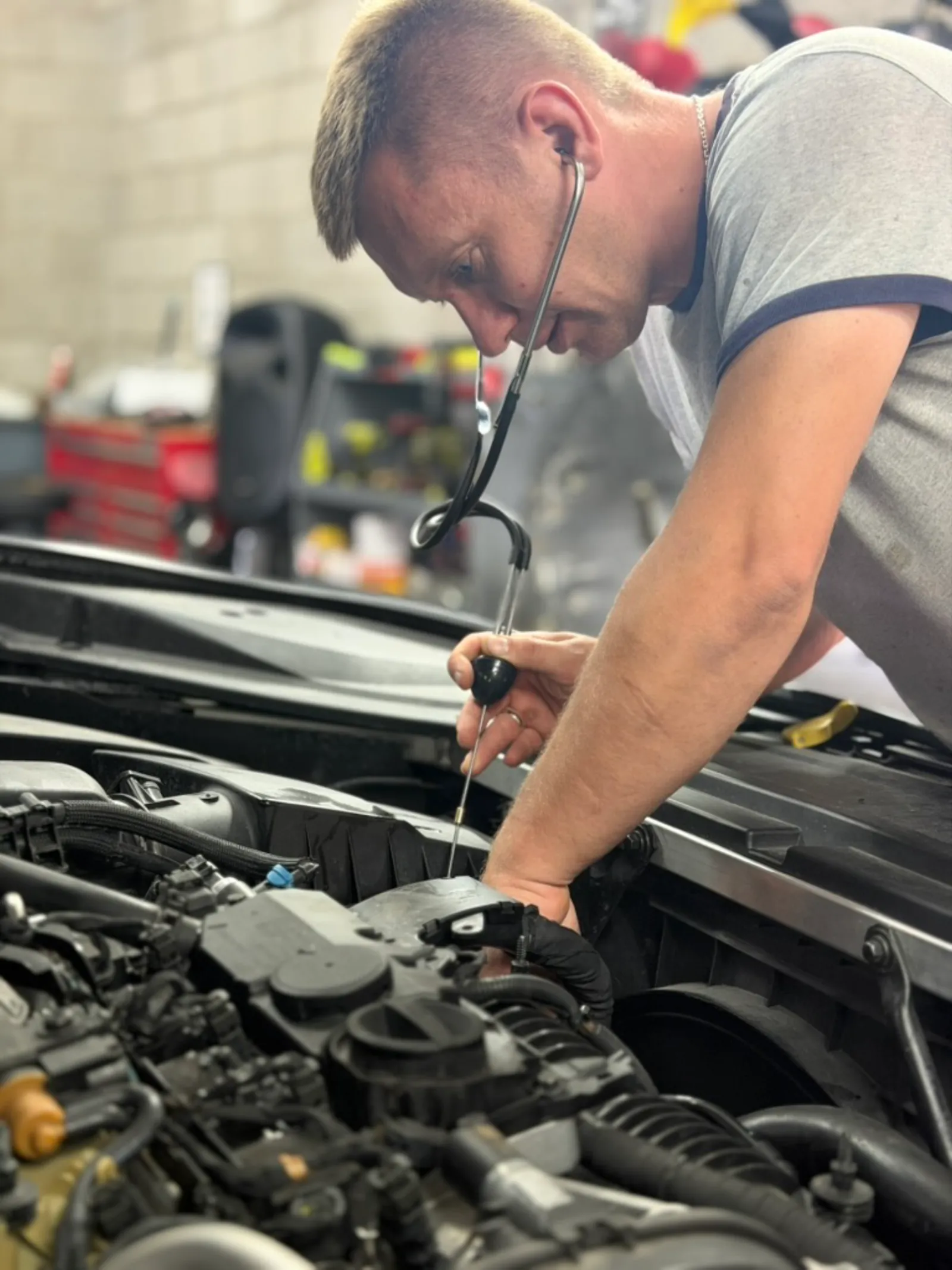
A 2017 BMW 340i came into our Arville Street shop last July with a “low coolant” message and a faint sweet smell. The owner had topped it off twice and figured it was no big deal. By the time we pressure-tested it, the plastic thermostat housing had a hairline crack, the water pump bearing was already noisy, and the expansion tank seam was weeping. On a German car these parts fail as a system, and once one goes the others are usually close behind. Done all at once with a proper coolant service, the bill lands in the $1,800-3,000 range. Done as three separate breakdowns over one summer — three tows, three diagnostics, three labor charges — it costs far more and strands you each time.
This is the article that explains why European cooling systems die early in Las Vegas, and the maintenance that gets ahead of it.
Why German cooling systems are different
BMW, Mercedes-Benz, and Audi engineer their cooling systems to be compact, light, and efficient. To hit those targets they use a lot of engineered plastic and tightly integrated components: plastic thermostat housings, plastic-bodied water pumps and impellers, plastic expansion (overflow) tanks, plastic coolant pipes, and on many engines an electric water pump and a map-controlled thermostat managed by the ECU.
Those choices are great for efficiency and emissions. They are not great for a desert. The failure mode that defines these cars is not corrosion — it is plastic embrittlement from heat cycling. Every time the engine heats to operating temperature and cools back down, the plastic expands and contracts. After enough cycles, especially with the extreme under-hood temperatures Vegas produces, the plastic loses its flexibility and cracks at the stress points: the seams, the necks, the threaded bungs.
Why Vegas accelerates it
The plastic in these systems ages two ways: by total time and by heat-cycle severity. Las Vegas pushes both:
- Under-hood temperatures routinely exceed 160°F with ambient over 110°F, so each heat cycle is hotter and harder on the plastic than the same cycle would be in a mild climate.
- Coolant degrades faster in heat — it loses its corrosion inhibitors and additive package sooner, which lets the system run hotter still.
- More frequent AC and idling load raises operating temperatures across the board.
We routinely see plastic cooling components fail at 60,000-80,000 miles or 6-7 years on Vegas cars that would comfortably reach 100,000+ miles in a coastal climate. The mileage isn’t the trigger — the accumulated heat damage is.
The parts that fail (and why they go together)
Plastic thermostat housing
On many BMW and Mercedes engines the thermostat is integrated into a plastic housing. The housing cracks at a seam or the sensor port and leaks coolant — often slowly enough that you smell it before you see a puddle. Because the housing also holds the thermostat, a failure here can cause overheating and a leak at the same time.
Water pump
Many late-model German engines use an electric or plastic-impeller water pump. The impeller can crack or strip, or the bearing can fail. When it goes, coolant circulation stops and the engine overheats fast — and on these cars overheating risks an aluminum head and an expensive head gasket job.
Expansion / coolant overflow tank
The plastic expansion tank is pressurized and heat-soaked. The seams and the cap neck crack with age, causing slow leaks and pressure loss. A failed tank cap alone lowers the system’s boiling point and lets it overflow.
Coolant pipes and hose connections
BMW in particular uses plastic coolant pipes (including some that run under the intake on certain engines). They become brittle and crack. Quick-connect fittings get hard and weep.
The reason a good shop quotes these together is simple: they share the same heat history. When we open up a cooling system on a 7-year-old German car and find a cracked thermostat housing, the water pump and expansion tank are almost always at the same point in their life. Replacing one and leaving the others is how customers end up back in two months.
The preventive maintenance that saves the big repair
You cannot stop plastic from aging, but you can replace it on your schedule instead of the freeway’s. Here is what we recommend for BMW, Mercedes, and Audi owners in this climate:
- Coolant service on the European interval, not the “lifetime” myth. Manufacturers often quote long coolant intervals; in Vegas heat we recommend a flush and fresh OEM-spec coolant every 3-4 years to keep the additive package and boiling protection intact. The right coolant matters — BMW, Mercedes, and VW/Audi each spec specific formulations, and mixing the wrong one accelerates plastic and seal damage.
- Pressure-test the cooling system annually, ideally before summer. A pressure test finds a hairline crack while it is still a $0 observation instead of a roadside steam cloud.
- Replace plastic components proactively at the 6-7 year / 70k-mile mark if any one of them shows weeping. Doing the thermostat housing, water pump, and expansion tank together saves duplicate labor — these jobs share a lot of the same teardown.
- Watch the coolant level and the messages. A German car that asks for coolant is telling you something. Topping off repeatedly is not maintenance — it is a leak you haven’t found yet.
- Use OEM or OEM-equivalent parts. Cheap aftermarket plastic housings often fail again quickly. On a heat-cycling part, material quality is the whole game.
We are equipped to service both R-134a and R-1234yf systems and to diagnose these cars properly, including the electric water pumps and ECU-controlled thermostats that a general shop may not be set up for. If you also want to understand the broader overheating warning signs that apply to every car, our guide on engine overheating in Vegas traffic walks through the gauge readings and the pull-over thresholds.
Real pattern from our shop
Most of our European cooling jobs fall into two groups. The first group comes in for a planned coolant service or a pre-summer inspection, we catch a weeping housing or a tired water pump, and we do the whole system in one visit at a predictable cost. The second group comes in on a flatbed in July with the temperature gauge already pinned, and now we are talking about whether the head survived. The parts and the labor are similar; the difference is whether the engine got cooked first.
If you drive a Mercedes-Benz or BMW in Las Vegas and it is past the 6-year mark, you are in the window where this matters.
Don’t wait for the steam. If your European car is 6+ years old, has ever asked for coolant, or you just want to know where the cooling system stands before the next heat wave, book a pressure test and inspection at /contact/ or call (725) 322-7768. We will tell you honestly whether you have months of runway or a repair that should happen now. Our shop at 4350 Arville Street, Suite 490 in Las Vegas runs Mon-Sat 9AM-6PM.