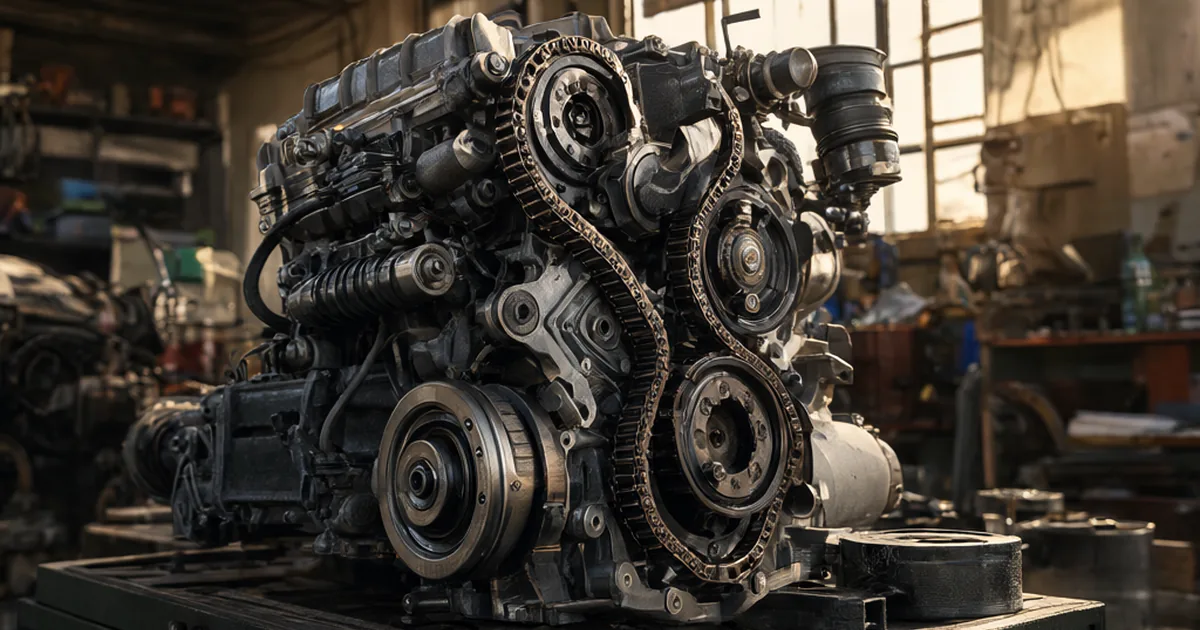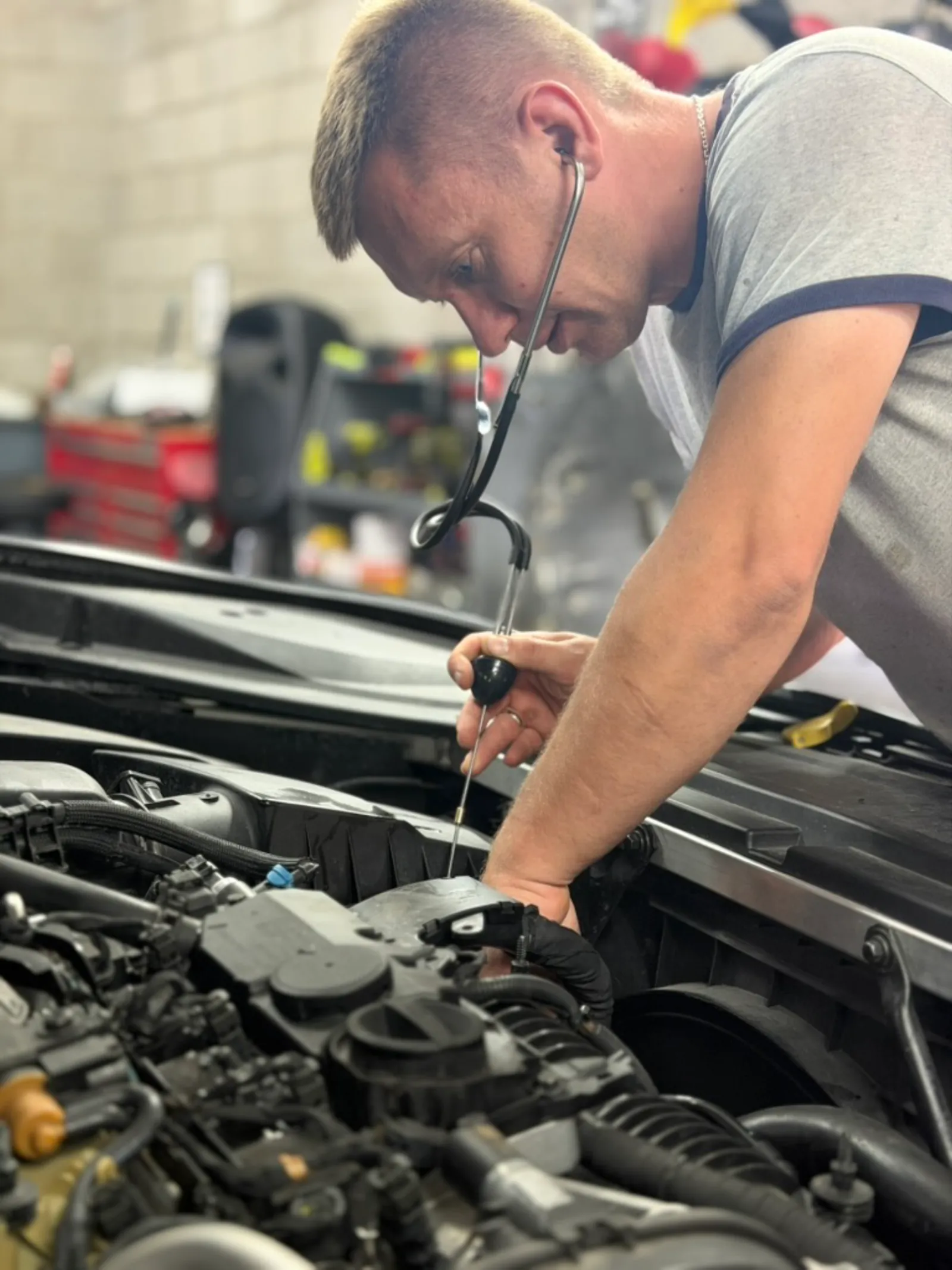
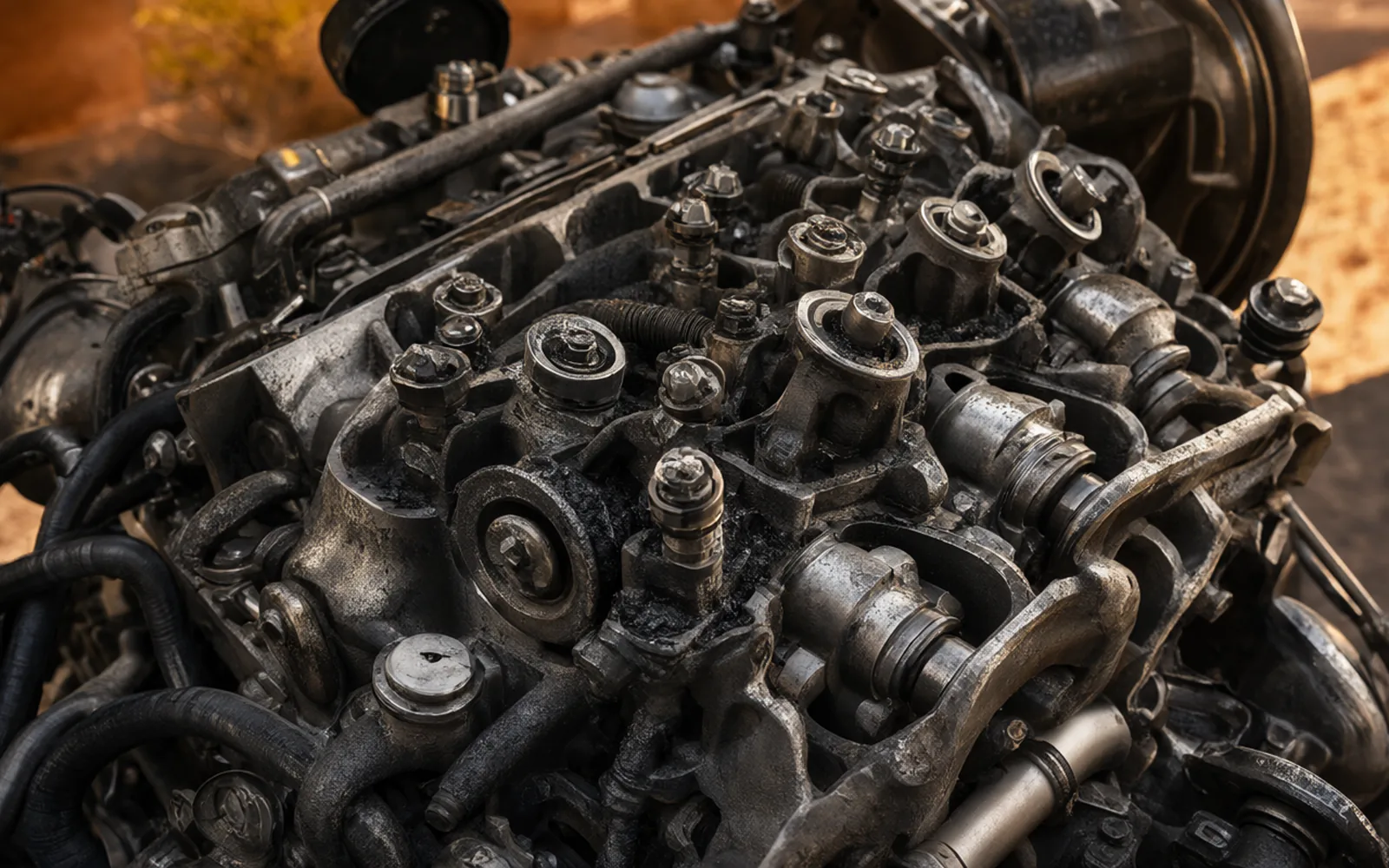
A common scenario on direct-injection European engines: a cold-start misfire and a check engine light (for example, P0301 — cylinder 1 misfire) that new spark plugs and coils never cure. Pull the intake manifold and the back of the intake valves can be caked with black, crusty carbon, restricting airflow at cold start. New plugs are not the fix. Walnut blasting is. This is one of the most misdiagnosed problems on direct-injection European engines, and almost every TFSI/EA888 owner needs it eventually.
Why Direct Injection Engines Build Carbon
The difference is mechanical, not behavioral. Port fuel injection sprays fuel onto the back of the intake valve as it opens — the fuel washes the valve continuously, keeping it clean. Direct injection (DI) sprays fuel directly into the cylinder, bypassing the intake valve entirely.
That means the intake valve never gets washed. Meanwhile, two streams of contaminants land on it:
- PCV oil vapor — the positive crankcase ventilation system routes blow-by gases (which contain oil mist) back into the intake manifold. That oil mist condenses on the cooler intake valve surface.
- EGR soot — the exhaust gas recirculation system pipes exhaust back into the intake to reduce NOx emissions. The soot bakes onto whatever it touches.
Over miles, those layers stack up. At 60K miles on a hard-driven car, the buildup can be a quarter-inch thick. The valve seat doesn’t seal cleanly, the intake port airflow is choked, and you start getting misfires — especially at cold start when there’s no thermal expansion helping the valve seal.
Which Engines Are Affected
Worst offenders (in our shop experience):
- Audi 2.0 TFSI (EA888 Gen 2 and Gen 3) — A3, A4, A5, Q5, TT
- Volkswagen EA888 family — Golf R, GTI, Tiguan, Passat, Jetta GLI
- Audi 3.0 TFSI supercharged V6 — S4, S5, Q7
- BMW N54, N55, N20, N26 — moderate buildup, less severe than TFSI
- Mercedes M270, M274, M276 — present but slower accumulation
Less affected:
- Toyota D-4S engines (Lexus IS350, GR Toyota) use both port and direct injection — the port injectors keep valves clean.
- Ford EcoBoost 3.5 V6 (later versions) added port injectors specifically to solve this.
Symptoms by Mileage
The progression is consistent:
- 50,000-70,000 miles: cold-start misfire on cylinder 1 or 4 (cylinders nearest the PCV inlet usually get worst), rough idle for 30-60 seconds on startup, light reduced throttle response.
- 80,000-100,000 miles: full power loss, fuel economy drops 2-3 mpg, sustained misfires (P0301-P0304), check engine light, sometimes a P0171 (system lean) from poor cylinder fill.
- 100,000+ miles: valve seat damage starts becoming a risk if neglected — the misfire pulse hammers the seat. This is where it goes from a cleaning job to a valve job.
If you have a turbocharged Audi or VW pushing past 60,000 miles and you’ve never had a walnut blast, you’re due — even if no light is on. Pending codes don’t always trigger the dash light. See our check engine light guide for what we look for on a scan.
The Walnut Blasting Procedure
This is what actually happens during the service:
- Disconnect intake plumbing, throttle body, PCV lines, fuel rail (if needed for access)
- Remove the intake manifold — typically 8-12 bolts plus harness disconnects
- Rotate engine to bring each cylinder pair to top-dead-center (intake valves closed)
- Manual scrape of the heaviest deposits with a brass or nylon pick — gets the chunks off so blasting media doesn’t waste time on them
- Walnut shell blast — crushed walnut shell media (hard enough to remove carbon, soft enough not to damage aluminum or hardened valve surfaces) fired through a specialty nozzle that seals against each intake port
- Vacuum extraction simultaneously — the blasting tool has an integrated vacuum hose that captures the spent media and carbon dust so nothing falls into the cylinder
- Inspection with a borescope — verify all valves are clean down to bare metal
- Reassembly with new intake manifold gaskets and any cracked vacuum lines replaced
The hardest part is the manual scraping on a really bad engine. The blasting itself is fast — about 4 minutes per cylinder once the port is sealed.
Cost and Time
- 4-cylinder TFSI/EA888: typically $600-$900 for the full job, half-day labor
- V6 (3.0 TFSI, 3.0 TDI): more time due to access — typically $900-$1,300
- Add PCV update: many of these cars have a known-bad PCV valve or breather that should be replaced at the same time — adds parts cost but pays for itself in longer interval to the next walnut blast
This is labor-intensive work. There’s no shortcut. Carbon-cleaning sprays sold at parts stores don’t touch real deposits — they’re marketing for engines that don’t have a buildup problem yet.
How Often Should You Walnut Blast?
- Hard-driven car (track use, frequent WOT, short trips): every 50,000-60,000 miles
- Mostly highway, long warm-ups: every 70,000-90,000 miles
- After the first cleaning: install an oil catch can if you want to extend the interval — captures PCV oil before it hits the intake, can double the time between services
We sell and install OEM-quality catch cans for most TFSI/EA888 applications. The math works out at around 60-70K miles between cleanings.
When Walnut Blasting Won’t Fix It
If misfires have been running long enough, the valve seat can be damaged — pitted or burned from repeated misfire-induced spark gaps. In that case, you need a valve job (valve seat re-cutting or valve replacement) on top of the blasting. We catch this with a leak-down test before the job — cylinders that leak more than 15% through the intake have valve seat issues, and we’ll tell you before we start.
This is rare but real. About 1 in 30 walnut blast candidates needs valve work on top.
Why Dealers Often Push Other Repairs Instead
Walnut blasting is high-labor, low-parts-margin work. It takes 4-5 hours of tech time and uses about $30 of walnut media. From a dealer’s profit standpoint, replacing $1,200 of fuel injectors generates more revenue. So you’ll often hear “your injectors need to be replaced” instead.
Walnut blasting is the right fix. We do it because European cars are most of what we work on, and we’d rather have a long-term customer than maximize one invoice. See /services/european-auto-repair-las-vegas/ for everything we cover.
Mini FAQ
Q: Does fuel injector cleaner help with intake valve carbon? No. Fuel injector cleaner runs through the injectors into the cylinder — it never touches the intake valve on a DI engine.
Q: How do I know if I need it without pulling the manifold? A borescope inspection through the intake manifold port (with the manifold off, or sometimes through a vacuum port) shows the deposits. We do this as part of the diagnostic if symptoms suggest carbon.
Q: Will it pass emissions after walnut blasting? Often the misfire-related codes clear and emissions improve dramatically. We’ve seen cars go from “won’t pass” to clean inspection on the same week.
Q: Can you walnut blast a non-DI engine? Possible but rarely needed. Port-injected engines don’t accumulate intake valve carbon at the same rate. Save your money.
If you own an Audi or Volkswagen and you’re past 60,000 miles, this is the maintenance item you’ve probably never been told about. Call (725) 322-7768 to schedule a borescope inspection, or book online. Shop is at 4350 Arville Street, Suite 490 in Las Vegas. Open Mon-Sat 9AM-6PM.