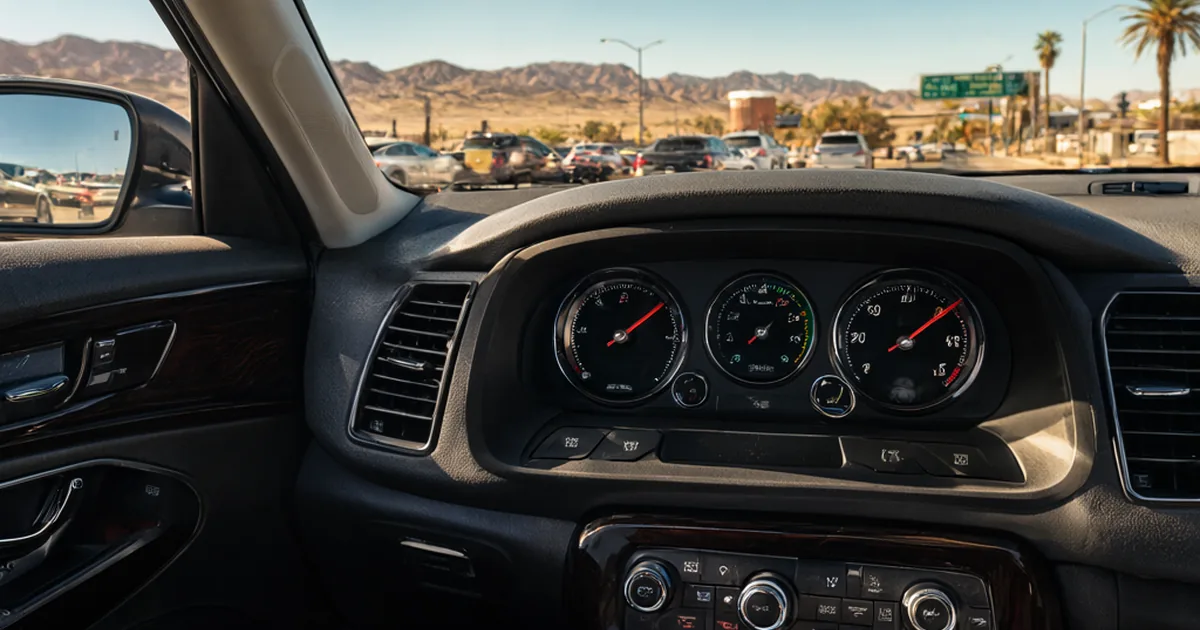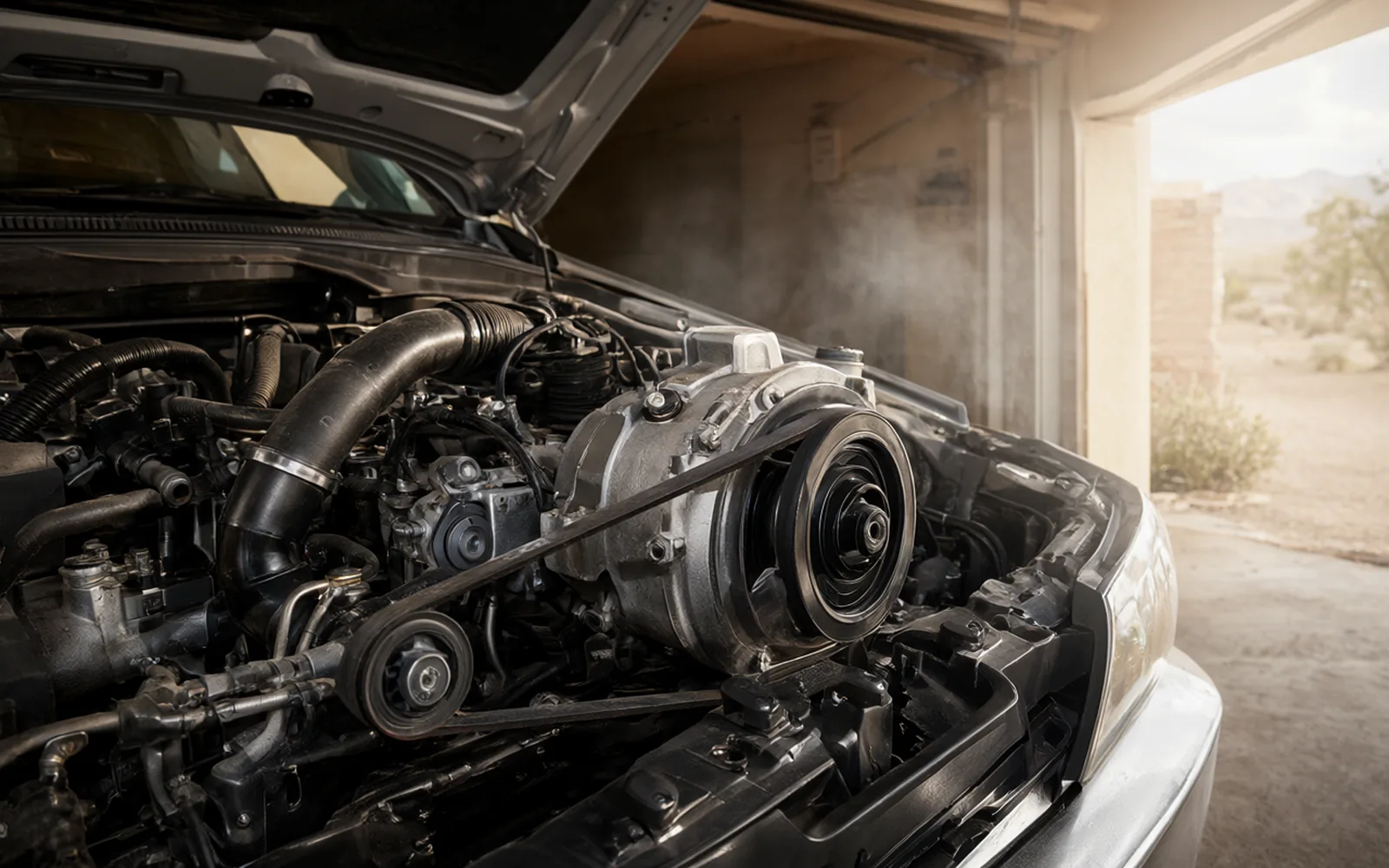
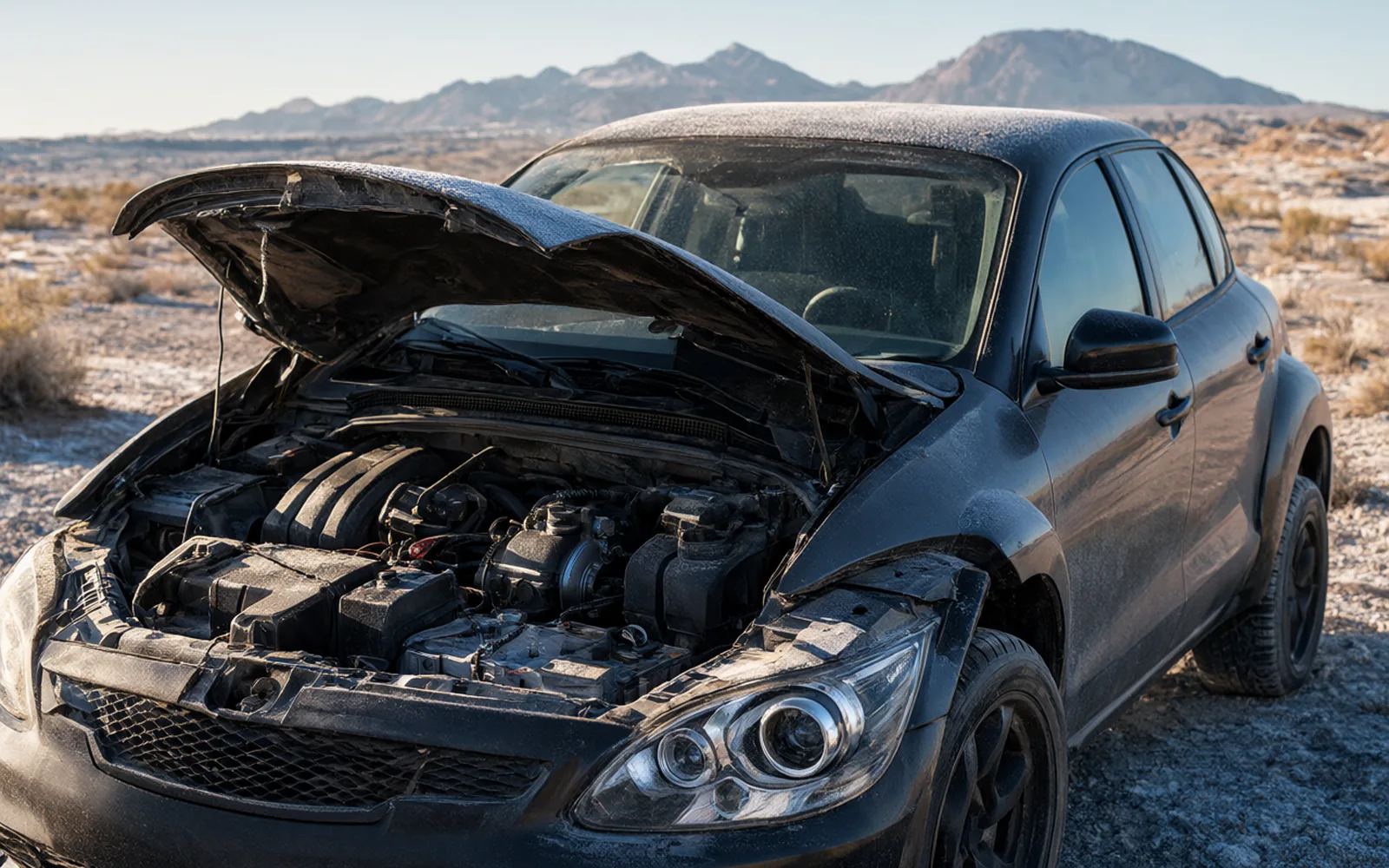
A 38°F January morning in Spring Valley is warm by Buffalo or Minneapolis standards. But it’s exactly cold enough to expose a battery that’s been quietly dying for the last six months in 110°F summer heat. We see this every year between mid-December and late February: cars that started fine all summer suddenly crank slow, click, or do nothing at all when the sun comes up over Sunrise Mountain.
Here’s the working mechanic’s reality: heat kills batteries; cold just exposes the damage. Your battery’s been losing capacity since the August monsoon. Cold mornings are the audit.
Battery: The First Suspect (70%+ of Vegas No-Starts)
A lead-acid battery’s Cold Cranking Amps (CCA) rating is measured at 0°F. At 32°F, that battery delivers roughly 65-70% of its rated CCA. At the same time, your engine oil is thicker, so the starter needs more current to crank. The math gets tight fast on a marginal battery.
Here’s the tricky part — and where most parts-store testers fail you. A battery sitting in your driveway may read 12.4-12.6 volts on a multimeter, which looks “fine.” But voltage tells you state of charge, not health. A battery can hold surface voltage and still fail under load. The only way to know is a proper carbon-pile load test or a conductance test (Midtronics-class tools).
Our workflow:
- Open-circuit voltage check (rested 4+ hours): >12.6V good, 12.4V borderline, <12.2V discharged
- Load test at half the CCA rating for 15 seconds — voltage must hold above 9.6V
- Conductance scan — gives us internal resistance and predicted CCA
- Cranking amp draw during actual start — tells us starter health at the same time
The Vegas climate ages batteries 30-40% faster than the national average. A “5-year battery” is often a 3-year battery here. If yours is 3+ years old and you’re seeing slow cranks, get a real load test — not the 30-second visual check at AutoZone. See battery replacement service for current pricing.
Starter: When Battery Tests Good but You Hear a Click
If the battery is healthy and you turn the key to a single loud “click” with no crank, the suspect list narrows to: starter solenoid, starter motor itself, or a high-resistance connection between them.
In Vegas, starters die from heat fatigue. Years of underhood temperatures peaking near 220°F bake the grease out of starter bearings, dry out the brush springs, and oxidize copper commutators. Most European cars hit starter failure between years 7 and 9 here — significantly earlier than the manufacturer’s design assumption based on European climate.
How we differentiate:
- Single click, lights stay bright: solenoid contacts pitted, or starter motor seized
- Rapid clicking, lights dim hard: battery or main cable problem, not starter
- Slow grunt then nothing: could be either; needs amp-clamp test
- Sometimes starts, sometimes doesn’t: classic worn brushes — intermittent commutator contact
A voltage drop test across both battery cables (positive and negative) during cranking catches the corroded-cable scenario that mimics a bad starter. It’s a 60-second test most shops skip.
Fuel System: When Spark and Crank Are Fine
If you’ve got good cranking and good spark, fuel is next. Cold mornings expose three failure modes:
Failing fuel pump: A pump can deliver 55 psi for years and slowly degrade. On a cold start, when injectors need a richer pulse, a pump that only makes 38 psi won’t atomize fuel properly. Symptoms: long crank, then start; occasional no-start; eventual stalling at idle.
Fuel pressure regulator: Leaking diaphragm pulls fuel into the vacuum line, fouling the intake and starving the rail. You’ll often smell fuel from the vacuum reference port.
Injector atomization at cold temps: Carbon-fouled direct-injection injectors (common on BMW N20/N55, Audi 2.0T, MB M276) don’t spray a fine cone at startup — they dribble. Result: rough cold start, then smooths out as cylinders warm.
Vegas-specific note: if you have a second vehicle that sits for weeks, ethanol-blend gasoline separates and absorbs moisture. After 90+ days of sitting, expect cold-start trouble even with a fresh battery.
How We Diagnose a No-Start (Workflow)
Our 30-40 minute diagnostic protocol:
- Visual — corrosion, loose terminals, mouse damage (yes, even in Vegas)
- Battery — rested voltage + load test + CCA conductance
- Cranking amp draw — clamp-on amp meter during crank
- Voltage drop — positive and negative cables during crank
- Fuel pressure — key-on prime + cranking pressure on a gauge
- Spark verification — inductive timing light or inline spark tester
- Scan tool live data — fuel trims, crank/cam correlation, immobilizer status
This is billed at our standard $49.99 engine diagnostic rate, not the “free check” gimmick. The reason: a real diagnosis takes real tools and a real technician — see our engine diagnostics service.
When It’s Something Else
About 5% of no-starts in Vegas aren’t battery, starter, or fuel:
- Immobilizer/key fob: dead fob battery, sometimes a re-pair is needed (common on BMW E60/E90 and W211 Mercedes)
- Ground fault: corroded engine-to-chassis ground strap — voltages get weird
- Security lockout: after a battery disconnect, certain Audis and Land Rovers need a relearn
- Crank/cam sensor failure: intermittent in heat, sets a P0335 or P0340
Quick Triage Table
| Symptom | Likely Cause |
|---|---|
| Dash lights dim during crank | Battery or main cable |
| Single loud click | Starter solenoid or pitted contacts |
| Rapid clicking | Battery flat or low voltage |
| Cranks but no start, no spark | Crank sensor or ignition switch |
| Cranks but no start, has spark | Fuel pressure, injectors, or immobilizer |
| Long crank then starts | Fuel pump check valve, or carbon-fouled injectors |
| Won’t crank at all, no click | Ignition switch, neutral safety, or dead battery |
FAQ
Can a battery die overnight? Yes — a parasitic drain (stuck relay, glove box light, aftermarket dash cam) can pull a marginal battery from 12.4V to 11.5V in 8 hours. We test for drain current with the car off.
Why does my car start with a jumper but not after sitting? Classic dying battery. The alternator gets it to surface voltage; it loses charge overnight because the plates can’t hold it. Replace it before you get stranded somewhere worse than your driveway.
How much does battery replacement cost? $99.99+ for typical applications. European batteries (BMW with battery registration, Mercedes AGM) run higher because the battery must be coded to the BCM with ISTA or XENTRY — otherwise the car keeps overcharging the new battery and kills it.
Get It Diagnosed Right
Vegas winter no-starts are almost always one of four things — battery, starter, fuel, or electrical — and we’ll pinpoint it in 30-40 minutes with real test equipment, not parts-cannon guesswork. Call (725) 322-7768 or book online. For more on cold-start diagnosis, see our car won’t start guide.
We’re at 4350 Arville Street, Suite 490, open Mon-Sat 9AM-6PM. If you can’t crank it, we’ll come get it.