Baker, California at 1 PM on a Friday in August is the worst place on Earth to discover your cooling system can’t handle 117°F ambient plus the 4,000 ft elevation drops between Mountain Pass and Halloran Summit. There’s no shade. There’s one gas station. AAA tows are 90+ minutes out.
Our shop on Arville Street gets 2-3 calls a week from May through September that start the same way: “I’m stuck on I-15, the temp gauge is in the red, what do I do?” About 80% of those calls trace back to issues that would have been caught — and fixed for under $200 — in a pre-trip inspection. The other 20% are bad luck. This post is about how to stay out of the first bucket.
Below is the same 11-point checklist Andrew runs on customer cars before they head to LA, San Diego, the Grand Canyon, or anywhere the trip involves more than 90 minutes on I-15 in summer. The whole inspection takes about 30 minutes and costs $49.99.
Item 1 — Cooling System Pressure Test (Not Just a Visual)
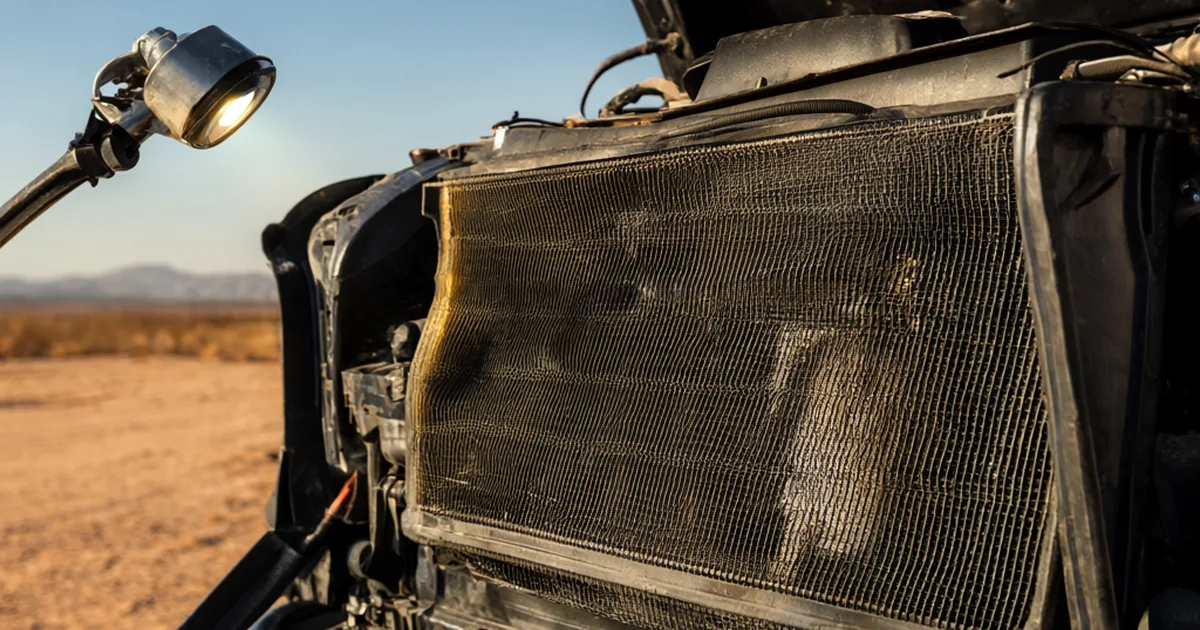
A visual check shows you obvious leaks. A pressure test shows you the cap that holds 16 psi when cold but bleeds off at 9 psi when the system is at 220°F. Radiator caps in Vegas lose their seal at 20,000-30,000 miles regardless of how the rest of the system looks. A weak cap fails at 100°F+ ambient and 75 mph sustained — exactly the conditions you hit between Primm and Baker. The pressure test is a $39 add-on to most services and finds the failure before it happens. Reference /services/cooling-system-repair-las-vegas/. Coolant service starts at $89.99.
Item 2 — Tire Age + Sidewall Inspection
Tread depth is the wrong metric in Las Vegas. UV and heat crack tire sidewalls by year 5 regardless of how much tread is left. We see it constantly: a tire with 7/32” tread, three years on a daily driver, but the sidewall is checked like old leather because the car sat outside in the sun. Look at the DOT date code on the sidewall — last four digits are week and year. Anything over 6 years old in Vegas should be replaced before a summer trip, no exceptions.
Item 3 — Brake Fluid Moisture Test
Brake fluid is hygroscopic — it absorbs water from the air. After 2-3 years it can hold 3-5% water by volume, and water boils at 212°F while clean DOT 4 boils at 446°F. On the descent into Baker from Mountain Pass — 7 miles of 6% downgrade — your fluid sees temperatures north of 300°F. If it boils, you get a pedal that goes to the floor with no warning. A $10 moisture test strip tells us in 30 seconds whether you need a flush. Front brake service (pads + rotors) starts at $349.99.
Item 4 — Battery Load Test (CCA + Reserve Capacity)
A hot battery cranks once and then sits there. Vegas heat kills battery internals at roughly twice the rate of moderate climates — average lifespan here is 30-36 months versus 48-60 elsewhere. A load test reads cold-crank amps and reserve capacity. Both numbers should be within 80% of rated spec. If they’re not, you’ll be the person at a Barstow gas station at noon waiting for a jump because your battery couldn’t restart a heat-soaked engine. Reference common car won’t start causes — battery is #1.
Item 5 — A/C Charge + Condenser Airflow
This one is obvious, but the failure mode isn’t. A/C systems that work fine in 95°F Vegas often can’t pull cabin temperatures down to comfort in 117°F desert with the cabin already heat-soaked at 140°F+. Low refrigerant charge (10-15% under spec) is invisible in mild conditions and crippling in extreme ones. Same with a condenser blocked by bug guts and road debris — fine at 80 mph in cool air, useless at idle in Baker. A/C service starts at $77.77 and includes a leak check.
Item 6 — Tire Inflation (Set Cold, Before Sunrise)
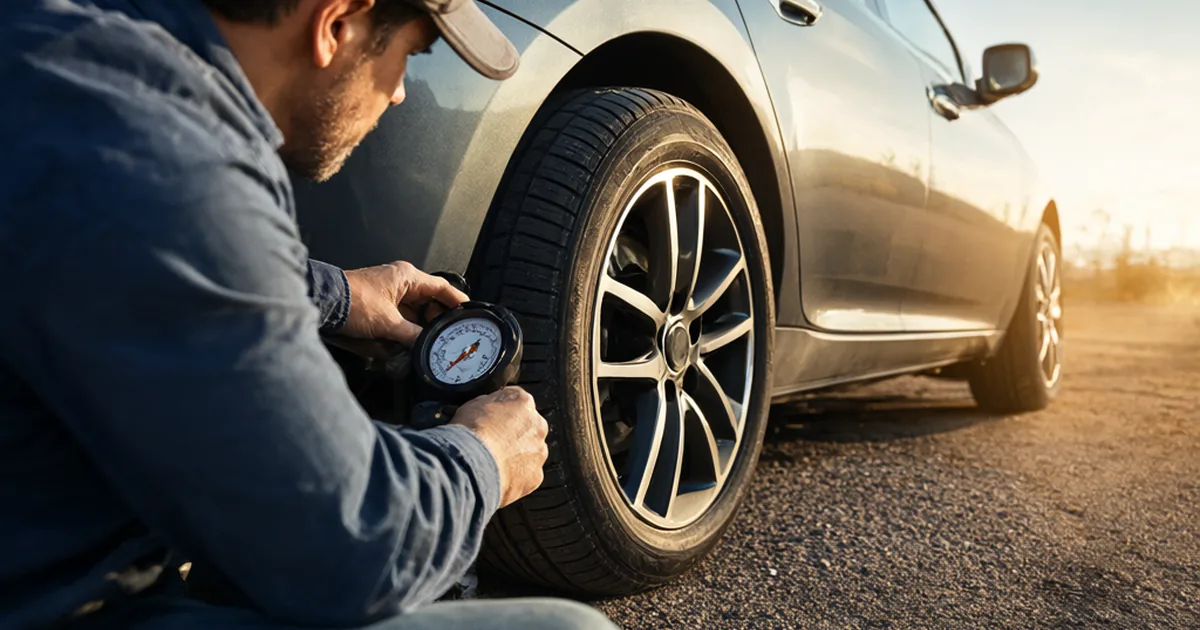
Tire pressure rises 1-2 psi for every 10°F increase. If you set your pressure at noon when the tire is sitting in shadow heat at 130°F surface temperature, you’ve already overshot the cold spec by 4-6 psi. By the time you hit 75 mph on I-15 in afternoon sun, you’re 8-10 psi over door-jamb spec, which is enough to ride on the center tread only and increase blowout risk. Set pressure cold, ideally before sunrise, to door-jamb spec. Not max-sidewall spec.
Item 7 — Spare Tire, Jack, Lug Wrench
About 30% of 2020-and-newer cars ship without a spare. Some have run-flats, some have a sealant + compressor kit, some have nothing. Know which you have before you need it. If you have a spare, check its pressure (usually 60 psi for compact spares — most are 20+ psi low when checked) and verify the jack and lug iron are present. We’ve seen brand-new BMWs and Mercedes show up to our shop with the spare tire well empty because a previous owner removed it for trunk space.
Item 8 — Washer Fluid + Wiper Rubber
Vegas-to-Mojave sandstorms — and they happen, especially in late spring — will sandblast unprotected wipers in one trip. Bad wipers smearing fine grit across a windshield at 75 mph at sunset is genuinely dangerous. New wiper rubber is $30. Top off washer fluid with summer-rated (not winter blue) fluid that won’t streak.
Item 9 — Oil Level + Condition
Pull the dipstick. Top up if it’s anywhere below the upper mark. If you’re within 1,000 miles of your next oil change, do it before the trip — sustained high-RPM highway driving shears oil viscosity faster than city driving. Our oil change is $49.99 and we use viscosity grades appropriate to your specific engine.
Item 10 — Emergency Kit
Cell coverage drops to nothing between Primm and Baker for stretches of 20+ miles. Pack: 1 gallon of water per person, jumper pack (not cables — pack), basic tools, road flares or LED triangles, paper map (yes, paper), a small tarp for shade if you have to wait roadside. We’ve had customers wait 3 hours for a tow in 110°F heat. Water matters.
Item 11 — Under-Hood and Under-Car Visual
Get under the car with a flashlight. Look for fresh fluid traces — coolant (sweet smell, green/pink/orange), oil (brown/black), transmission (red/brown), power steering (red, thinner). A slow drip you’ve been ignoring for months becomes catastrophic at sustained 75 mph and 110°F. We see this constantly: small coolant leak ignored in March, totaled engine in July. If you see anything suspicious, reference /problems/car-overheating/ before the trip — don’t gamble on it.
Our 30-Minute Pre-Trip Inspection — $49.99
We run all 11 items above plus a diagnostic scan with our LAUNCH X-431 to pull any pending codes the dashboard hasn’t shown you yet. You get a written report of what’s good, what’s marginal, and what needs attention before the trip. Most customers book this 1-2 weeks before a major drive so there’s time to address anything found. Booking through /contact takes about 60 seconds.
We’ve been doing this in Summerlin, Henderson, Green Valley, Southern Highlands, and Centennial Hills since 2022. Andrew personally signs off on every pre-trip inspection. Reference our broader scheduled maintenance menu for what to include if the trip is longer than a weekend, and engine diagnostics if anything pending shows up in the scan.
Mini FAQ
How early should I schedule before a trip? Two weeks is ideal. That leaves time to order parts if anything serious is found. One week minimum.
Should I take a backup car for a hot trip? No. A properly inspected car is more reliable than a “backup” you haven’t driven in months. Stale fuel, dead battery, and dry seals fail at a higher rate than properly serviced cars.
Is Mt. Charleston harder on a car than I-15? Different stress profile. Mt. Charleston demands more from brakes and cooling on the descent. I-15 demands more from cooling, A/C, and tires under sustained high-speed heat. Both are worth a pre-trip inspection.
Booking is easy. Call (725) 322-7768 or use /contact. We’re at 4350 Arville Street Ste 490, Las Vegas NV 89103. Monday-Saturday 9 AM - 6 PM. BBB A+.