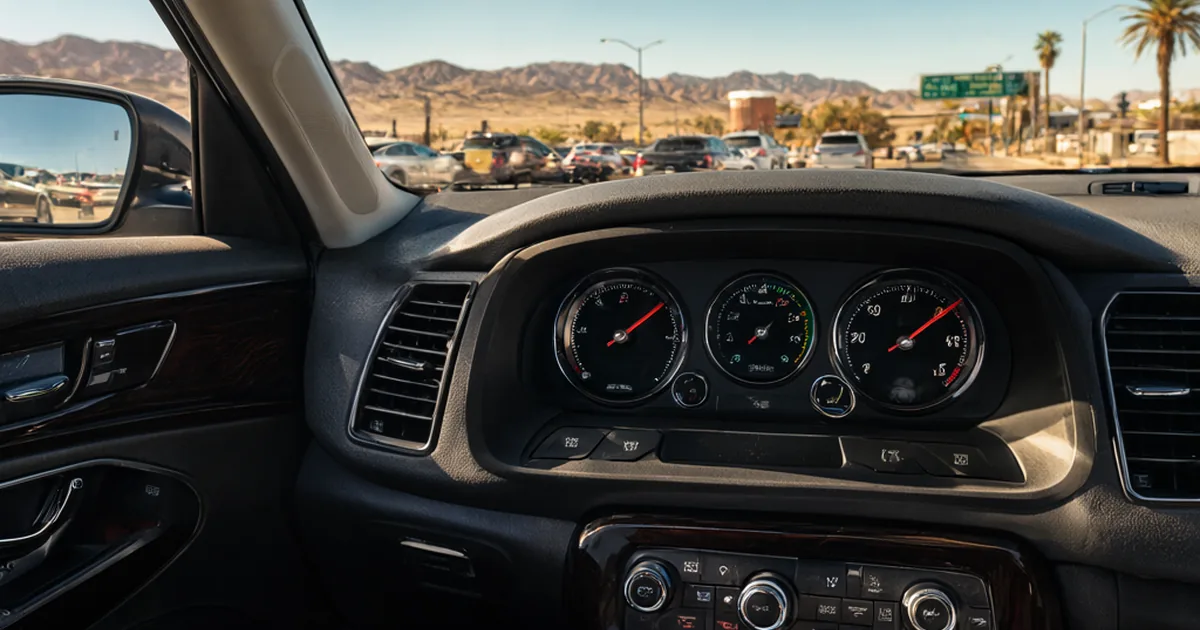
Every June, the first stretch of 105°F days sends AC repair demand through the roof, and parts get harder to find. Every year it’s the same pattern: drivers ignore the marginal AC in April, then panic when the cabin hits 120°F at noon in Henderson traffic. This is the spring checklist that prevents that.
How Your Car’s AC Actually Works
Five components, one closed loop:
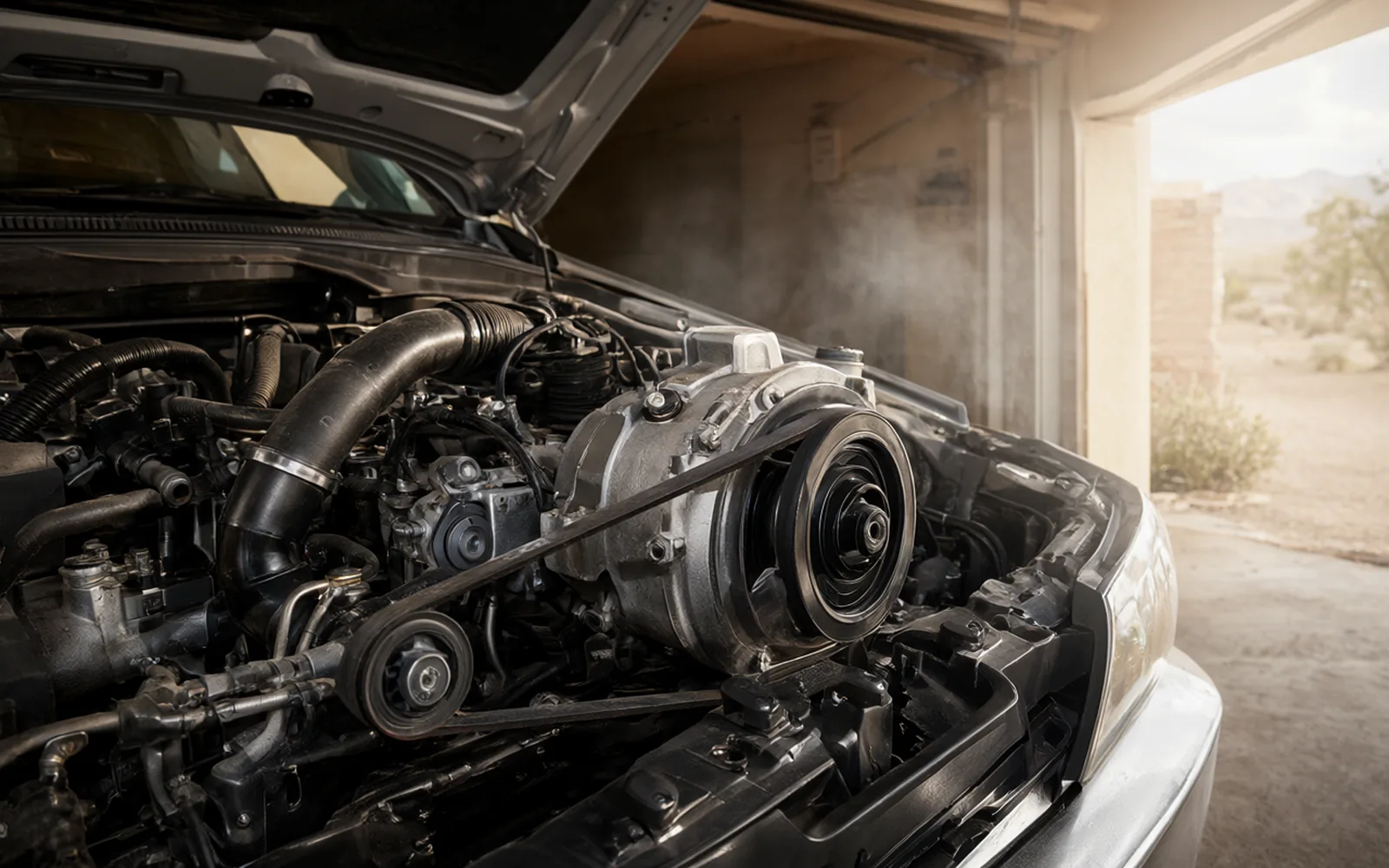
- Compressor — driven by a belt off the engine, pumps refrigerant (raises pressure + temperature)
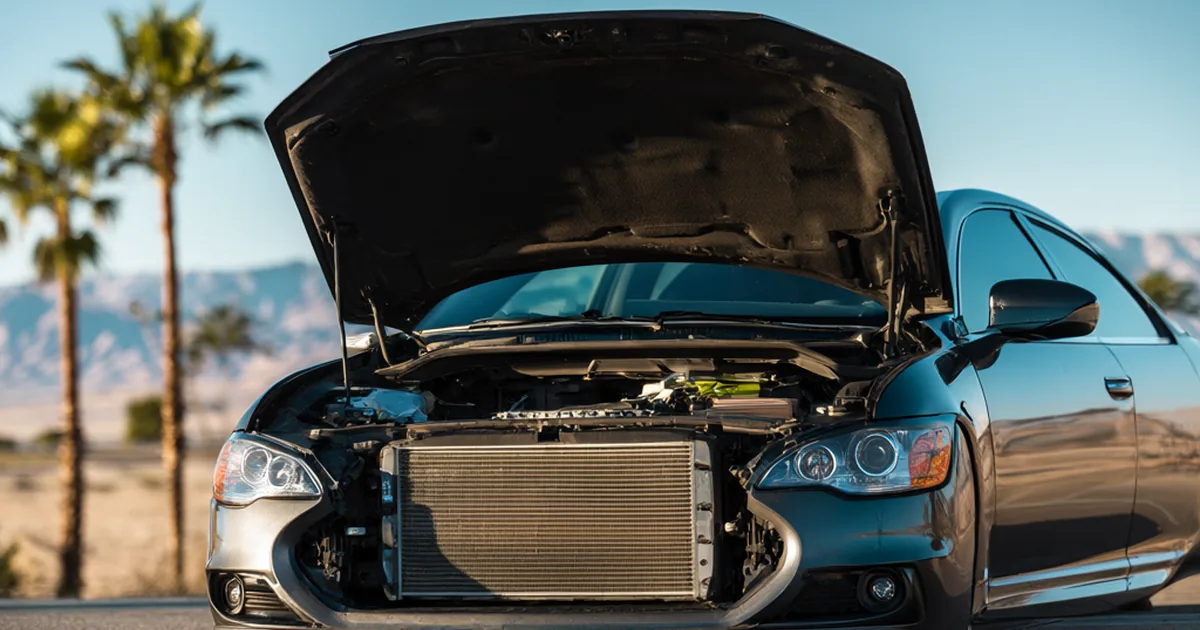
- Condenser — radiator-style heat exchanger at the front of the car, dumps heat to ambient air
- Expansion valve (or orifice tube) — drops pressure suddenly, cooling the refrigerant
- Evaporator — small radiator inside the dash, absorbs heat from cabin air
- Blower — fan that pushes cabin air across the evaporator
In Vegas summer the system fights physics: ambient air at 110°F can only absorb so much heat from the condenser. Refrigerant boil-off rises, head pressures climb, the system runs harder. A weak component that works fine in March overheats and fails in June.
R-134a vs R-1234yf: Know Which One You Have
This matters because refrigerant cost has changed by 4-5×:
- Pre-2015 cars: mostly R-134a. Refrigerant is cheap, recharge is straightforward.
- 2015-2017 cars: transition — check the underhood sticker.
- Post-2017 cars: mostly R-1234yf. EPA-mandated lower-GWP refrigerant, requires different recovery equipment, costs significantly more per ounce.
You can’t mix them. A shop without R-1234yf equipment can’t service a 2019 Audi Q5, 2020 BMW X3, or any current Mercedes properly. We’re equipped for both.
The Spring Inspection Checklist
This is what we run during a $77.77 AC inspection:
- Static pressure reading — engine off, system equalized. Compare to ambient temp/pressure chart. Tells us if the charge is in spec without running the compressor.
- Electronic leak detection — a sniffer that detects refrigerant in the air around fittings, condenser, evaporator drain, compressor seal
- UV dye check — if the system has dye from a previous service, a UV light reveals leak points instantly
- Compressor clutch engagement — does it click on with low-pressure switch input? Cycle rate at idle?
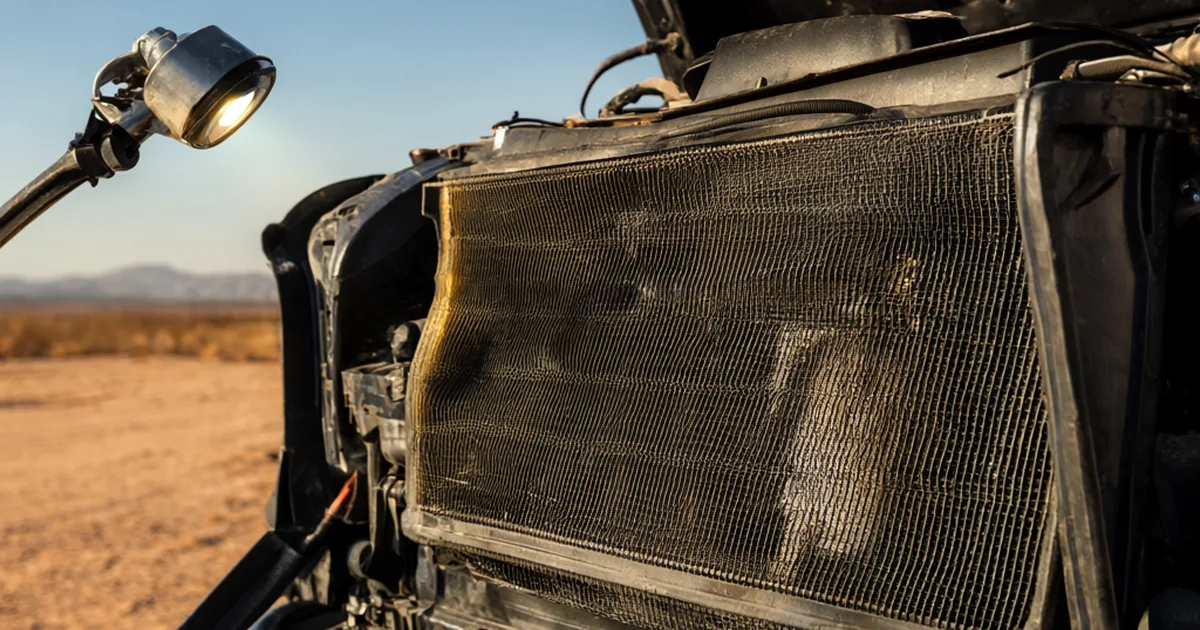
- Condenser airflow — debris from spring sandstorms regularly clogs the condenser. Vegas haboobs in April push tumbleweeds and dust into the front-end stack.
- Cabin filter — clogged filter restricts airflow, dropping vent output temperature
- Evaporator drain — if blocked, water pools in the case and the carpet gets wet (and mold grows)
- Vent temperature test — engine at 1500 rpm, AC max, recirculate on. Center vent should hit 38-45°F at the duct in moderate ambient.
The Most Common Failures We See
Ranked by frequency on Vegas cars:
- Condenser stone damage — I-15 gravel, especially behind trucks. Tiny puncture leaks 4-6 oz/year. Slow leak that “comes back every summer” until someone actually replaces the condenser.
- Compressor clutch wear — bearing failure or coil burnout. Stop-and-go traffic on the Strip cycles the clutch 200+ times per drive.
- Expansion valve flutter — symptom is uneven cooling, sometimes cold then warm at idle.
- Evaporator pinhole on aged BMW/MB — internal corrosion, dash-out repair, expensive.
- Compressor shaft seal — older R-134a systems, slow leak from the front of the compressor.
- Low-side service port valve — Schrader valve under the cap can leak, $5 part.
For a deeper look at cooling system service, there’s also the radiator side to consider — AC and engine cooling share the front-end air mass.
Vacuum-Decay Leak Test: Why “Top It Off” Wastes Money
If a shop just adds refrigerant and sends you off, they didn’t fix anything. Refrigerant doesn’t get consumed — if you’re low, you have a leak. We pull vacuum on the system to 29.5 inHg and hold for 30 minutes. If pressure rises more than 0.5 inHg in that window, there’s a leak — we find it before we charge.
Skipping this step is why customers come back two weeks later asking why the AC is warm again. It’s not the refrigerant grade. It’s the leak nobody looked for. See also /problems/car-ac-not-cold/ for symptom-to-cause matching.
AC System Disinfection (The Stinky Vent Problem)
Bacteria and fungus grow on the evaporator fins in the dark, damp environment behind the dash. Symptom: musty smell when AC first turns on, gone after 30 seconds. Solution: a foaming cleaner sprayed through the cabin filter housing or directly onto the evaporator. The foam expands, kills the biofilm, drains out the evaporator drain. $19 add-on to any AC service. Skip it if you don’t care about smell, do it if anyone in the car has allergies.
Pricing Summary
- AC inspection: $77.77+ — full leak test, pressure readings, vent temp
- R-134a recharge (no leak): typical $120-180 with refrigerant included
- R-1234yf recharge: significantly higher due to refrigerant cost, varies by capacity
- Condenser replacement: parts + 2-3 hours labor
- Compressor replacement: most common big-ticket — parts + 3-4 hours labor + recharge
When You Should Definitely Come In
- Vent air is warmer than 60°F at idle with AC max
- AC cools on the freeway but goes warm in traffic (low charge or condenser airflow)
- Click-click-click from the compressor (clutch cycling rapidly = low charge)
- Wet carpet on the passenger floor (blocked evaporator drain)
- Musty smell when AC first turns on
- AC was OK last summer but you haven’t used it in 6 months — seals dry out
Mini FAQ
Q: How often should I service my AC? Inspection every spring. Refrigerant recharge only if low (it doesn’t get used up).
Q: Can I use the cans of refrigerant from auto parts stores? Strongly discouraged. Most contain sealer that clogs expansion valves and contaminates recovery equipment. Some have wildly inaccurate gauges.
Q: Why does my AC blow cold on the freeway but warm at a red light? Two possibilities: low refrigerant charge (loses cooling capacity at low compressor rpm), or condenser fan not running. Both need diagnosis.
Q: How long does AC service take? Inspection: 45 minutes. Recharge: another 30-45 minutes. Most cars are out in under 2 hours.
Don’t wait for June. A March inspection costs the same as a July one but with same-day parts and zero panic. Call (725) 322-7768 or book online. Our shop at 4350 Arville Street, Suite 490 in Las Vegas runs Mon-Sat 9AM-6PM.