If you’ve driven Arville Street, the stretch of Flamingo Road between the 215 and I-15, or basically any side street in North Las Vegas after a summer monsoon, you already know what we’re talking about. Las Vegas roads develop potholes fast — the extreme heat-to-cold temperature swings crack the asphalt, monsoon rains undermine the base, and heavy traffic finishes the job. Every one of those impacts quietly shifts your wheel alignment, and most drivers don’t notice until they’ve already scrubbed $200 worth of tire tread off one corner of their car.
Why Vegas Roads Are Especially Hard on Alignment
Alignment refers to the precise angles at which your tires meet the road — camber (tilt), toe (direction the tires point), and caster (steering axis angle). From the factory, those angles are set to tight specifications. A single sharp pothole hit or a glancing blow off a parking curb can move them enough to matter.
Here’s what makes Las Vegas uniquely rough on alignment:
- Thermal expansion and contraction. Pavement that bakes at 115°F in July and cools to 35°F on a January night expands and contracts constantly, creating surface cracks and subsurface voids.
- Flash flooding. Summer monsoons wash out road bases on streets throughout Spring Valley, Enterprise, and Henderson, leaving depressions and uneven patches that reappear every season.
- Curb exposure. Tight parking lots at Las Vegas strip malls, the resort corridor, and Green Valley shopping centers mean frequent low-speed curb contact — enough to shift toe settings without leaving a visible mark on the tire.
- Long straight highways. Heading out on US-95 toward Centennial Hills or climbing toward Mt. Charleston? A slight pull you barely notice at 40 mph becomes exhausting and fuel-wasting at highway speed.
Signs Your Alignment Needs Attention
Don’t wait until you’re buying tires prematurely. Watch for these:
- Steering wheel off-center on a straight road (even slightly)
- Vehicle pulling left or right when you let go of the wheel
- Uneven tire wear — one edge of the tread wearing faster than the other, or one tire wearing faster than its partner on the same axle
- Feathering or scalloping on the tread face, which you can feel by running your hand across the tire
- Vibration at highway speed that isn’t wheel-balance-related
- Increased steering effort or a vague, wandering feel through the wheel
A common sign: the car pulls to one side on the freeway, and the driver assumes a low tire. Often a pothole hit is the cause, leaving excess negative camber on one corner and the inner edge of the tire starting to feather. Caught early, an alignment and a tire rotation put the car back on spec. Wait another month and that tire is trash.
What a Proper Alignment Check Involves
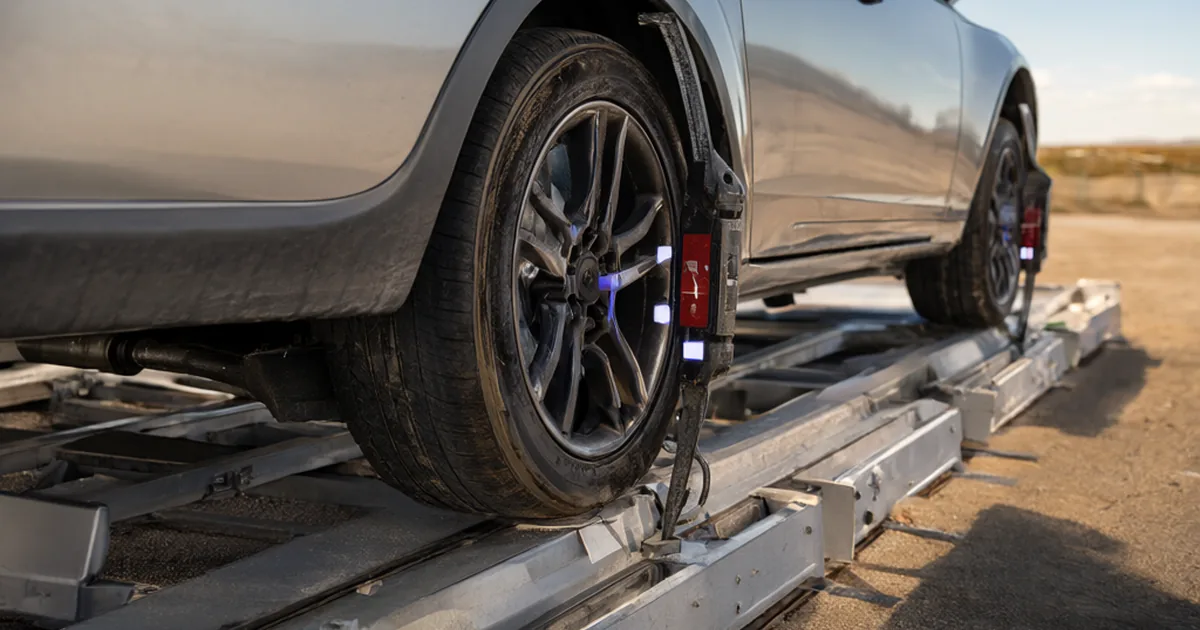
A four-wheel alignment on a modern alignment rack measures all four corners of the vehicle against your car’s factory specification sheet. We check:
| Angle | What It Affects | Common Cause of Misalignment in Vegas |
|---|---|---|
| Toe (front & rear) | Tire wear, straight-line tracking | Pothole impact, curb strikes |
| Camber | Inner/outer edge wear, cornering | Bent control arm, worn ball joint |
| Caster | Steering feel, return-to-center | Hard impact, collision damage |
| Thrust angle | Rear axle tracking, dog-tracking | Rear suspension wear |
If the angles are adjustable and within correctable range, we adjust them. If something is bent or worn — a tie rod end, a control arm bushing, a ball joint — we’ll show you exactly what we found before recommending any additional work.
The Real Cost of Skipping It
A set of mid-range tires for a European sedan or a domestic truck runs roughly $600–$1,000 installed. Driving on a misaligned vehicle for three to six months can wear a tire unevenly enough to require replacement thousands of miles before it should. We’ve seen Paradise-area customers come in having replaced tires twice in two years without ever addressing the alignment that was eating them.
Consider the math: an alignment service is a small fraction of a tire replacement. Doing it once a year, or after any significant impact, is straightforward insurance.
How Often Should You Check Alignment?
- At minimum: Once per year, or every 12,000–15,000 miles
- After any significant impact: Pothole, curb hit, or parking lot collision — even if it felt minor
- When buying new tires: Always align before or immediately after mounting new rubber
- If you notice any symptom listed above: Don’t wait for the next scheduled interval
FAQ
Can a bad alignment damage my suspension, not just my tires? Yes. Misalignment puts uneven stress on tie rod ends, ball joints, and wheel bearings over time. Catching it early keeps the problem limited to a simple adjustment rather than compounding into worn steering components.
My car drives straight — does that mean my alignment is fine? Not necessarily. Some misalignment conditions, particularly rear toe or mild camber issues, won’t produce a noticeable pull but will silently destroy tires. If you can’t remember the last time you had an alignment check, it’s overdue.
Do you need a four-wheel alignment or just a front-end alignment? Most modern vehicles with independent rear suspension — which includes the majority of European sedans, crossovers, and many domestic trucks — benefit from a four-wheel alignment. Front-only alignments are generally appropriate only for solid rear axle vehicles, and even then we prefer to measure all four corners first.
Bottom Line
Las Vegas roads are genuinely rough on alignment — the heat, the monsoons, the potholes, and the constant curb contact in crowded parking lots add up fast. The warning signs are easy to miss until you’re replacing tires ahead of schedule or feeling that slow highway pull every single commute. A proper four-wheel alignment check is one of the most cost-effective maintenance items you can do, especially after our summer road construction season leaves fresh damage across Summerlin, the valley floor, and everywhere in between.
Schedule online at /contact or call (725) 322-7768 — our team at 4350 Arville Street handles alignment on European and domestic vehicles and will tell you straight whether your angles need correction or you’re good to go. See our full list of suspension and alignment services while you’re here.