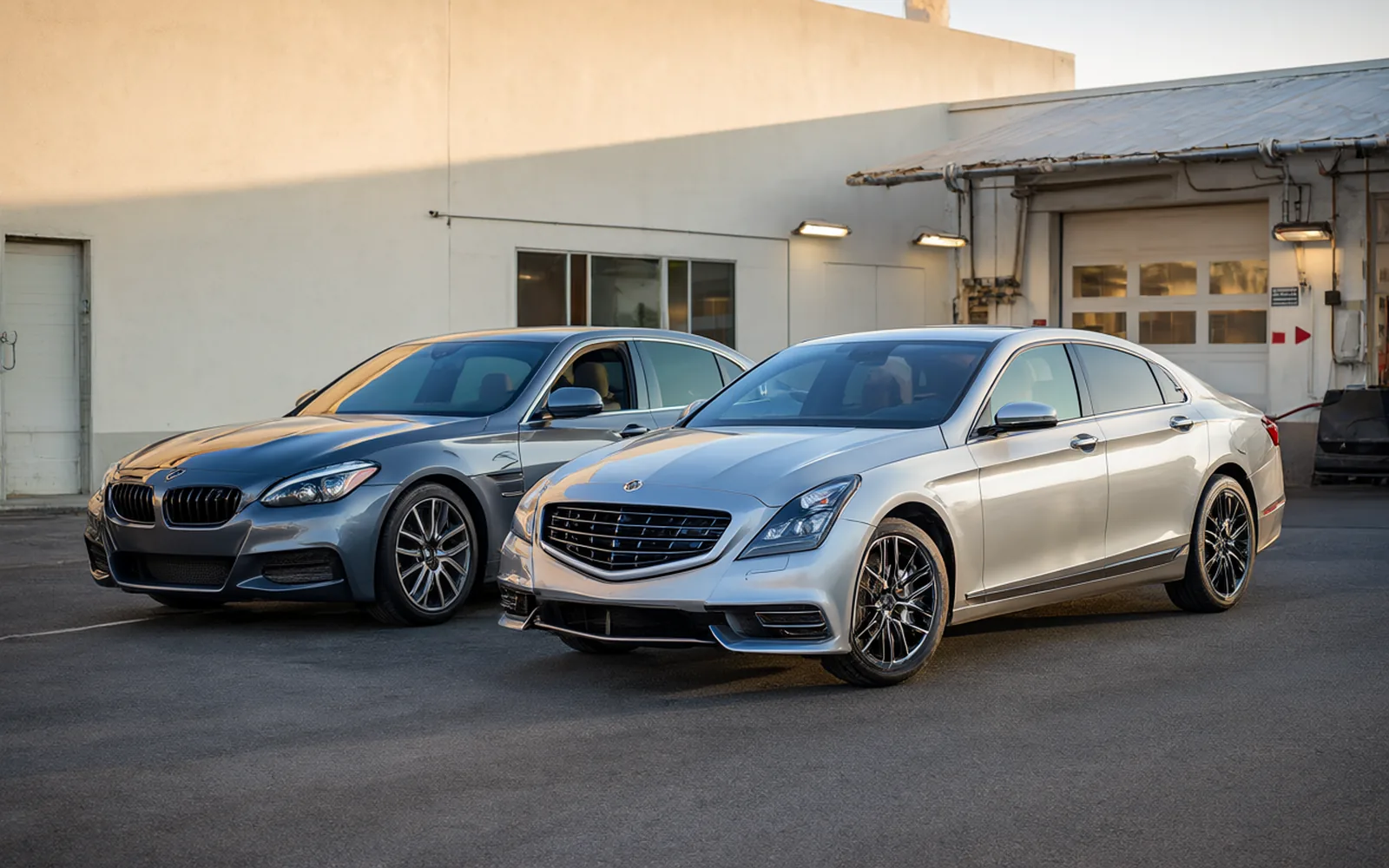
“BMW or Mercedes — which one breaks more?” It’s the single most common question we get from luxury buyers walking into our shop, usually right before they commit to a 5-year ownership on a $70,000 car. The honest answer is: it depends on the model year, the engine, and the service category. Some years BMW wins clearly. Some years Mercedes wins clearly. Sometimes it’s a coin flip.
So instead of giving the usual “it depends” answer, here is a side-by-side of typical market ranges for 10 common services. These are general estimates, not figures from our own invoices.
Category 1 — Oil service
Both manufacturers specify long-life synthetic oil. Both call for service every 10,000 miles in normal use, though we recommend 7,500 miles in Vegas heat for both.
- BMW LL-04 spec oil, typically 6-7 quarts for a 3.0L inline-six: about $69-$79 fluid cost. Filter is $18-$24.
- Mercedes MB 229.5 / MB 229.71 oil, typically 7-8 quarts for a 3.0L inline-six or V6: about $65-$75 fluid cost. Filter is $22-$28. Service A on Mercedes includes a cabin filter at every visit, which adds $39-$59.
Net pricing at our shop:
- BMW oil service: $239-$329 depending on engine size and oil capacity
- Mercedes Service A: $249-$339 including cabin filter (which BMW doesn’t bundle in)
Verdict: essentially a wash. Slight edge to BMW on a strict apples-to-apples oil-and-filter, but Mercedes’ bundled cabin filter has value in dusty Vegas.
Category 2 — Brake service
Both manufacturers use brake-pad-wear sensors. Both have similar caliper architectures. The differences are in pad and rotor pricing.
- BMW front pads: OEM Textar or Pagid pads ~$129-$159 per axle. Hawk and Akebono equivalents about the same. Rotors $189-$289 per pair on most non-M cars.
- Mercedes front pads: OEM Brembo or TRW ~$159-$189 per axle. Rotors $199-$309 per pair.
Net pricing at our shop for front pads + rotors (the typical “next brake job” scope):
- BMW: $389-$590 depending on model
- Mercedes: $429-$640 depending on model
Verdict: slight BMW advantage on brake parts cost, particularly on non-M-sport models. The gap narrows on M and AMG variants where both use larger Brembo systems.
Category 3 — Air conditioning service
Both manufacturers transitioned to R-1234yf refrigerant on 2017+ models. Both have similar manifold gauge profiles when functioning correctly. Both have known weak points.
- BMW AC compressor failures: most common on N20 and N55 engines around 100,000 miles. Replacement $1,290-$1,890.
- Mercedes AC blend-door actuator failures: known weakness on W205 (2015-2021 C-Class) and W213 (2017-2023 E-Class). $189-$289 repair, but failure rate is high.
Both base AC inspections start at $77.77 at our shop. Recharge with leak repair $249-$590. See our seasonal Vegas summer AC guide for the full diagnostic tree.
Verdict: tie on absolute cost, but Mercedes has more frequent climate control issues in our experience. BMW AC tends to either work flawlessly or fail completely; Mercedes climate has more “weird intermittent issue” complaints that take diagnostic time to chase down.
Category 4 — Transmission service
- ZF 8HP in BMW (3-series, 5-series, X3-X7): drain and fill with ZF Lifeguard 8 fluid, new pan + filter, scan-tool fill procedure. $349-$499.
- Mercedes 7G-Tronic and 9G-Tronic: drain and fill with MB 236.15 or 236.17 fluid (more expensive per quart), new internal filter, XENTRY scan-tool fill procedure. $399-$549.
Mercedes is consistently $50-$100 more on transmission service due to higher fluid cost and the 9-speed having a wider sump that requires more fluid.
Verdict: BMW wins on transmission service cost by roughly 10-15%. Both transmissions are excellent when serviced; both fail prematurely when not.
Category 5 — Suspension
This is where the analysis gets interesting and the prices diverge.
- Standard BMW suspension (non-air, non-adaptive): conventional struts and shocks. Replacement at 80,000-120,000 miles. $589-$1,290 per axle.
- BMW Adaptive M Suspension / EDC: electronically controlled dampers. $890-$1,690 per axle.
- Mercedes conventional suspension (C-Class, E-Class non-AIRMATIC): $590-$1,290 per axle, similar to BMW non-air.
- Mercedes AIRMATIC (E-Class, S-Class, GLE, GLS, GLC AMG, all GL-series): air struts + compressor. Vegas heat kills AIRMATIC components faster than BMW air systems (when they’re equipped). Front air struts $890-$1,490 each. Compressor + valve block $890-$1,490.
This is where Mercedes ownership costs spike. AIRMATIC fails earlier in Vegas heat and is more expensive to service.
Verdict: clear BMW advantage on suspension long-term cost, especially on the high-end SUV class where Mercedes nearly always uses AIRMATIC and BMW often uses conventional with optional adaptive dampers.
Category 6 — Where BMW clearly wins on cost
In general, BMW tends to have lower long-term maintenance cost in these categories:
- Non-air-suspension models — significantly cheaper suspension service
- Brake wear items — slightly cheaper pads and rotors
- xDrive vs 4Matic — BMW’s xDrive transfer case service is less complex and cheaper than Mercedes 4Matic
- Transmission service — $50-$100 cheaper per visit
- Spark plugs — more accessible on most BMW inline-six engines than on Mercedes V6/V8
Category 7 — Where Mercedes wins on cost
Mercedes tends to have lower maintenance cost in these categories:
- Service interval flexibility — Mercedes Service A/B alternating system allows slightly longer intervals on certain items
- Diesel variants (BlueTec) — if you bought a Mercedes diesel before they exited the US market, fuel economy and engine longevity offset higher service costs
- Interior durability — Mercedes interiors hold up better in 110°F UV exposure on dashboards and seat surfaces (which isn’t strictly maintenance, but affects ownership cost)
- AMG vs M comparison on premium models — AMG service is generally cheaper than M-division service, though both are expensive
Category 8 — Estimated 5-year/75,000-mile total ownership cost
Rough estimates for a hypothetical 5-year ownership in Vegas, starting at 30,000 miles and ending at 105,000 miles, with typical maintenance and 2-3 wear-item repairs:
- BMW 5-series (530i or M550i) non-air-suspension: $8,400-$11,200 total maintenance over 5 years
- Mercedes E-Class (E350 or E450) with AIRMATIC: $9,800-$13,500 total maintenance over 5 years
- BMW X5 (xDrive40i): $10,200-$13,800 total
- Mercedes GLE (GLE350/GLE450) with AIRMATIC: $11,500-$15,400 total
Across comparable trim levels, BMW often comes out somewhat lower in total maintenance over 5 years in Vegas conditions.
Where the comparison gets close
The gap closes — and sometimes reverses — on:
- Performance variants (M3/M5 vs C63/E63): M-division service is brutal on consumables (carbon-ceramic brakes, special fluids, more frequent intervals). AMG can actually be cheaper to maintain than M.
- Older vehicles (2010-2014 models): different engines, different issues, no longer current to our 12-month data window
- High-mileage daily drivers (150,000+ miles): both brands start needing similar work — water pumps, accessory drives, valve cover gaskets, oil cooler seals
For BMW-specific maintenance details, see our BMW repair service and BMW brand page. For Mercedes-specific work, Mercedes repair service and Mercedes brand page.
Vegas climate adjustments
A few things specific to our market that influence the comparison:
- AIRMATIC failure rate is higher in Vegas heat than in temperate climates. If you’re cross-referencing this with maintenance data from cooler regions, expect Mercedes air suspension costs to look worse here.
- Cabin filter intervals halve in Vegas. Both brands need them more often; Mercedes builds it into Service A which is slightly more efficient cost-wise.
- Coolant degrades faster in our temperature swings. Both brands benefit from coolant service every 4-5 years instead of the factory 6+ years.
Verdict — which one should you buy?
Honestly, the answer is: buy what you love driving. Maintenance differences of 7-12% over 5 years are real, but they’re not life-changing. Both BMW and Mercedes are excellent vehicles when maintained correctly. Both are expensive disasters when neglected.
What matters more:
- Find an independent European auto repair shop you trust before you buy the car. The dealer-only crowd pays 35-50% more lifetime.
- Service at the recommended intervals, not “when something feels wrong.”
- Avoid the cheapest aftermarket parts on safety-critical or wear-critical systems.
Mini FAQ
Which is more reliable? Based on general market experience, comparable trim levels are within 5-10% of each other on overall service frequency. The differences are in what breaks more than how often something breaks. BMW tends to have predictable wear patterns (oil leaks at known gaskets, ZF transmission service at known mileage). Mercedes tends to have more electronics-related complaints (blend doors, electronics modules, AIRMATIC sensors).
Do you charge more for German cars than for domestic cars? Slightly, on labor — our hourly rate is the same across all vehicles, but European cars typically take longer due to more complex disassembly required for access. Parts cost is what really separates them: German OEM parts are 30-50% more expensive than equivalent domestic parts. We always offer OEM and quality-aftermarket options where available.
Should I extend the warranty on a BMW or Mercedes? This depends on the specific car and the extended warranty terms. We’ve seen extended warranties save customers $4,000+ on a single repair. We’ve also seen extended warranties refuse to cover the most common failure mode for a specific model. Read the fine print, especially the exclusions list. If you want a second opinion on a specific warranty contract before signing, bring it in — we’ll review the coverage list against the known failure points for your specific car.
Both BMW and Mercedes can be excellent long-term ownership propositions in Vegas if you have the right shop, the right maintenance schedule, and realistic expectations on cost. We service both as core specialties. Pricing transparency is part of why we’re BBB A+ rated and why most of our customers come from referrals.
Call (725) 322-7768 or book a maintenance consultation. Bring your last few service invoices and we’ll do a quick comparison against what we’d charge for the same work.