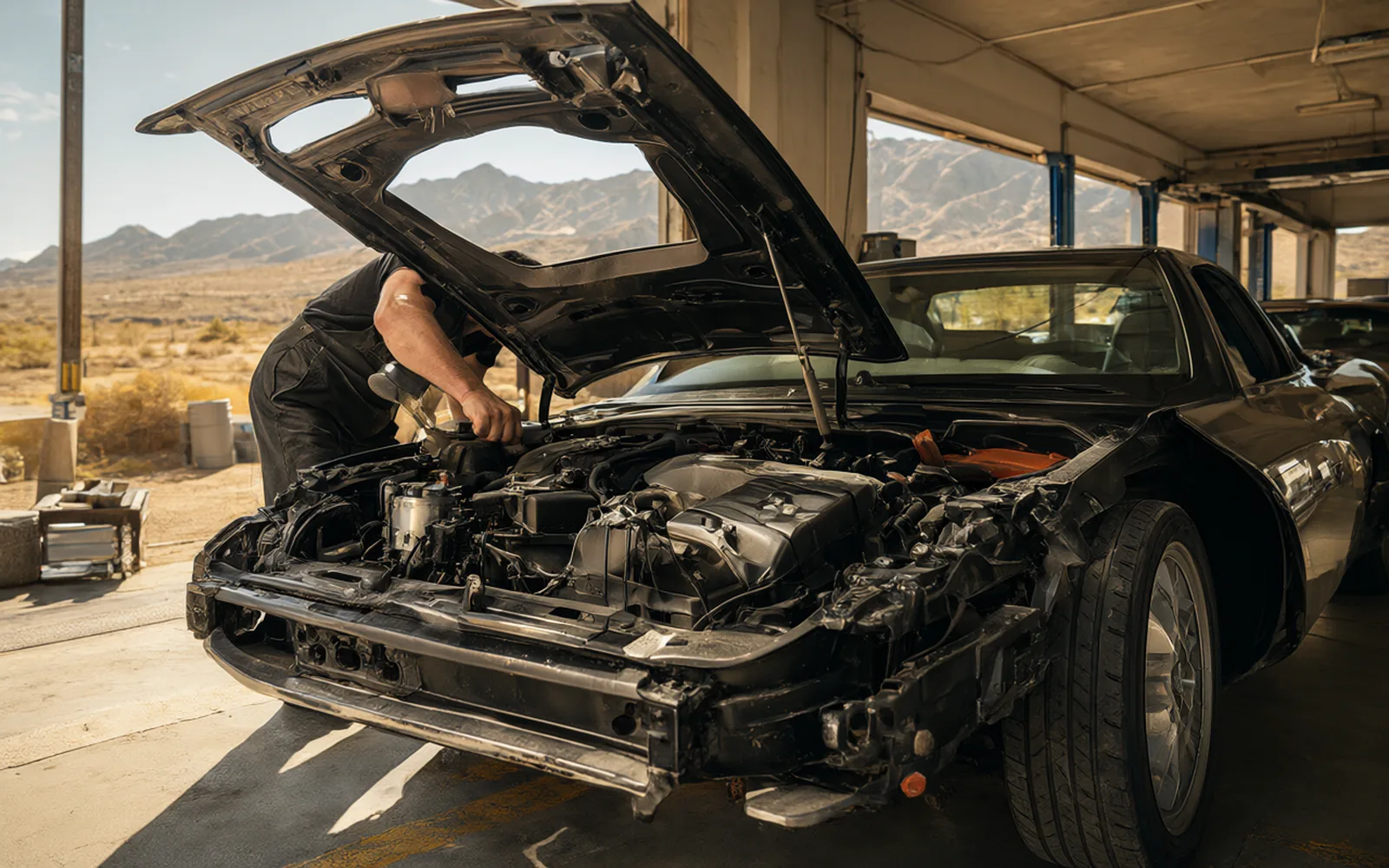
We’ve inherited problem repairs from more than 40 Vegas shops in the past three years. Bent injectors that “needed” replacement, transmissions condemned because of a $30 solenoid, brake jobs done with the wrong pad compound. The patterns of bad shops repeat: no written estimate, refusal to show old parts, “we can’t tell you the part number, our system doesn’t work that way.” Google reviews don’t catch this — too many shops have purchased five-star ratings or filter for them. Here’s the actual checklist we’d use to pick a shop if we weren’t one.
Check 1: BBB Rating
The Better Business Bureau is imperfect but useful. A+ with zero complaints is meaningful — it means the shop has been operating long enough to be rated and has resolved any disputes that came up. An “A” rating with multiple unresolved complaints is a yellow flag. A shop not listed at all is a yellow flag for a different reason — they’re either brand new or have never registered.
We’re BBB A+ rated. The badge is in our footer with a direct link to our profile. Look for that on any shop site.
Check 2: ASE Certifications and Brand-Specific Training
ASE (Automotive Service Excellence) certifications are the baseline. Master Technician status requires passing eight separate ASE tests and having two years of work experience. Walk into a shop and ask which certifications the lead tech holds. If they can’t answer, leave.
For European cars, you want brand-specific factory training:
- BMW STEP (Service Technician Education Program)
- Mercedes-Benz STAR training
- Audi Academy alumni
- Porsche factory courses
These programs teach diagnostic procedures and recall information that aftermarket training simply doesn’t cover. Our European auto repair page lists the marques we cover.
Check 3: OEM Diagnostic Tools
This is the question that separates real shops from parts-cannon operators. Each manufacturer has a proprietary diagnostic suite:
- BMW: ISTA / ISTA-D
- Mercedes-Benz: XENTRY (formerly DAS)
- Audi / VW: ODIS / VAG-COM (VCDS)
- Porsche: PIWIS
- GM / Chevrolet / Cadillac: GDS2
- Ford / Lincoln: IDS
- Land Rover / Jaguar: Pathfinder / SDD
- Toyota / Lexus: Techstream
Ask point-blank: “What scan tool do you use on a BMW?” If the answer is a generic “OBD reader” or “Snap-on Solus,” they cannot code modules, program injectors, register batteries, or perform manufacturer-mandated guided fault-finding. They can read a P-code. That is not the same thing.
We run BMW ISTA, Mercedes XENTRY, Audi/VW ODIS, and Snap-on Verus Edge for everything else. This is the line between a shop that can fix your German car and a shop that can read codes.
Check 4: Written Estimate Before Work Starts
No verbal-only repairs over $100. Period. An itemized estimate should show:
- Each part (with part number) and its price
- Labor hours by line item
- Diagnostic fees clearly stated
- Disposal fees (if any)
- A total with sales tax
If the estimate is “about $800-ish,” walk out. Ambiguity in writing is intentional.
Check 5: Warranty Terms — in Writing
Industry standard for an independent shop is 12 months / 12,000 miles on labor and parts. Dealer warranties on parts can be longer (24 months from some BMW reman parts, for example), but the shop’s labor warranty should be at least 12/12. Anything less and you’re paying retail to be a beta tester.
Get the warranty in writing on the invoice. “Don’t worry, we stand behind our work” is not a warranty.
Check 6: They Show You Old Parts
Every shop should offer to show you the worn brake pads, the failed alternator, the cracked control arm. If they say “we already threw it out,” that’s a red flag. Used parts may have core charges (a refundable deposit because the manufacturer wants the old one back to remanufacture) — those go back to the parts supplier, not the trash. Either way, you should see them first.
Check 7: Fluid and Battery Disposal
Used oil, coolant, refrigerant, and lead-acid batteries are regulated by EPA and Nevada DEQ. A legitimate shop has:
- Sealed used-oil tank with pickup contract
- Refrigerant recovery equipment (separate machines for R-134a and R-1234yf)
- Battery core return program
- Coolant separator or proper disposal manifest
A shop that doesn’t visibly handle disposal is either fly-by-night or dumping. Both are bad signs.
Check 8: Pricing Transparency
A wide price range based on actual job complexity is fine — a BMW N54 oil change is harder than a Camry oil change. What’s not fine is “starts at $X” with no upper bound and no explanation. Our pricing is published per service:
- Oil change: $49.99+
- Engine diagnostic: $49.99
- Brake pads + rotors (front): $349.99+
- Transmission service: $149.99+
- A/C inspection: $77.77+
- Coolant service: $89.99+
“From $X” is honest because it depends on parts grade and vehicle. “Call for pricing” with no published number is opacity.
Check 9: What the Shop Won’t Do (Humility)
Run from any shop that says “we do everything.” Real specialists know their limits:
- We don’t do body work (frame, paint, collision) — we refer to a body shop
- We don’t do glass replacement — we refer
- We don’t do tire-only work (we refer high-volume tire sales)
- We don’t do transmission rebuilds in-house (we work with a Vegas transmission specialist for full rebuilds)
A shop that says yes to everything has a backlog problem, a quality problem, or both. We’d rather refer than do something halfway.
Why We Publish Prices
The /services pages on this site list every service we offer with starting prices. We don’t bury rates behind “we’ll quote when you come in.” That’s because a quote requires a vehicle on the lift — but a starting price is honest information that helps you decide whether to even call.
If a shop’s website says “competitive pricing” without numbers, they’re competing on something other than price. Usually volume.
Mini FAQ
Q: I had a bad experience at a previous shop. Can you redo their work? Yes — we handle “second opinion” jobs daily. Bring the previous invoice if you have it.
Q: Do you accept extended warranty / service contracts? Yes, most of them. Call first with the policy info so we can verify covered items before you bring the car in.
Q: Can I bring my own parts? We can install customer-supplied parts, but we can’t warranty them. Most insurance and warranty companies require OEM or OE-equivalent parts that we source.
Q: Where are you located? 4350 Arville Street, Suite 490, Las Vegas NV 89103. Easy access from I-15, US-95, and the 215. We serve Summerlin, Henderson, Green Valley, Southern Highlands, and Centennial Hills.
Doing your homework before picking a shop pays back tenfold. If you’d rather skip the comparison and just talk to a shop that hits all nine, call (725) 322-7768 or book online. Open Mon-Sat 9AM-6PM.