I-215 west of the airport. Tropicana between Decatur and Jones. Sahara through the medical district. The new construction zones north of Summerlin. Anywhere a road crew patched a patch last year. If you live in Las Vegas, you know exactly which stretches will rattle your fillings out.
Vegas pothole season is essentially year-round, but it peaks in early spring when winter contraction cracks meet the first 90°F days. The asphalt cracks open like a dry lakebed, and the next pickup truck full of landscape rock pops the chunks out.
Hit one wrong, and you’ve just bought yourself a suspension repair. Here are the five signs we see most often, in roughly the order they show up.
Why Vegas Roads Pothole So Aggressively
The Mojave climate is uniquely bad for asphalt:
- Daily temperature swing of 35-45°F is normal in spring and fall. Asphalt expands and contracts; the aggregate (the rock in the mix) separates from the binder (the tar)
- 80°F+ summer surface temperatures soften the binder. Heavy trucks push aggregate down, then ride passes pump it back up
- Low annual rainfall (~4 inches) means cracks don’t get sealed by moisture-driven swelling. Instead they widen, sharp-edged, ready to chunk out
- Monsoon downpours (August) flood those cracks suddenly, and the hydraulic action under tires lifts whole chunks of pavement out in a single afternoon
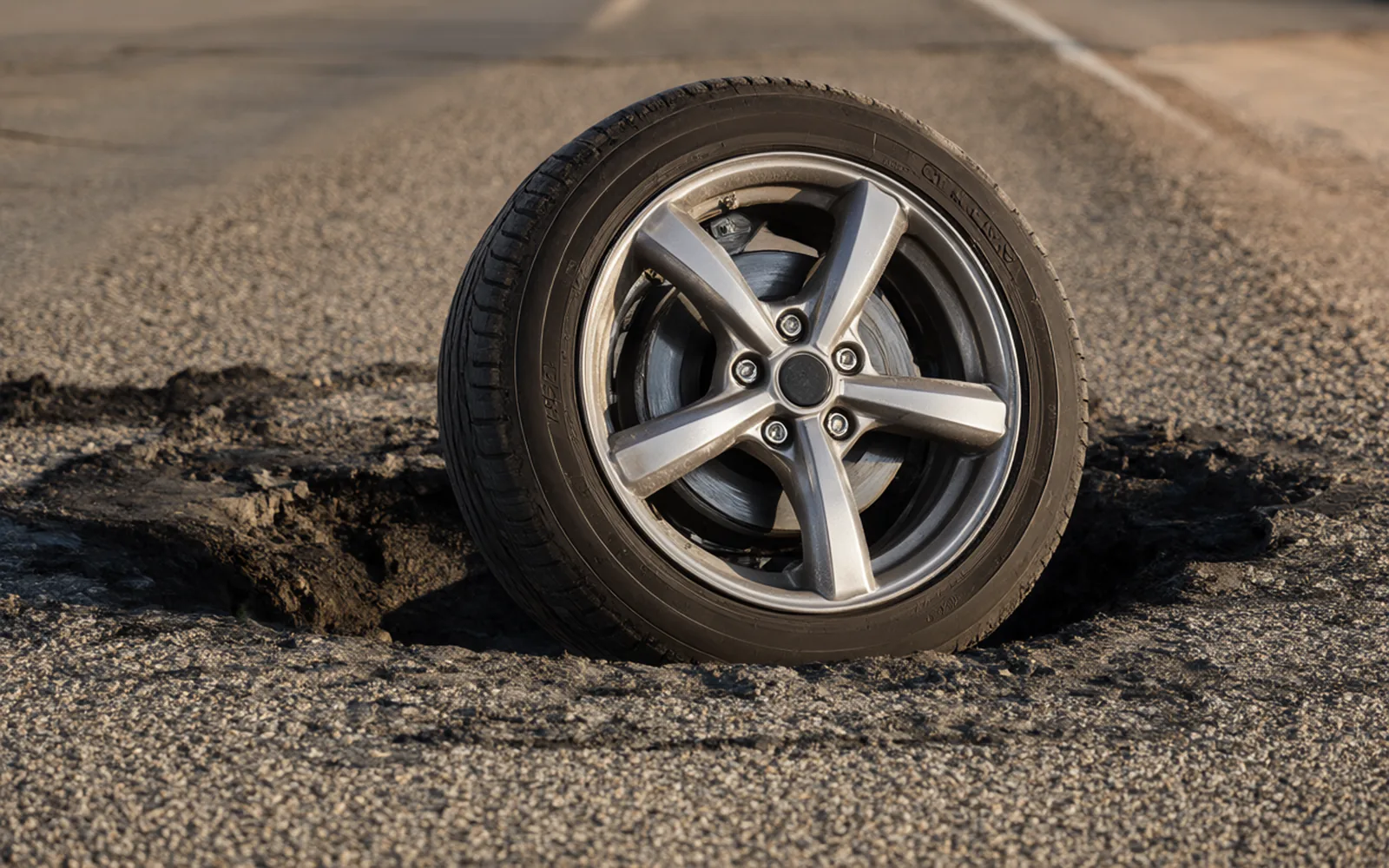
Result: sharp-edged potholes, often deep enough to bottom-out a 20-inch rim. Compare that to humid climates where potholes are usually smoother-edged and shallower.
Sign 1: Vehicle Pulls to One Side
After a hard hit, you let go of the wheel on a straight section of US-95 and the car drifts. Steady drift left or right = something moved.
Possible damage:
- Knocked-out toe alignment — most common, cheapest fix. Hit shoved the steering rack or moved a tie rod
- Bent control arm or knuckle — visible, sometimes catastrophic. Needs replacement, not realignment
- Tire belt shift — tire’s internal structure is damaged; it will pull regardless of alignment until replaced
- Brake drag — a caliper that was already marginal can get a sticking piston after a hard impact
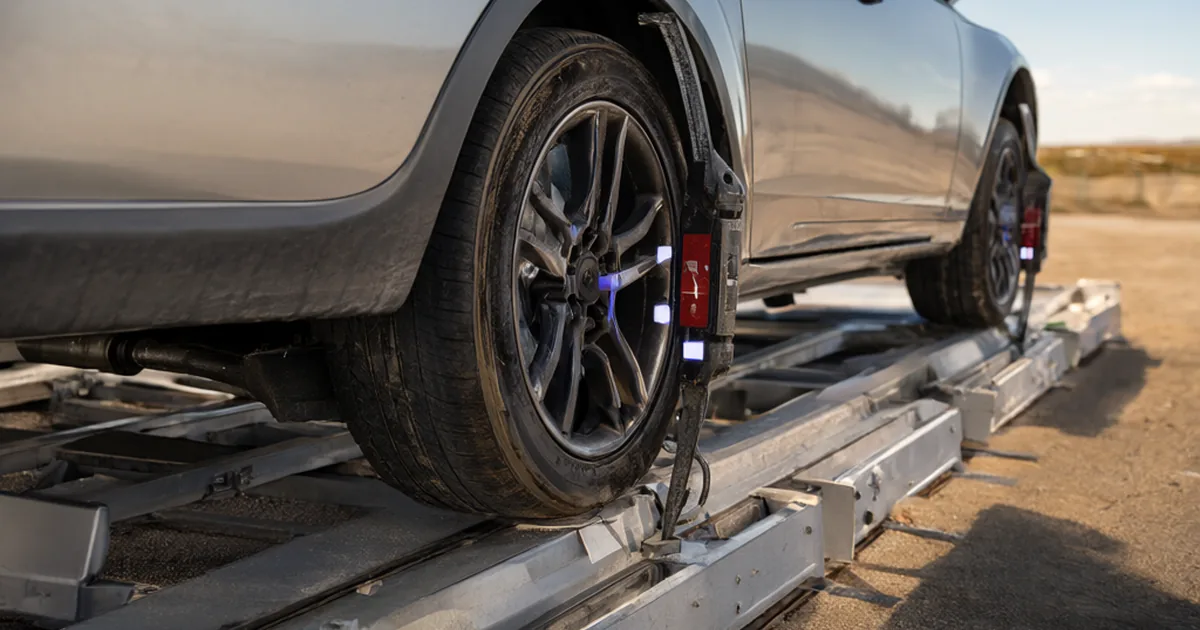
Diagnostic: lift the car, check every steering and suspension joint for play, then 4-wheel laser alignment. $129 alignment at our shop catches and fixes simple cases. See suspension repair for the full diagnostic flow.
Sign 2: Vibration at Highway Speed
You hit a pothole at 60mph on I-15 toward Primm, and now at 55-70mph there’s a steady vibration in the steering wheel or seat.
Three primary causes, ranked:
- Bent wheel/rim — common on aluminum alloy. Visible bend, doesn’t hold air pressure stable, or shows runout on a wheel balancer. Sometimes repairable ($75-150), sometimes replace ($350-1,200 for OEM)
- Tire belt separation — the internal steel belt of the tire shifted. Tire balances poorly and creates a thump that worsens with speed. Replacement required
- Wheel weight knocked off — easy fix, $25 rebalance
If your vibration follows speed (worse at 65, better at 50 or 75), it’s wheel/tire. If it follows engine RPM regardless of speed, it’s drivetrain — different problem.
Sign 3: Knocking or Clunking Over Bumps
You roll over a speed bump in the Galleria parking lot at 5mph, and you hear a “clunk” from a corner. Or driving over the seams on Charleston Boulevard, there’s a metallic knock with every joint.
This is the classic worn-suspension-component sound, accelerated by pothole impacts. Suspects, in order of frequency on cars 60K+ mi:
- Sway bar end links — a 5mm ball stud worn down to nothing. ~$120 per side
- Strut top mounts — bearing failed or rubber isolator cracked. ~$249-549 depending on side count
- Control arm bushings — rubber separated from the metal sleeve. Common on BMW E60/E90 thrust arms (lollipop bushings)
- Ball joints — worn lower or upper, can be safety-critical. Replacement essential
- Strut/shock mounting bolts — loosened from impact, simple fix
Diagnostic technique we use: put the car on a hoist with weight on the wheels, technician pries each joint with a pry bar while another watches for movement. Most knocks are found in 10-15 minutes.
Sign 4: Uneven Tire Wear (Within Weeks)
If your tires were even 3 weeks ago and now you see feathering or one-sided wear, the alignment got hit hard. Specific patterns:
- Feathering (inner-to-outer wave pattern) = toe out of spec
- Inner shoulder bald, outer still good = excessive negative camber
- Outer shoulder bald = positive camber or under-inflation
- Cupping (scalloped depressions) = worn shocks, sometimes worn ball joints
We see this most often on lowered cars, performance cars (M-Sport BMWs, AMG Mercedes), and air-suspension vehicles where a pothole hit shifted the ride height calibration.
Catching it within 1,000 miles of the hit can save the tires. Wait 5,000 miles and you’re buying new tires plus the alignment. Pencil-tread the inside edge of your front tires monthly if you drive aggressive routes.
Sign 5: Ride Height Drop or One Corner Low
You walk out in the morning and notice the car is squatting on one corner. Or you take a photo from the front and the left side is visibly lower than the right.
Possible causes:
- Broken coil spring — common on cars 10+ years old, especially around the lowest coil where rust pits start cracks (less of an issue in dry Vegas air, but still happens). Symptom can also be a snapping noise when turning
- Leaking strut/shock — visible oil on the strut body. Loses damping authority; corner sags
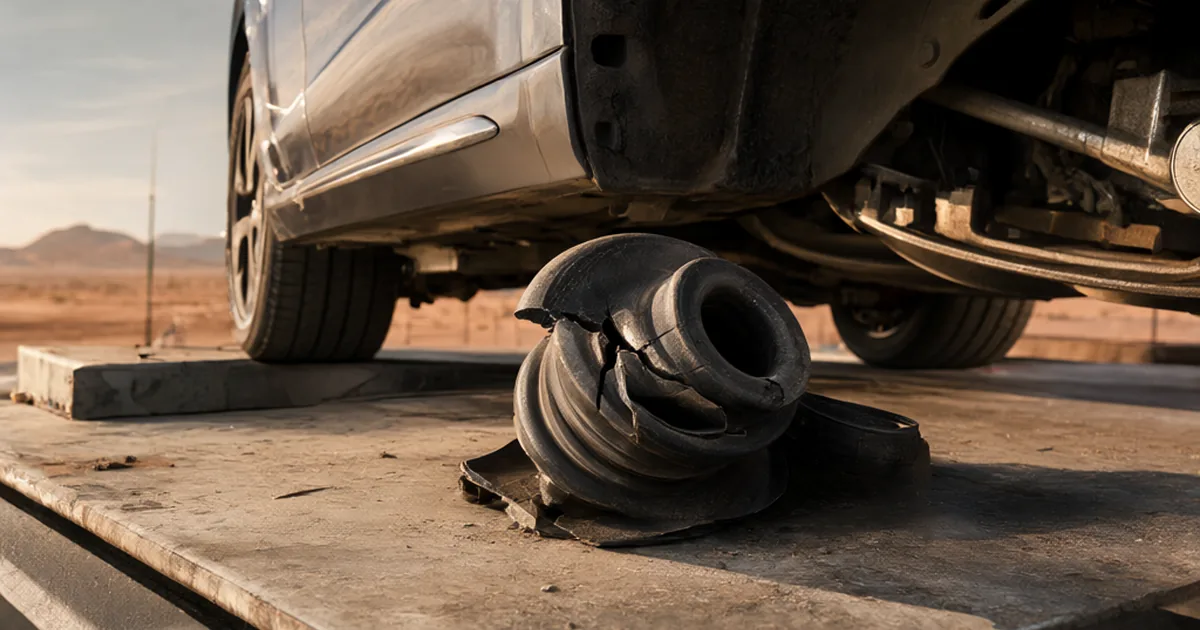
- Air suspension failure (Range Rover, Audi A8/Q7, S-Class, certain BMW X5/X7) — air strut leaks, compressor overworks, eventually system locks out in fault mode. Vegas heat and dust are brutal on these rubber bladders. Expect failure between 80K-130K mi on most air-sprung vehicles
- Bent strut housing — direct impact damage. Whole strut assembly replacement
Air suspension repair is its own specialty — see our European auto repair and Land Rover service for context on these systems.
Pricing Matrix (Common Repairs)
| Repair | Price Range |
|---|---|
| 4-wheel laser alignment | $129 |
| Strut replacement (pair, front) | $599-1,290 |
| Strut replacement (air, single) | $1,490-2,890 |
| Lower control arm (one side) | $349-749 |
| Ball joint (one side) | $289-549 |
| Sway bar end links (pair) | $189-349 |
| Tie rod end (one side) | $189-389 |
| Tire mount + balance + repair | $49+ per tire |
| Bent rim repair | $75-150 |
European cars (especially BMW with thrust arm assemblies, Mercedes with air struts, Audi/VW with multi-link rear) typically land at the upper end of these ranges.
When NOT to Wait
Some suspension issues are nuisances. Others are safety-critical. Stop driving and get a tow if:
- Loud clunk + pulling + the wheel feels loose — possible ball joint separation imminent
- Steering wheel sitting noticeably off-center after a hard hit — tie rod or rack damage
- Visible fluid leaking from a strut or shock with reduced ride control
- One corner suddenly drops dramatically (broken spring or coil) and the tire is contacting the fender
A ball joint that separates at 70mph on I-15 is a wheel-coming-off event. Don’t gamble. We’re 5 minutes off the freeway at Arville and Hacienda.
Where We See This Most
Pothole damage from specific stretches we hear about weekly:
- I-215 between Rainbow and Decatur — construction joints with edge drops
- Tropicana between I-15 and Maryland — seasonal pothole eruption
- Charleston east of Maryland Parkway — old asphalt, deep cracks
- Maryland Parkway around UNLV — heavy bus traffic chewing the surface
- I-15 north toward Apex — sun-baked, freeze-cracked
- Construction north of Summerlin — temporary patches that don’t last
If you live in Summerlin, Henderson, or Enterprise and you commute through any of these, you’re not paranoid — your suspension is taking real damage.
Get It Diagnosed Before It Snowballs
A bent tie rod left alone for 5,000 miles eats $400 of tires. A loose ball joint snaps. A leaking air strut puts the whole system in fault. Catch these early — most suspension fixes are under $600, most catastrophic failures start above $2,500.
Call (725) 322-7768 or book a suspension inspection. We’ll put it on the lift, check every joint, and give you a written report with priorities and pricing. 4350 Arville Street, Suite 490 — Mon-Sat 9AM-6PM.