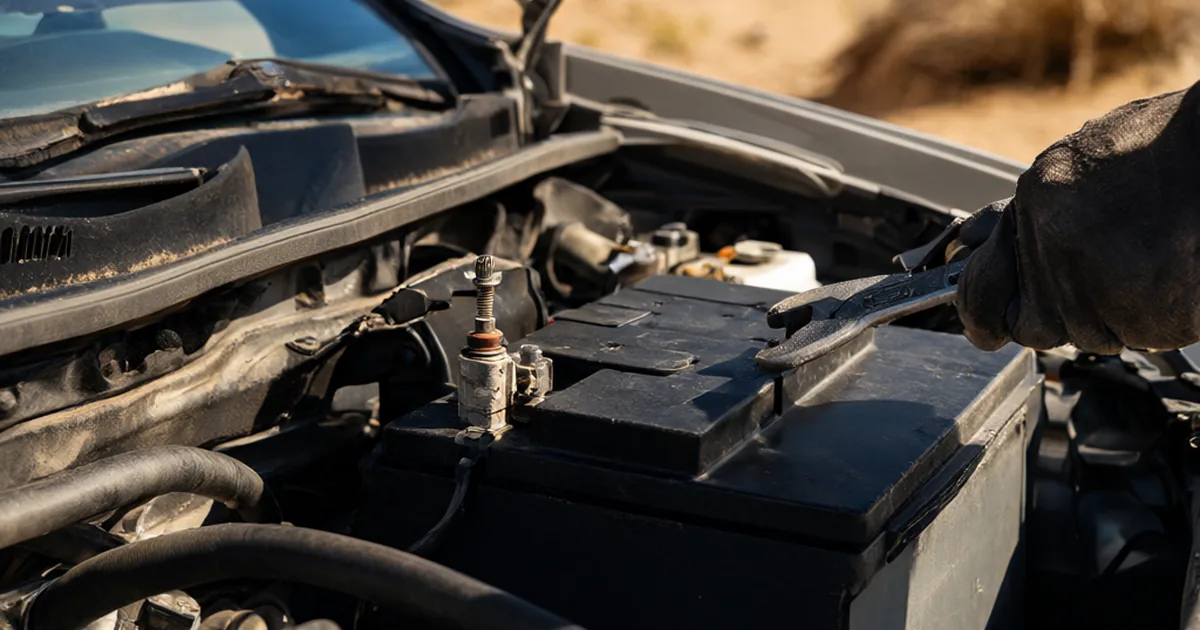

It is the most common false negative we see at our Arville Street shop: a customer brings in a car that wouldn’t start that morning, we test the battery with a basic voltmeter, get 12.4V, and the customer says — “see, the battery’s fine.” Then we put it on a real load tester and the voltage collapses to 8.7V at 200 amps and we explain that in Las Vegas summer, a battery that measures good can still be functionally dead.
This is the article that should keep you from buying a $980 starter you don’t need.
What a multimeter actually tells you
A standard digital multimeter draws essentially no current. It samples the no-load resting voltage of the battery. That number gives you one piece of information: whether the battery’s cells are charged. It tells you nothing about whether the battery can deliver the 600+ amps a starter motor demands for 2 seconds on a hot Vegas morning.
The relevant numbers at rest:
- 12.7V+ — fully charged, healthy cell chemistry
- 12.4V — about 75% state of charge
- 12.2V — 50%, marginal
- 12.0V — 25%, undercharged
- Below 11.9V — discharged or one cell failing
But here is the trap: a battery with a failing internal plate, sulfation on the negative grid, or dropped cell capacity can still read 12.4V at rest because the surface chemistry holds voltage until you ask it to do work.
Why Vegas heat is uniquely brutal
Battery industry data is unambiguous: heat kills batteries faster than cold. The rule of thumb in lead-acid chemistry is that battery life is roughly halved for every 15°F increase in average operating temperature above 77°F. In Las Vegas, the under-hood temperature during summer routinely exceeds 160°F when the ambient is 110°F+. We see batteries fail at year 3 here that would have lived to year 6 in San Diego.
What the heat does:
- Water boil-off from the electrolyte (even in sealed AGM batteries via the pressure-relief valves).
- Positive grid corrosion — the lead-calcium grid loses physical contact with the active material.
- Stratification — denser electrolyte settles to the bottom, leaving the top half of the cell weak.
- Sulfation — lead sulfate crystals that don’t dissolve back during charging once they harden.
A battery in this condition can have 12.4V resting voltage and 40% of its rated cold-cranking amps. Drop in temperature back to 35°F on a January morning in Spring Valley, and it can’t crank a cold engine.
What a real load test does
A carbon-pile load tester applies a measured electrical load — typically half the battery’s CCA rating — for 15 seconds while monitoring voltage. A healthy battery holds above 9.6V under load. A failing battery collapses below 9.0V, sometimes to 7V or lower.
Modern conductance testers (Midtronics, Argus, Snap-on EECS series) do the same job electronically by measuring internal resistance, but the standard remains: voltage under load is the truth. Voltage at rest is hope.
We use a Midtronics MDX-650 at our shop. The test takes 6 seconds. The printout gives:
- Measured CCA vs rated CCA
- Internal resistance in milliohms
- State of health (SOH) percentage
- Pass / Replace / Bad-cell verdict
When a customer pulls up with a “weird no-start,” this is step one. Cost: included in our $9.99+ electrical diagnostic flat fee.
How to read the load test yourself
If you own a carbon-pile tester or a decent conductance meter, here are the calls:
| Result | What it means |
|---|---|
| Measured CCA ≥ 80% of rated | Battery is healthy |
| Measured CCA 60–80% of rated | Marginal — replace before winter |
| Measured CCA < 60% of rated | Failed — replace now |
| Internal resistance > 8 mΩ on a small battery | End of useful life |
| Voltage drops below 9.6V under load | Failed |
A car battery that reads 12.6V at rest but 8.4V under load is functionally dead even though it would pass a multimeter check.
Real cases from our last 90 days
Three customer scenarios from this spring:
Case 1 — 2019 BMW 330i, Summerlin. Customer reports occasional slow crank. Multimeter at AutoZone said 12.5V — “battery good.” Our load test: 9.1V at 350 amps. Measured CCA: 380 against a rated 750. Replacement and the slow crank disappeared.
Case 2 — 2017 Mercedes E300, Henderson. Customer paid for a new starter at another shop. Issue returned in 60 days. Their multimeter said 12.6V. Our load test: 7.8V under load. The original starter was fine. The battery had been the problem all along.
Case 3 — 2022 Audi Q5, Centennial Hills. Two-year-old factory battery, customer says car sometimes won’t unlock with the fob. Our load test: 580 / 760 CCA — marginal. Internal resistance 9.4 mΩ. Replaced under our 1-year battery warranty (purchased here previously). Module sleep current was draining a weakened battery overnight; symptom resolved completely.
When you need replacement vs charging
A weak but not failed battery can sometimes be recovered with a 12-hour smart charger cycle, especially if the failure is just deep discharge after sitting (winter storage, lights left on, parasitic drain). A battery with internal grid corrosion or dropped cell capacity cannot be recovered — charging just masks it for 24 hours.
Our rule of thumb in Las Vegas: a battery 3+ years old that fails a load test should be replaced, not recovered. The chemistry is past the point of stable performance through the next summer.
Parasitic drain — the other thing the load test reveals
Sometimes the battery is fine but something in the car is draining it overnight. A current clamp on the negative cable with the car asleep (all modules timed out, ~30 min after lock) should read under 50 mA on most modern vehicles. Higher numbers mean a module isn’t sleeping — common culprits in our shop:
- Aftermarket dash cams wired to constant power
- Trailer-brake controllers on trucks
- Failed BCM relays sticking on
- Mercedes COMAND modules not entering deep sleep (W212/W213)
- Range Rover infotainment hanging awake (Pivi Pro issues)
Pricing for parasitic drain diagnostic: $49.99–129 depending on how deep the trace goes (some require sleeping the car for 45 min between probes).
FAQ
Can I use my phone’s OBD adapter to test the battery? No. Bluetooth OBD adapters read voltage but cannot apply load. They report the same false-positive a $20 multimeter does.
How long should a battery last in Las Vegas? Our average is 3.5–4.5 years for a standard flooded battery, 4.5–6 years for an AGM, in this climate. Outside Vegas (say, Reno or Seattle) these numbers extend to 5–7 and 7–9 years.
Why does my car start fine in the morning but die at work? Heat-soaked battery — afternoon under-hood temperatures collapse remaining capacity. Classic Vegas summer failure pattern.
Bottom line
A multimeter is a useful tool, but in Las Vegas climate it gives you a number that doesn’t predict whether your car will start tomorrow. The load test does. If your car has cranked slow even once this month, get a proper load test before you replace anything else.
Schedule the test online at /contact or call us directly at (725) 322-7768 — we run the test, give you the printout, and tell you the truth about your battery. No-pressure, no upsell. If it passes, we say so and you drive home. See also /services/battery-replacement-las-vegas/ for our pricing and what’s included with a fresh battery install.