Engines don’t speak English, but they speak. After 20+ years of leaning over engine bays, we’ve learned that almost every internal mechanical issue announces itself with one of four basic sounds: knock, tick, whine, or hum. Each sound maps to a different family of root causes. Each family has a different cost profile — and dramatically different urgency.
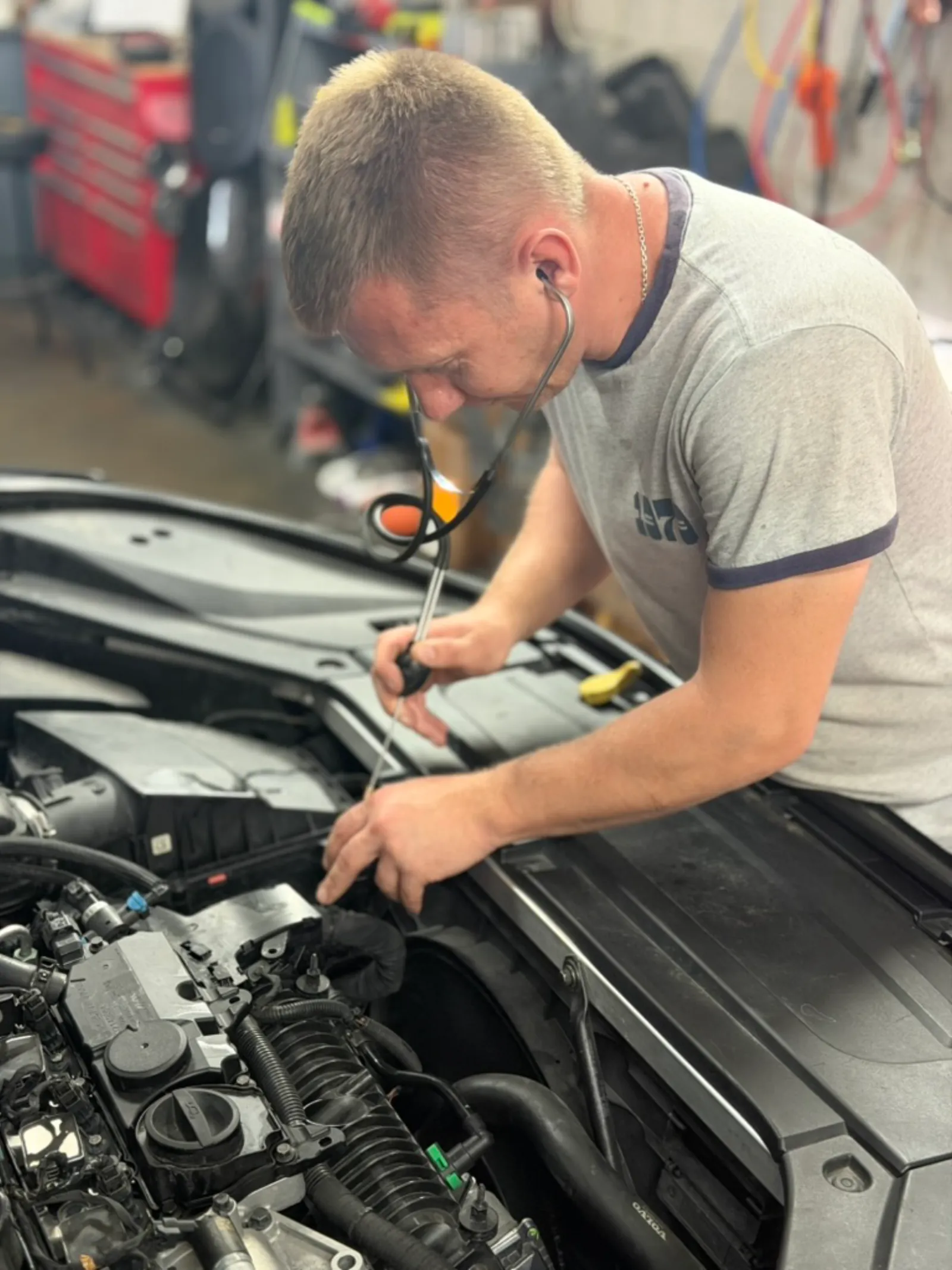
A customer who can describe the noise accurately saves us 20 minutes of diagnostic time. A customer who can describe when it happens (cold start vs warm idle, under load vs deceleration, at speed vs at stop) saves us another 20. The photo above shows the part of the job a customer can’t do at home.
Photo Context
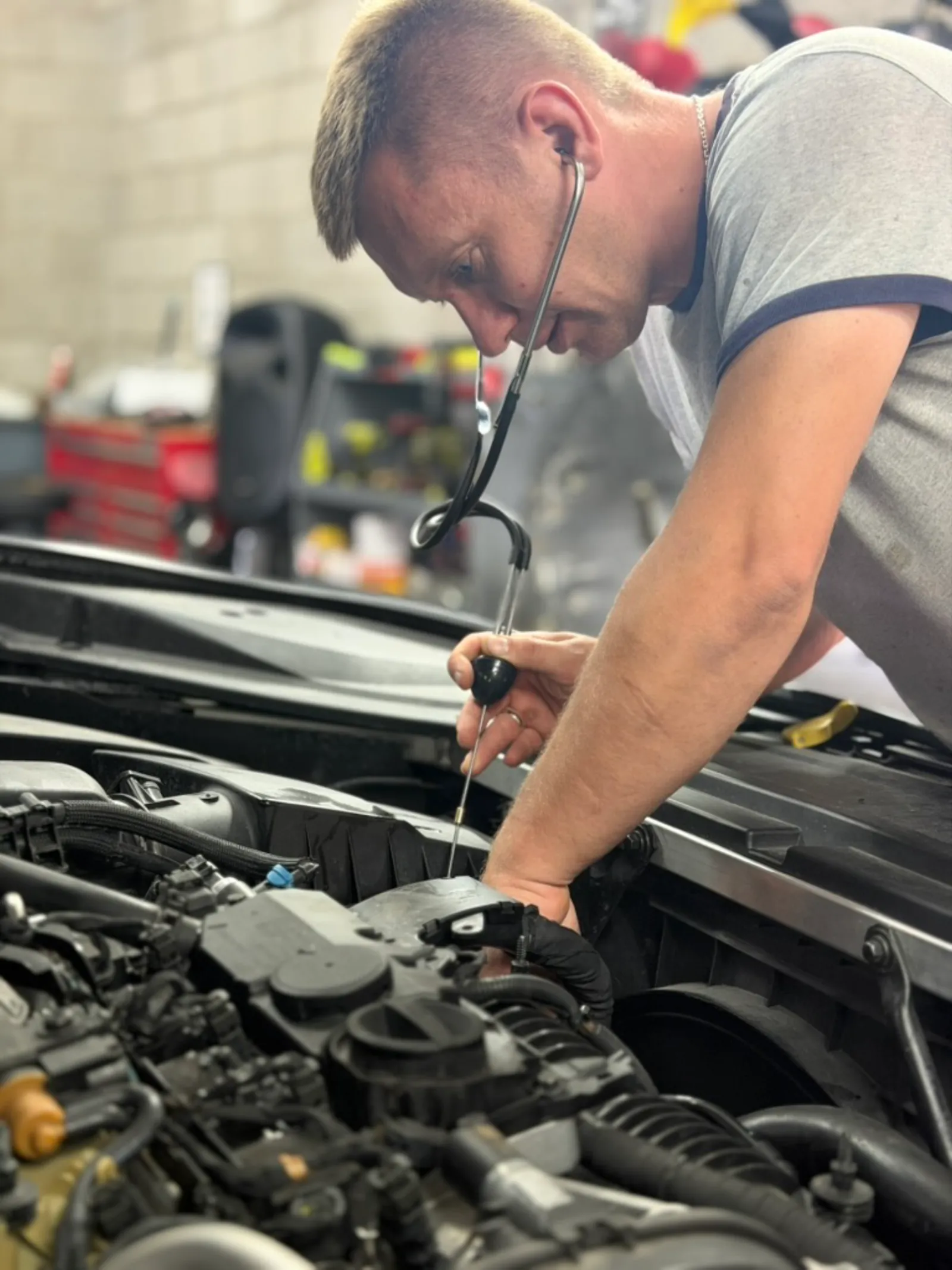
Pictured above: Andrew at the engine bay during a noise diagnosis at our Arville Street shop. The stethoscope probe is placed near the timing cover — a key listening point for chain rattle, cam phaser tick, and tensioner failure. We move the probe methodically across half a dozen points on the engine to triangulate the source. It’s the same principle a doctor uses to find a heart murmur: single-point acoustic contact filters out everything else.
KNOCK — The Deepest Sound, the Worst Diagnoses
A knock is low-frequency, percussive, and usually loud enough that the customer hears it from inside the cabin. Knocks generally come from below the deck of the engine — rotating assembly, not valvetrain. The cause families:
- Rod knock — bottom-end bearing wear on a connecting rod. Sound is consistent with RPM, gets louder under load, often loudest just off idle around 1,500 RPM. This is engine-replacement territory. Stop driving. Tow.
- Main bearing knock — similar profile, slightly deeper pitch, usually steadier across RPM. Same severity.
- Spark knock / detonation — knock only under throttle, especially climbing hills or accelerating in too-high a gear. Usually disappears with higher-octane fuel. Often a timing or carbon issue, not catastrophic if addressed.
- Piston slap — knock that’s loud on cold start, fades after 60-90 seconds of warm-up. Common on aged engines (200K+ miles) with skirt wear. Annoying but usually not progressive.
The diagnostic test: rod knock loads heavier under load, spark knock disappears with premium fuel, piston slap goes away with heat. If you’re not sure which, get it checked before driving more — the cheap diagnoses get expensive fast if they’re actually the bad ones.
TICK — The Most Common, the Most Misdiagnosed
A tick is high-frequency, steady, often rhythmic with engine RPM (one tick per crank revolution typically means valvetrain). Cause families:
- Hydraulic lifter tick — common on BMW N52/N62, Mercedes M272/M273, older Toyotas. Loud on cold start, fades within 5 minutes as oil pressure builds and lifters pump up. Persistent lifter tick on a warm engine = oil flow restriction or a collapsed lifter, fixable.
- Exhaust manifold leak — tick at idle, often louder cold and quieter once the manifold expands and seals. Common on Ford trucks, German V8s.
- Fuel injector tick — direct-injection engines (most cars 2010+) tick mechanically at the injectors. This is normal, not a defect. It’s louder on diesels and on early-generation DI engines.
- Valve clearance out of spec — older overhead-cam engines (Honda K-series, some Subaru) need periodic valve adjustment. Tick that follows a specific cylinder is the clue.
The distinguishing test: locate the tick. Stethoscope at the valve cover finds lifter issues. Stethoscope at the exhaust manifold flange finds exhaust leaks. Stethoscope at the injector rail finds DI noise. Stethoscope at the timing cover finds chain or cam phaser issues — and chain rattle on a BMW or Mercedes is its own expensive conversation.
WHINE — Variable Pitch, RPM-Dependent
A whine pitches with engine RPM (or with road speed, separately — that distinction matters). Cause families:
- Power steering pump — lower-pitched whine that worsens when wheel is turned at low speeds. Common, cheap, fluid check is step 1.
- Supercharger snout bearing — Range Rover, Audi 3.0 TFSI S-platform, some Mercedes AMG. High-pitched whine in a specific RPM band, often 1,500-3,000.
- Turbocharger imbalance — very high-pitched whine that scales with boost. Usually a sign of impending failure.
- Serpentine belt slip — high-pitched squeal that comes and goes with load (A/C on, alternator load, power steering effort).
- Alternator bearing — whine that follows engine RPM but is louder with electrical load (headlights on, defrost on).
The diagnostic test: temporarily remove the serpentine belt and start the engine for a few seconds. If the whine disappears, it’s belt-driven accessory. If it persists, it’s internal to the engine or supercharger.
HUM — Vehicle-Speed, Not RPM
A hum is the trickiest because it usually isn’t the engine at all. Hums depend on vehicle speed (mph), not engine speed (RPM). That’s the key tell — if the noise stays constant when you push the clutch in or shift to neutral and coast, it’s drivetrain, wheels, or tires, not engine.
- Wheel bearing — hum that’s louder from the bad side. Test: at 40 mph, gently swerve left and right. Turning left transfers weight to the right wheels and a bad right bearing gets louder.
- Tire wear pattern (cupping) — hum that goes away on smooth pavement and returns on coarse surfaces.
- Differential bearing — hum tied to vehicle speed, often present in all gears, gets louder under load.
- Transmission bearing — hum tied to vehicle speed in specific gears, goes away when shifted out of that gear.
Listening Technique
We use two tools: a mechanical stethoscope (rigid probe + sealed acoustic chamber) for under-hood diagnosis, and chassis ears (extended probes that magnetically attach to suspension/drivetrain components) for noises that only happen while driving. The chassis ears feed into a small headset so a tech in the passenger seat can listen to specific suspension corners while the car is in motion.
We don’t rely on smartphone recordings sent by customers. Useful as a “yes, there really is a noise” confirmation, but the cabin captures HVAC fan, road noise, exhaust resonance, and tire hum simultaneously. Compression on messaging apps strips out the 8-12 kHz range where most engine ticks actually live. The recording sounds different from what the engine is actually making.
When a Sound Suddenly Changes
If the noise is brand-new on a warm engine — a knock that wasn’t there yesterday, a tick that just appeared — stop driving and get diagnosis. New mechanical noises on warm engines are almost always progressive. A sudden whine is usually a belt or pulley, which can be checked in 5 minutes. A sudden knock usually isn’t, and continuing to drive can turn a $1,800 repair into a $4,500 engine replacement.
This is especially true in Vegas summer. Heat soak makes minor mechanical issues louder and accelerates wear. We see overheating-related cascading failures more frequently in July-September than any other season.
Our Diagnostic Flow
- Listen with the customer present, both at idle and at the RPM where the noise is loudest.
- Stethoscope at 6-8 standard listening points (timing cover, valve cover, oil pan, block sides, accessories).
- Scan tool data — camshaft position offsets, oil pressure, knock sensor reads. Numbers correlate with what we’re hearing.
- Targeted physical test if needed — compression test, leakdown test, smoke test, belt-off test.
The whole flow is typically 30-45 minutes for engine noise. Suspension and drivetrain hums take longer because we usually need a road test. Reference engine diagnostics for our full menu.
What It Costs
Diagnostic is $49.99. Common repair ranges, ballpark, for the diagnoses above:
- Bad hydraulic lifter (single): $649-1,290 depending on engine.
- Timing chain kit (BMW N20/N26): $1,890-2,890 at our shop, dealer commonly $3,800+.
- Exhaust manifold gasket: $290-690.
- Power steering pump: $390-790.
- Wheel bearing (per side): $390-590.
- Rod knock: engine rebuild or replacement — $5,000+.
Catching a tick early — before it becomes a knock — is the single highest-ROI thing you can do as an engine owner. We catch a lot of N20 chain rattles in Summerlin and Henderson at the cheap fix point. We also see a lot of customers who waited six months and now need engines.
Mini FAQ
Should I keep driving with a new tick? Cold-start tick that fades — probably fine, but worth a diagnosis. Warm-engine tick that persists or worsens — stop driving for daily use until diagnosed.
Why does it only do it cold? Oil viscosity is highest when cold. Clearances are tightest. Lifters haven’t pumped up yet. Many marginal issues are loudest in the first 60-90 seconds and disappear with heat. That doesn’t mean they’re not real — it means they’re early.
Can a YouTube video diagnose my noise? Sometimes, for textbook cases. Most real-world noises are mixed — a chain rattle layered over a normal lifter tick layered over an injector buzz. Three sounds at once isn’t what’s in the YouTube examples.
If your engine is making a new sound, the cheapest version of fixing it is happening right now. Call (725) 322-7768 or book through /contact. Also worth checking /problems/check-engine-light/ if a CEL accompanied the noise. 4350 Arville Street Ste 490, Las Vegas NV 89103. Mon-Sat 9 AM - 6 PM. BBB A+.