A customer pulls up to our shop with a phone recording of a tick. We listen on the parking lot. It could be one of 8 things — exhaust manifold leak, hydraulic lifter, injector noise, cam follower wear, timing chain rattle, valve clearance, vacuum leak, or just a heat shield rattling against the exhaust. Eight possibilities. Eight different cost profiles ranging from $0 (heat shield zip-tie) to $2,890 (BMW N20 chain kit).
Then we walk to the engine bay with a mechanical stethoscope and find the source in 3-5 minutes. The difference isn’t 20 years of experience (though that helps). The difference is point-source isolation — and that’s something a microphone in a moving cabin physically cannot capture, no matter how good the phone is.
Photo Context
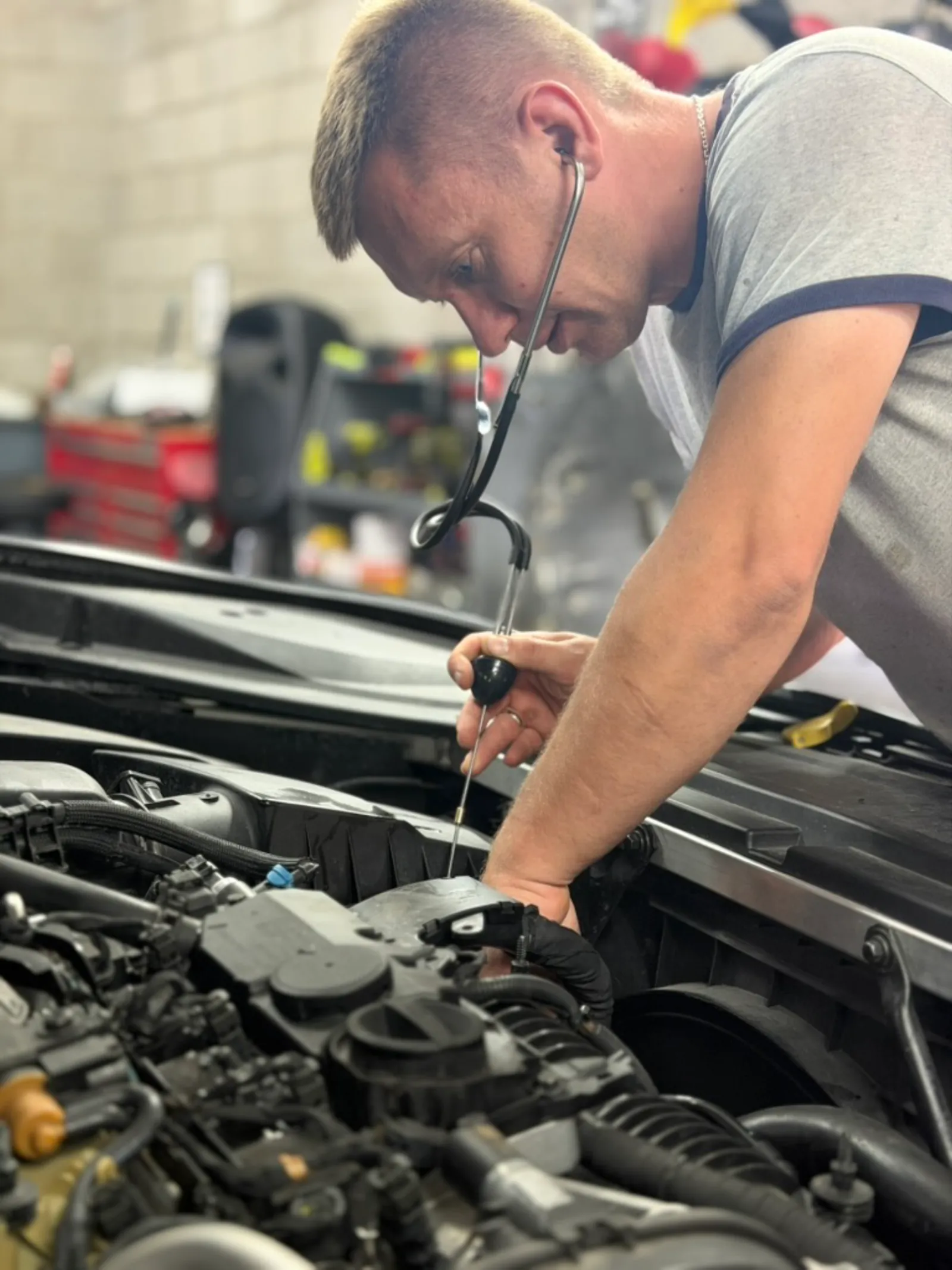
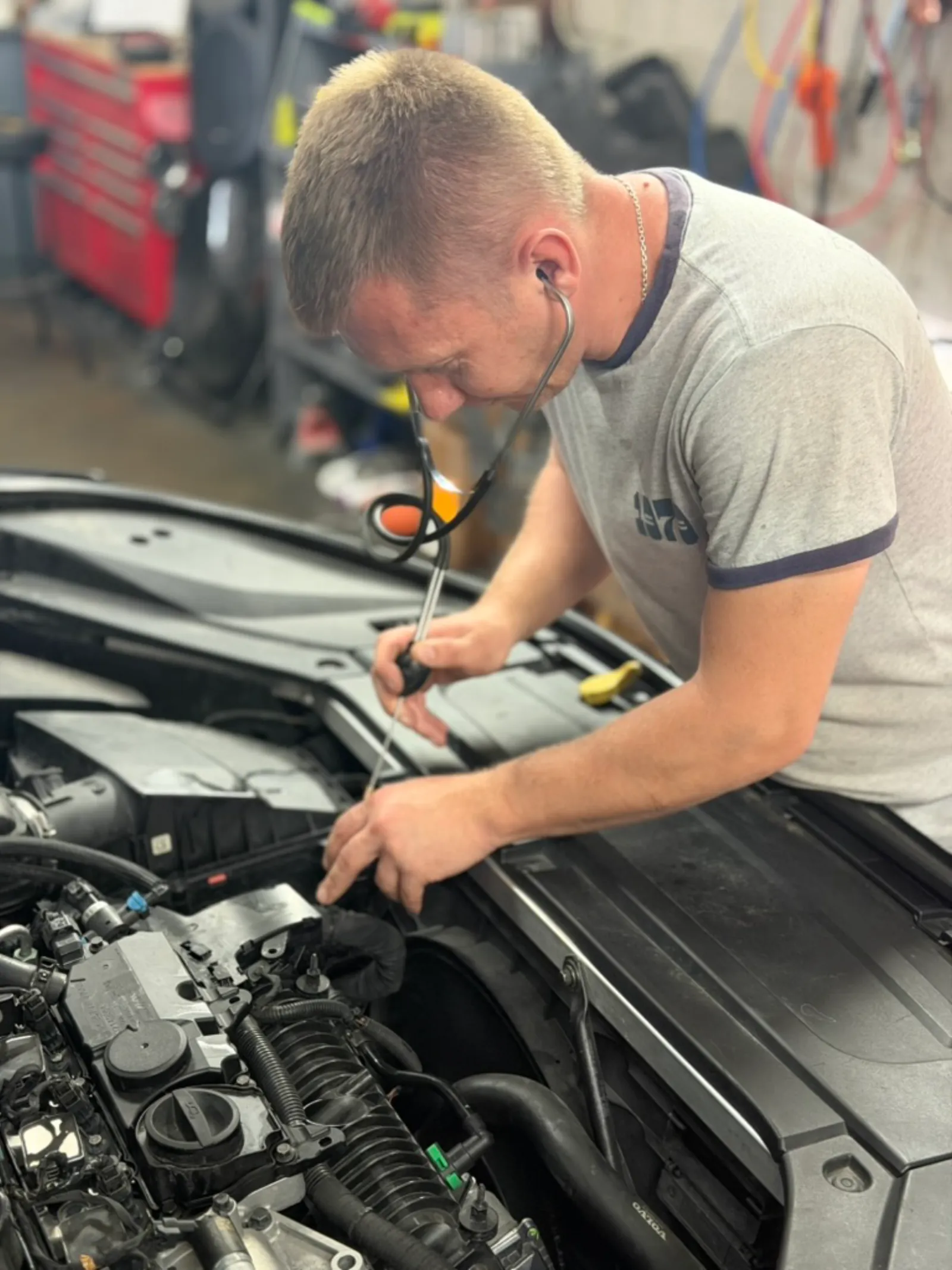
Pictured above: Andrew during an engine noise diagnosis at our Arville Street shop. The stethoscope probe is placed methodically across the timing cover, valve cover, oil pan, and accessory components — each location filters out the noise coming from the others. We work through the listening points in a consistent order so we don’t miss anything. The whole sequence takes about 5 minutes and pinpoints the source with high reliability.
What a Mechanical Stethoscope Actually Does
A mechanical stethoscope is a rigid probe (usually steel) connected to a sealed acoustic chamber that channels vibration directly to your ear. When the probe tip contacts a single point on the engine, you hear the vibration through that material — bone-conducted, essentially — and the surrounding airborne noise drops by 30-50 dB.
In practice: a noisy engine bay at idle (cooling fan, exhaust pulse, accessory noise, the lift fans running 20 feet away) gets reduced to a single channel of “what is vibrating at this exact spot on the engine block.” A timing chain rattle that sounds like a vague rattle in the engine bay becomes obviously loud at the timing cover and obviously quiet 6 inches away at the valve cover. That’s the diagnosis right there.
A $30 mechanic’s stethoscope, used properly, is more diagnostic than a $5,000 scan tool for a lot of mechanical noises. It’s not a substitute for the scan tool — you need both — but for “where is this sound coming from,” nothing beats it.
Why Phone Recordings Fail
There’s a reason we don’t diagnose from customer recordings. Several reasons, actually:
- The microphone is omnidirectional. It captures everything in the cabin equally — HVAC fan, exhaust resonance through the floor pan, road noise if the car is moving, even the recording hand brushing against fabric.
- Cabin acoustics distort the engine signature. Sound waves bounce off the firewall, the headliner, the dashboard. What reaches the phone microphone is a heavily reverberated, attenuated version of what’s actually happening at the source.
- Messaging apps compress audio aggressively. WhatsApp, iMessage, and most SMS-based recording sends strip out the 8-12 kHz range. That’s where most metallic engine ticks actually live. A lifter tick recorded and sent through iMessage sounds like a low thump because the high frequencies are gone.
- The recording doesn’t capture the RPM correlation. A tick that follows engine RPM (valvetrain, internal) versus a tick that’s independent of RPM (exhaust leak at certain temperatures, accessory) is a critical distinction. Without RPM data and the recording timeline correlated, we can’t tell.
We’ve had customers swear they recorded a knock. We get to the car and find a piece of plastic engine cover loose, vibrating at idle. The recording made it sound like a serious internal noise. The fix was a $3 screw.
Standard Listening Points (In Our Usual Order)
We work through these in a consistent sequence. Each one filters out the others:
- Timing cover — chain rattle, cam phaser tick, tensioner failure. Big one on European cars.
- Valve cover (each side on a V engine) — lifter tick, valve clearance, cam follower wear.
- Oil pan / main cap area — bearing knock (lower end), crankshaft thrust noise.
- Block side, mid-deck — piston slap, internal cylinder issues.
- Each accessory — alternator bearing, AC compressor clutch, power steering pump, water pump bearing, idler pulley, tensioner pulley.
- Exhaust manifold flange — manifold gasket leak (the tick that’s louder cold and fades warm).
- Intake manifold — vacuum leak hiss, injector noise.
- Turbocharger housing (if equipped) — turbo bearing imbalance, wastegate rattle.
By the time we’ve worked through all 8 points, we’ve isolated which system is producing the loudest signal. That tells us where to dig next.
Chassis Ears — The Other Tool
For noises that only happen while driving — wheel bearing hums, CV joint clicks, driveshaft vibration, suspension creaks — a stethoscope doesn’t help because we can’t have a probe touching the car at highway speeds. That’s where chassis ears come in: a set of 4-8 wireless microphones that magnetically attach to suspension corners, exhaust, driveshaft, etc., feeding a headset that the tech wears while driving the car.
We can switch channels and listen to each location independently while driving the route the customer described. A clicking CV joint that’s loudest under acceleration in left turns gets confirmed in 10 minutes instead of pulled-apart-for-inspection in 2 hours.
Common Stethoscope-Only Diagnoses
A few examples of issues we’ve diagnosed at our shop using nothing but a stethoscope (verified later by scan tool or teardown):
- BMW N20 timing chain rattle on cold start — loud at timing cover, quiet everywhere else. Confirmed by camshaft offset readout. $1,890+ for full chain kit. Reference our BMW repair and /brands/bmw/ pages.
- Audi 2.0 TFSI cam follower tick — loud at valve cover (intake side), normal valvetrain noise elsewhere. Caught early = $129 fix. Caught late = $1,490+ HPFP cam replacement.
- Mercedes M272 timing chain stretch — low rattle at timing cover, cam timing fault codes corroborate. $2,490+ for the kit and labor. See /brands/mercedes-benz/.
- Honda K-series VTEC solenoid tick — loud at the solenoid housing on the cylinder head. $189 solenoid screen replacement. (We service all makes, not just German — but the K-series tick is common enough to mention.)
- Range Rover supercharger snout — high-pitched whine localized at the supercharger snout, not elsewhere. $1,290+ snout rebuild.
When the Noise Isn’t Actually the Engine
A surprising fraction of “engine noise” complaints aren’t engine at all. Loose heat shields rattling against exhaust pipes mimic ticks. AC compressor bearings sound like internal noises. Loose plastic engine covers buzz at specific RPMs. Suspension knocks transmit through the firewall and sound under-hood when they’re actually in the front struts.
The stethoscope rules these out in minutes. If the probe is loudest at a non-engine location, that’s where the issue is. We’ve saved customers from unnecessary “preventive” engine work multiple times by showing them the noise was a $20 heat shield clip.
The 5-Minute Diagnostic
Here’s the actual flow:
- Engine at operating temp, idling.
- Listen at each of the 8 standard points for 20-30 seconds each.
- Note which point is loudest. That’s the system.
- Within that system, listen at sub-locations to narrow further.
- Verify with scan tool data (cam timing, oil pressure, knock sensor) if applicable.
- If still ambiguous, do a targeted physical test (compression, leakdown, smoke, belt-off).
Total: usually 5 minutes for the stethoscope work, another 10-20 for scan-tool verification, total diagnostic time 30 minutes max.
Cost
Diagnostic is $49.99 flat. That includes stethoscope work, scan tool review, and a written summary of findings. If the diagnosis leads to a repair we do, the diagnostic time rolls into the repair labor — we don’t double-charge.
The real value isn’t the $49.99. The real value is not spending $800 on a guess-and-replace at a generalist shop that swaps the timing chain when the actual issue was a $129 cam follower. We see those misdiagnoses regularly in Summerlin and Green Valley — customers who paid for the wrong fix because nobody actually listened to the engine first.
Mini FAQ
Can I buy a mechanic’s stethoscope? Yes. $30-80 at any auto parts store. Use it carefully — touching a probe to a spinning belt or hot exhaust is a bad day. Practice on a known-good engine first.
Why didn’t the dealer find this? Dealers often diagnose by code first, stethoscope second (or never). If your noise hasn’t triggered a code, dealers can struggle. We diagnose by sound, scan, and physics in that order.
How is your stethoscope different from a doctor’s? The acoustic principle is the same. Difference is the probe — a rigid steel rod that transmits vibration through metal contact, instead of a flexible bell that captures airborne sound. Same idea, optimized for different materials.
If something doesn’t sound right, the diagnostic conversation starts at (725) 322-7768 or /contact. Reference engine diagnostics for the broader workflow. 4350 Arville Street Ste 490, Las Vegas NV 89103. Mon-Sat 9 AM - 6 PM. BBB A+. We’ve been doing this in Vegas since 2022.