A classic complaint is “brake noise,” followed by quotes for a full pad-and-rotor job. Measure the pads first: if they are barely half worn, the real culprit may be warped rotors from a textbook Vegas combo — a 113°F afternoon, a hard descent off I-15 toward Mountain Springs, then a quick wash at the gas station before the rotors have cooled. Thermal shock. Three different brake problems — pads, rotors, fluid — get blamed for each other all the time. Here’s how to actually tell them apart.
Brake Pads: Measure, Don’t Guess
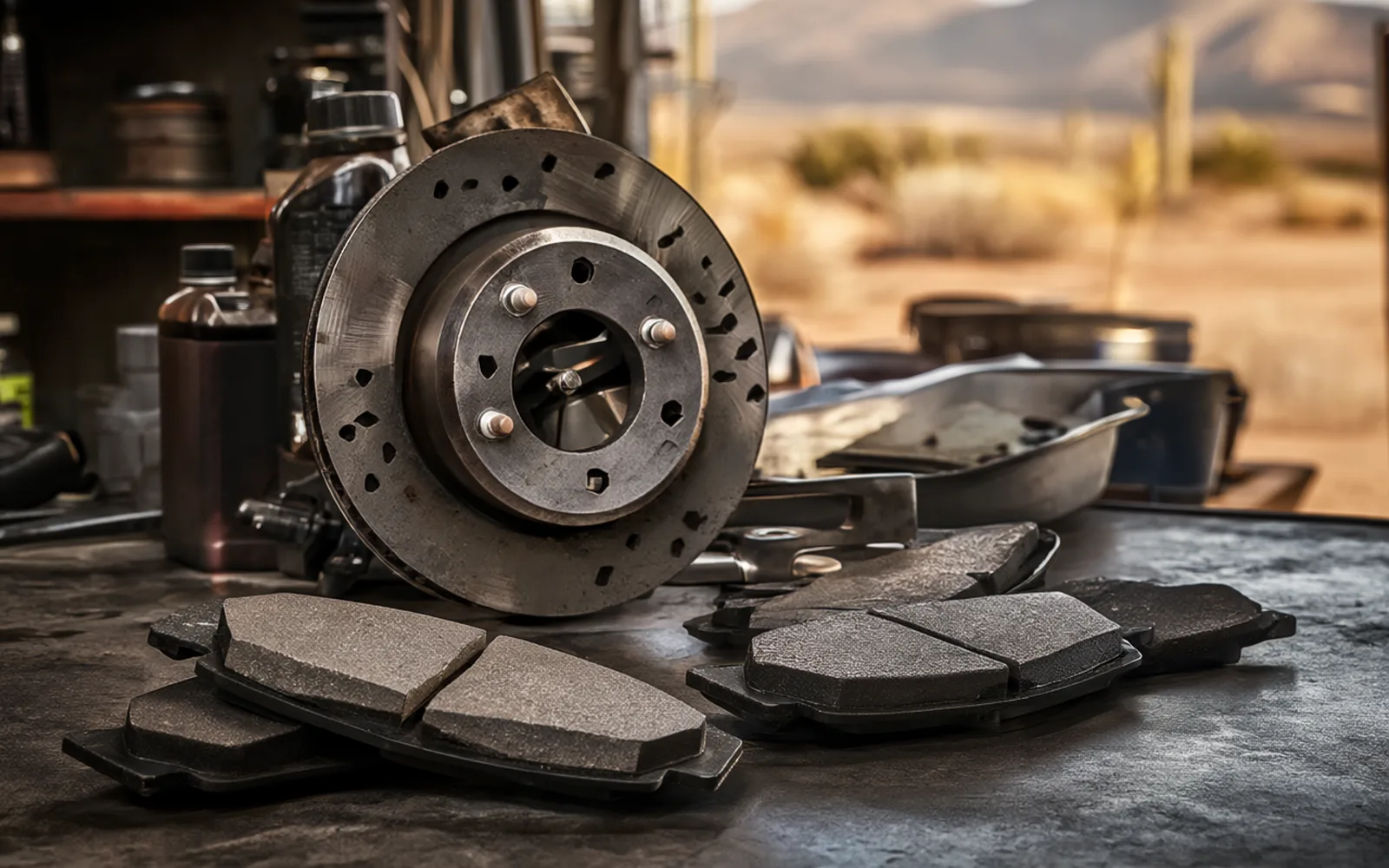
Pads are wear items. Friction material thickness is what matters, not mileage. We measure with a tire-tread gauge or a digital caliper through the wheel spokes:
- New pads: 10-12mm thickness
- Half worn: 5-7mm — still safe, plan replacement in 6-12 months
- Worn: <3mm front, <2mm rear — replace now
- Metal-on-metal: 0-1mm — rotor damage guaranteed
European cars (BMW, Mercedes, Audi) use electronic pad wear sensors — a small wire embedded in the pad that grounds out when material is too thin, triggering a dash light. Domestic and Japanese cars usually rely on mechanical “squealer” tabs that scrape the rotor at low pad thickness, producing a high-pitched whine when not braking that goes away when you press the pedal.
Vegas-specific wear factors that shorten pad life:
- Steep grades on I-15 to Mountain Springs, US-95 to Mt. Charleston, or 215 to Henderson — repeated high-temperature braking
- Stop-and-go traffic on the Strip during weekends and conventions
- Heavy summer brake fade in 110°F+ heat causes drivers to press harder, accelerating wear
Typical pad replacement interval on a mixed-driving Vegas car is 30,000-50,000 miles front, longer rear (rears do less work on most front-biased systems).
Rotors: Resurface or Replace?
Every rotor has a minimum thickness stamped into the hat (the center hub). Common values: 22mm new → 20mm minimum on a typical mid-size sedan, or 30mm new → 28mm minimum on a BMW X5 or Q7. Below minimum, the rotor can’t dissipate heat fast enough and will warp again immediately.
We resurface (machine on a brake lathe) only when:
- Rotor is well above minimum thickness
- Pulsation is from minor warpage, not deep scoring
- No heat cracks visible
We replace when:
- Below minimum thickness
- Deep grooves or hard spots
- Cracks radiating from cooling vanes (common in Vegas — heat-cycle fatigue)
- Pad material transferred unevenly (“hot spots”)
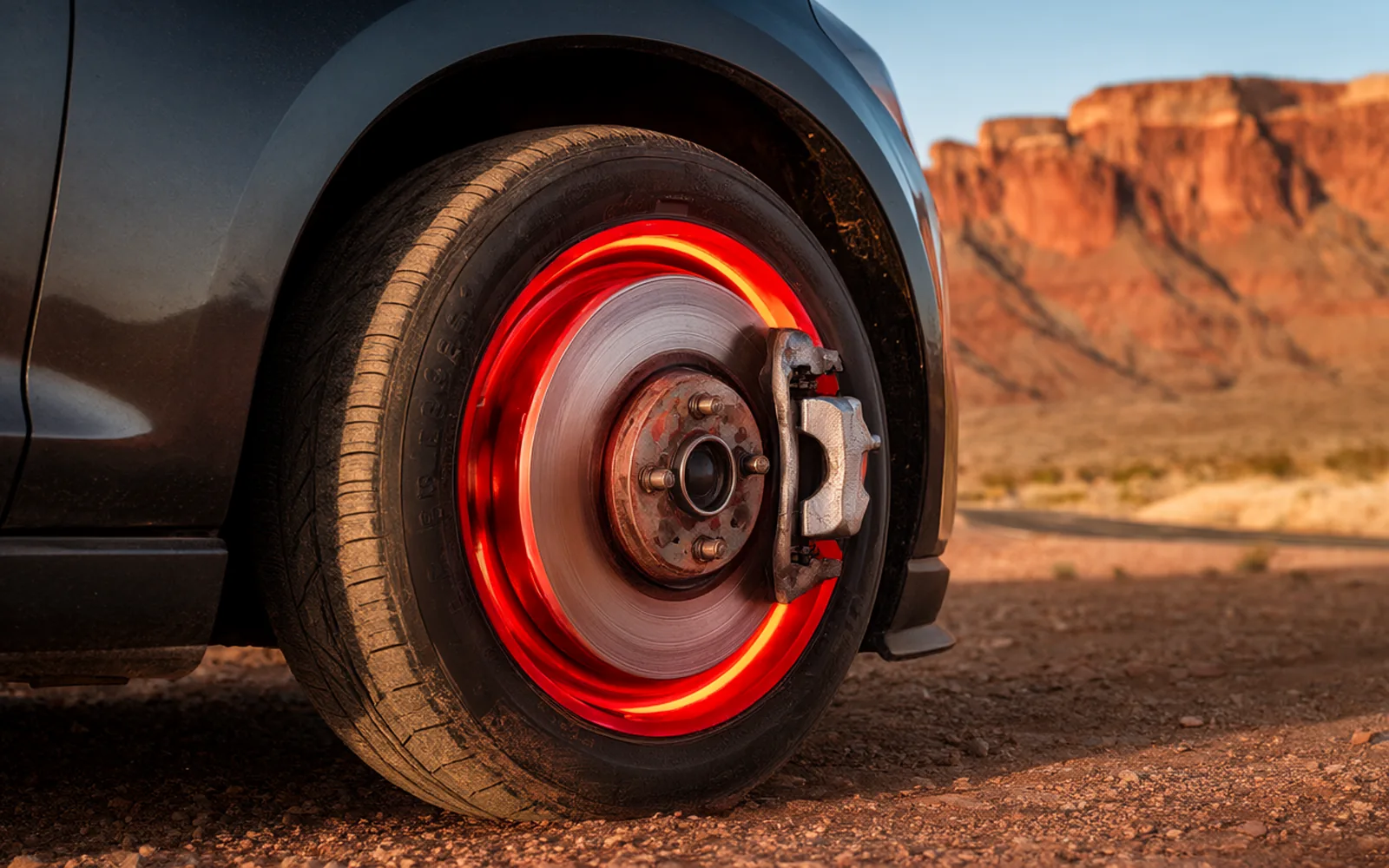
Why Vegas heat warps rotors faster: a rotor running at 600°F after a hard descent that then catches a 70°F car-wash spray drops 500°F in seconds. Thermal shock causes microstructure stress that shows up as pulsation in the steering wheel a few hundred miles later. Tip: if you drove hard, let the car sit 20 minutes before washing.
Our front pad + rotor replacement starts at $349.99+ — includes OEM-spec rotors, ceramic pads, and a torque-spec wheel reinstall. See /services/brake-repair-las-vegas/ for full details.
Brake Fluid: The Silent Killer
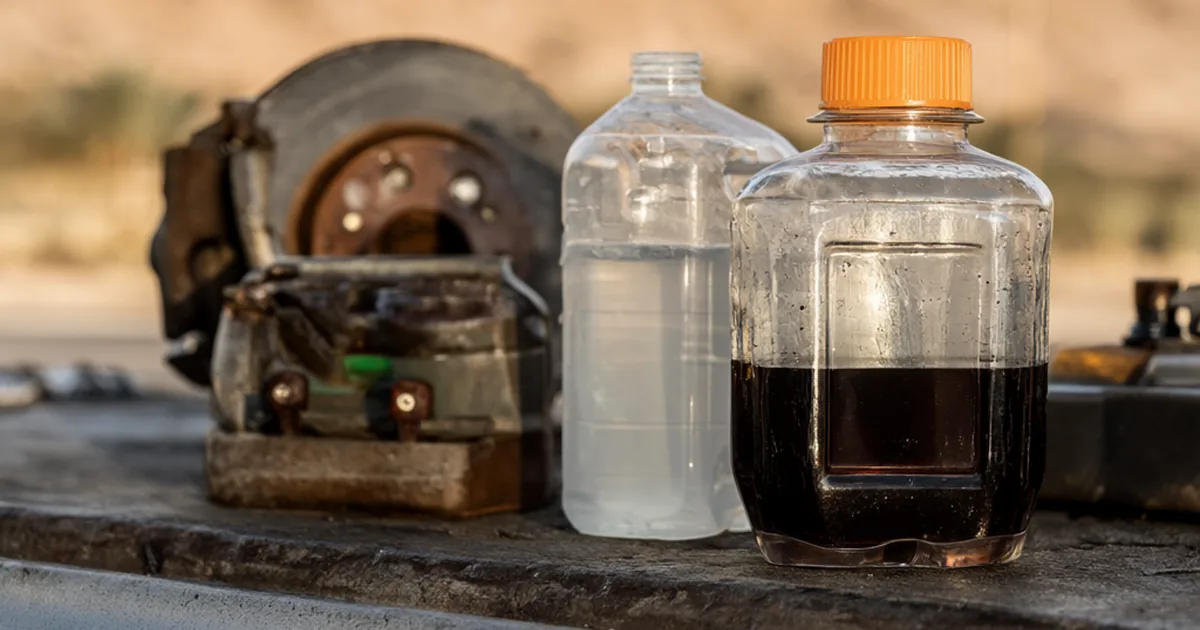
This is the part most drivers — and unfortunately most shops — ignore. Brake fluid is hygroscopic: DOT 4 absorbs water from the air through microscopic pores in rubber brake hoses and around the master cylinder cap. Typical absorption: 2-3% water in 24 months, up to 4% in a high-humidity climate.
Why Vegas is worse than people think: the dry-then-monsoon cycle (40% RH in May, 70% RH in July monsoons) drives faster moisture diffusion than steady-humid climates. The fluid’s dry boiling point of 230°C drops to about 155°C at 3.5% water content. On a long descent off Mt. Charleston with brakes glowing, that fluid can flash to vapor — vapor compresses, pedal goes to the floor, you have no brakes. Vapor lock.
How We Test Brake Fluid
We don’t guess based on color alone. Three measurements:
- Moisture meter: a probe that reads water percentage directly. >3% = change immediately
- Copper test strips: copper leaches from internal brake lines as fluid degrades. >200 ppm = fluid is past its life
- Visual: clear amber = good, dark brown = oxidized, black = neglected
Color alone is a weak indicator — fluid can look fine and still be 4% water.
Brake Hoses: The Overlooked Failure Point
Vegas UV destroys rubber. We pull every wheel and inspect:
- Cracks at the fitting (sun exposure)
- Swelling under pedal pressure (internal delamination — fluid pushes into the hose wall but can’t push the caliper piston)
- Soft spots when squeezed
A swollen hose causes a brake-pull (one side grabs because that caliper actually gets pressure). Cheap to replace, dangerous to ignore.
ABS Module Bleeding: Where It Gets Technical
Modern European cars require scan-tool actuation of the ABS module during fluid flush. The ABS pump and valves hold trapped fluid that gravity bleeding can’t reach. Without ISTA for BMW, XENTRY for Mercedes, or ODIS for Audi, you’re flushing only 70% of the fluid. The other 30% — sitting inside the ABS block — stays old, slowly contaminating the fresh fluid you just put in.
This is why a brake flush from a chain shop on a 2018 BMW 5-Series often doesn’t fix a spongy pedal: they bled the calipers, not the ABS module. We do both.
Real-World Service Intervals in Vegas
- Pads: 30,000-50,000 miles depending on driving style
- Rotors: 60,000-100,000 miles, or replaced with pads if scored
- Fluid: every 24 months by spec, 18 months in Vegas heat
- Hoses: visual inspection every service, replace at 8-10 years regardless of mileage
Mini FAQ
Q: My brake pedal feels fine. Do I still need to change the fluid? Yes. Spongy pedal is a late symptom. By the time you feel it, you’ve lost a safety margin on a mountain descent.
Q: Can I just top off brake fluid instead of flushing? No. Adding fresh fluid to contaminated fluid doesn’t restore boiling point. The water is already in the system.
Q: Why do my brakes squeal when cold and stop after warm-up? Usually pad material composition + slight rust film on the rotor after sitting overnight. If it persists after the rotor is warm, the pads are glazed or worn.
Q: How long does a brake job take at BiTurbo? Front pad/rotor replacement is typically 90 minutes. Add 30 minutes for a brake fluid flush with ABS module bleed.
Stop guessing on your brakes. Whether your pedal feels off, your steering shimmies when you brake, or it’s just been two summers since your last flush — we’ll measure everything and tell you exactly what needs to happen. Call (725) 322-7768 or book online. Our shop at 4350 Arville Street, Suite 490 is open Mon-Sat 9AM-6PM.