“Lifetime fluid.” It’s printed in your BMW owner’s manual. Your Mercedes service advisor says it. Audi’s marketing has built three model generations on it. And yet the symptoms show up again and again: a ZF 8HP that shudders on the 1-2 shift, a Mercedes 722.9 that bangs into gear, or an Audi DSG that drops into limp mode on the I-15 between Henderson and downtown.
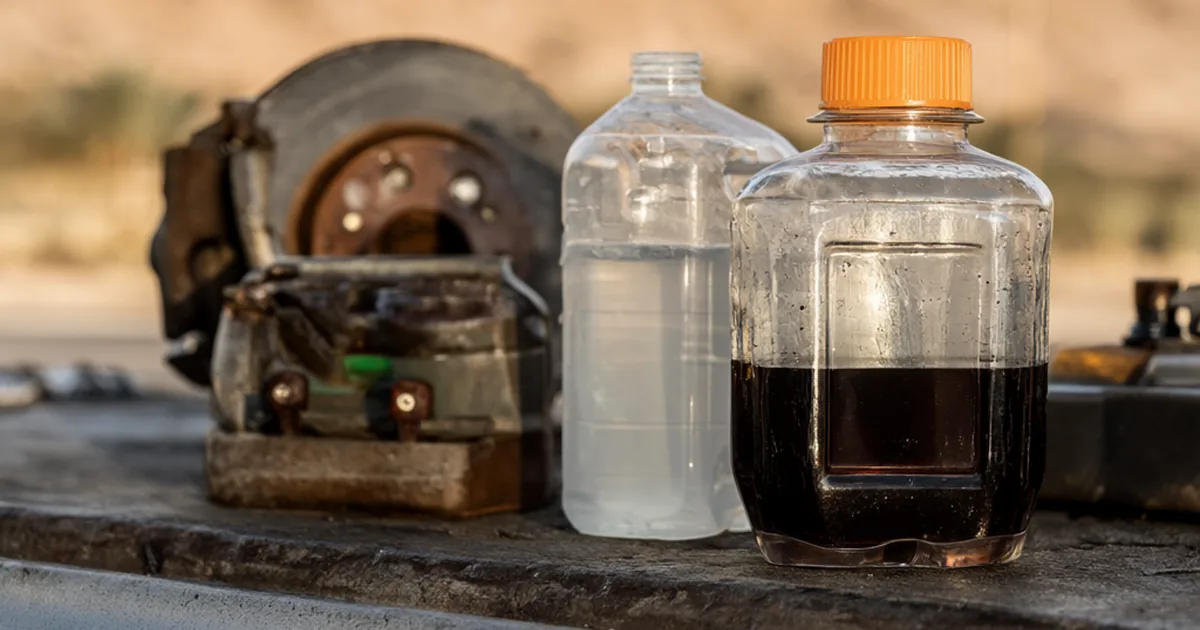
Here is what “lifetime fluid” actually means in the automotive industry: lifetime of the powertrain warranty period. Typically 80,000 to 100,000 miles. After that, the fluid is on its own — and your transmission is on its own with it. In a city where summer pavement hits 145°F and transmission coolers fight a losing battle against the heat, fluid breakdown is accelerated. We see slip start at 70,000 miles in cars that should have made 150,000 with clean fluid.
ZF 8HP — the German workhorse that needs the most attention
The ZF 8HP series (8HP45, 8HP70, 8HP90) is in nearly everything that costs more than $40,000 these days: BMW 3, 5, 7-series, X3 through X7, Land Rover Range Rover and Discovery, Audi A8, Jeep Grand Cherokee, even Rolls-Royce. It’s an excellent transmission — when serviced. ZF’s own technical literature recommends a drain-and-fill at 80,000 miles. BMW’s marketing department forgot to mention that.
In Vegas, we see the early symptoms (1-2 shift shudder under light throttle, torque converter lockup judder around 40 mph) starting at 70,000 to 100,000 miles. The fluid comes out black and smells burnt. Done early, a proper service brings the shift quality back. Done at 150,000 miles, you’re often staring at a $4,500 valve body or a $7,200 rebuild.
Mercedes 722.9 (7G-Tronic) and 9G-Tronic — same story, different fluid
The Mercedes 722.9 and the newer 725.0 (9G-Tronic) follow the exact same pattern. The factory says “no service required.” Our scan-tool data on the live fluid temperature and pressure adaptation values says otherwise.
Critical details on Mercedes ATF service:
- Use Mercedes spec MB 236.17 (9-speed) or MB 236.15 (7-speed) — these are not interchangeable with each other and not interchangeable with Dexron or ATF+4
- The pan-internal filter must be replaced. Most chain shops skip this because it requires dropping the pan and resealing
- Final fill level is checked at a specific transmission fluid temperature (typically 40-50°C) via XENTRY scan tool — not a cold dipstick reading, not “fill until it runs out the fill plug”
Audi/VW DSG and S-Tronic — these explicitly REQUIRE service
Here’s where “lifetime fluid” becomes especially misleading. Audi and VW’s dual-clutch transmissions — the DQ250 (wet 6-speed DSG), DQ500 (wet 7-speed in S3, Golf R, Tiguan), and DL501 (longitudinal 7-speed S-Tronic in A4/A5/A6/Q5) — all require service every 40,000 miles per the manufacturer’s own service manual. There is no “lifetime” claim on these.
Each one uses a different fluid:
- DQ250: VW G 052 182 (wet clutch DSG fluid)
- DQ500: VW G 052 529 (different formulation)
- DL501: VW G 052 529 + separate Haldex/clutch pack fluid
Mixing them is a fast way to ruin a mechatronic unit. We’ve seen it twice this year on cars that went to general shops that thought “DSG fluid is DSG fluid.”
Conventional Aisin and ZF planetaries — varies by manufacturer
Toyota, Honda, Ford, and GM transmissions generally specify 60,000 to 100,000 mile service intervals in their owner’s manuals. Toyota’s Aisin 8-speed (AWR8F45 in Lexus IS/RC) calls for 60,000 mile fluid. Honda’s 10-speed wants 30,000 mile severe-duty service in heat — and Vegas qualifies. Ford’s 10R80 (F-150, Mustang) calls for 150,000 mile change but we see TSBs from Ford itself acknowledging earlier issues. GM’s 8L90 is similar.
What “service” actually involves at our shop
A proper transmission service is not “hook up the flush machine for 20 minutes and call it done.” Here’s what we do:
- Scan-tool full system check — read all transmission adaptation values, fault codes, fluid temperature live data
- Drive the car to operating temperature and log shift quality
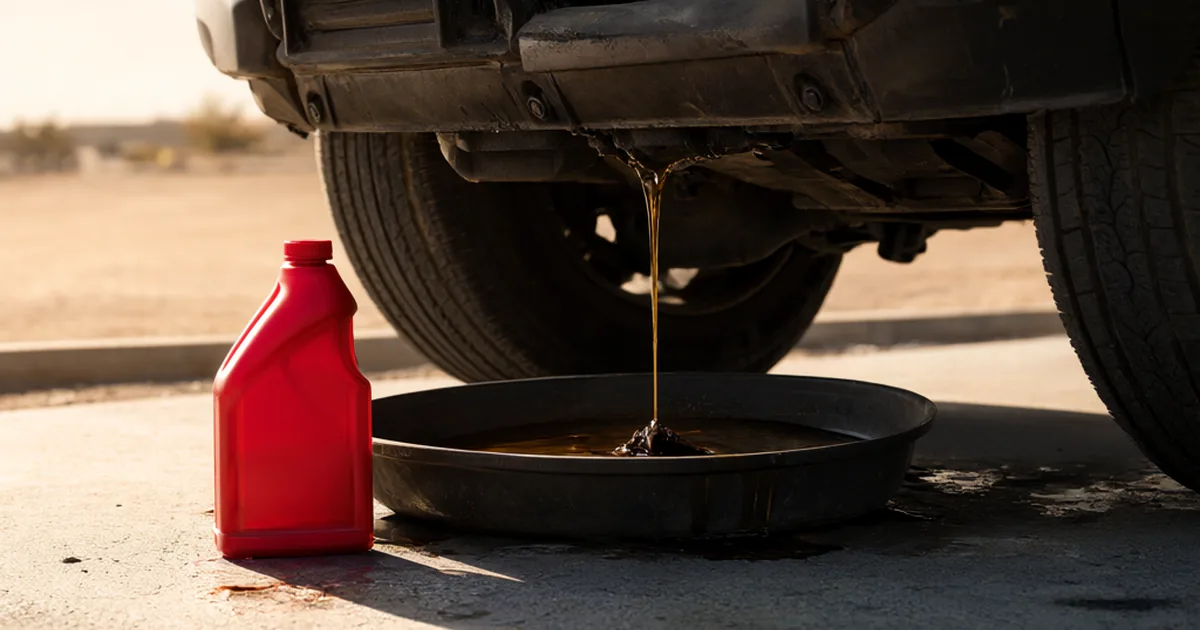
- Drain the pan (or fill-plug drain on pan-less designs like ZF 8HP)
- Replace the internal filter (when the design has one — required on Mercedes, often skipped by indies)
- New OEM-spec pan gasket
- Refill with factory-spec fluid measured to the gram
- Bring transmission to spec fill temperature with the scan tool, then top off to factory level
- Clear adaptation values when appropriate (varies by transmission family)
- Test drive and re-log shift quality
For deeper repair work beyond fluid service, see our transmission repair service.
Pan-drop vs full flush — when each makes sense
In about 90% of cases, a pan-drop service (or staged pan-drop done twice) beats a machine flush. Here’s why:
- Pan-drop removes the most contaminated fluid (the gunk that settles at the bottom) and replaces the filter
- Full flush machines pump fluid under pressure, which can dislodge debris and send it into the valve body solenoids
- On a high-mile transmission that’s never been serviced, a flush can actually accelerate failure — the old fluid was holding clutch material together
We typically pan-drop, drive 200-500 miles, then pan-drop again to bring total fluid replacement to 70-80%. Safer than aggressive flushing on a Vegas-heat-cooked transmission.
Symptoms you’re ignoring too long
Customers in Summerlin and Henderson regularly come in with these symptoms after months of “it’ll be fine”:
- Harsh or banging 1-2 shift under light throttle
- Slip at wide-open-throttle (engine RPM rises before vehicle accelerates)
- Delayed engagement when shifting from Park to Drive (more than 1 second)
- Limp mode (transmission stuck in 3rd or 4th gear, “transmission fault” message)
- Codes P0700, P0729, P0741, P0744 — all torque converter or shift-related
- Torque converter shudder at light throttle around 35-45 mph (classic ZF 8HP symptom)
See transmission slipping symptoms for the full diagnostic tree.
Pricing — what a real transmission service costs
At our shop:
- ZF 8HP service (BMW, Range Rover, Audi A8): $349-$499 — includes 8-9 quarts of ZF Lifeguard 8 (yes, that’s what ZF actually named it), Mann filter, pan/sump gasket, scan-tool fill procedure
- Mercedes 722.9 / 725.0 service: $399-$549 — MB 236.15 or 236.17 fluid, internal filter, gasket, XENTRY fill procedure
- Audi/VW DSG service: $329-$449 — correct fluid for transmission code, filter, ODIS fill procedure
- Toyota/Honda/Ford conventional: $189-$329 depending on capacity
Compare to a dealer quote of $700-$950 for the same work, or a rebuild quote of $5,500-$8,000 when the maintenance got skipped too long.
Mini FAQ
Will my dealer void my warranty if I service the transmission at an independent shop? No. The Magnuson-Moss Warranty Act prohibits manufacturers from voiding warranty for using an independent shop, provided we use OEM-spec fluids and parts (which we do) and document the service. Keep the invoice.
Can I just keep driving with the early shudder? You can, until you can’t. Every mile on degraded fluid accelerates clutch pack wear. A $400 service at 90,000 miles is a $5,500 rebuild at 130,000.
What’s the actual difference between a flush and a drain? A drain (pan-drop) removes 30-50% of fluid by gravity and replaces the filter. A flush uses a machine to pump new fluid in while old fluid is forced out, replacing 90%+ of fluid but not the filter. Drain is gentler. Flush is faster but riskier on high-mile units.
Most German transmissions in Vegas need a fluid service somewhere between 70,000 and 100,000 miles regardless of what the owner’s manual claims. It’s the single highest-ROI maintenance item you can do on a modern automatic — a few hundred dollars to potentially save several thousand.
Call (725) 322-7768 or book a transmission service consultation. We service BMW, Mercedes, Audi, VW, Land Rover, Porsche, and conventional Japanese and domestic transmissions from our European auto repair shop on Arville Street.