Across check-engine-light diagnoses, a small number of root causes account for the large majority of the work. A dozen issues cover roughly 80% of cases, and the same pattern holds quarter after quarter.
This post breaks down those 12 in order of frequency, with real DTC numbers, real diagnostic logic, and typical repair price ranges.
How a Check Engine Light Works (Quick Primer)
Your car runs OBD-II monitors — software routines that test emissions-related systems during normal driving. Each monitor checks one thing: catalyst efficiency, EVAP integrity, oxygen sensor response, misfire detection, fuel system trim, etc.
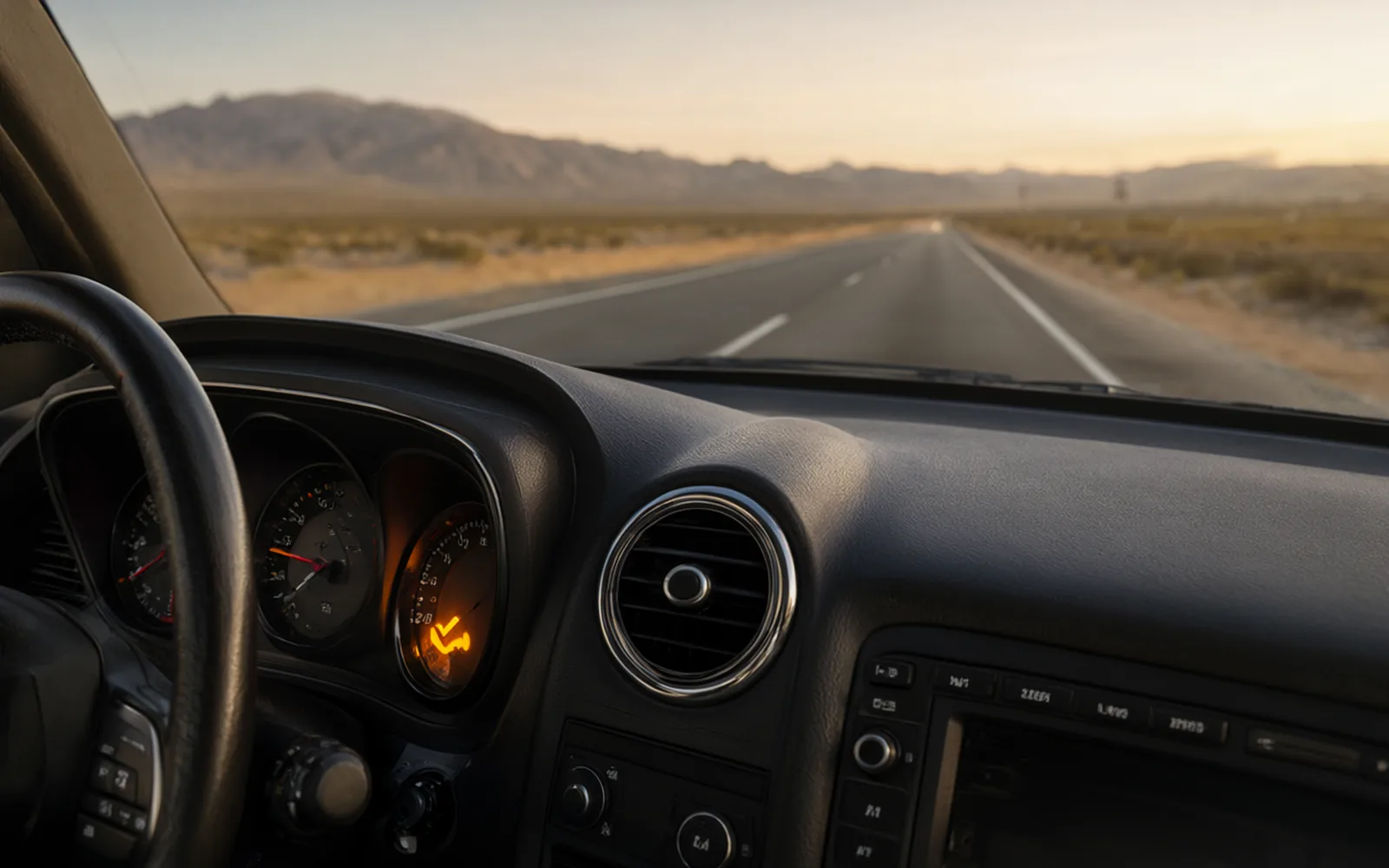
When a monitor fails its threshold test, the Engine Control Module (ECM) stores a “pending” code. If the same fault is detected on the next drive cycle, the code matures and the MIL (Malfunction Indicator Lamp) — your check engine light — turns on. At the moment of fault detection, the ECM also records a freeze-frame snapshot of sensor data: RPM, coolant temp, fuel trims, vehicle speed, load. That snapshot is gold for diagnosis.
To clear naturally, the system needs 3 consecutive clean drive cycles without re-detection. To get a hard re-occurrence with codes already matured, it takes only 2 drive cycles.
Most parts-store code readers give you the P-code and nothing else. We pull P-code + freeze frame + pending codes + readiness monitors + live data — that’s where actual diagnosis lives.
Cause #1: Catalyst Efficiency (P0420 / P0430)
Frequency: ~14% of our CEL volume.
P0420 = bank 1 catalyst below threshold. P0430 = bank 2. The ECM compares pre-cat and post-cat oxygen sensor signals. A healthy cat flattens the post-cat signal; a worn cat lets it mirror the pre-cat signal.
Root causes (in order of likelihood):
- Aged catalyst (life: 120K-180K mi typical, less on engines that ran rich for extended periods)
- Failed downstream O2 sensor (it’s not the cat — the sensor is reading wrong)
- Exhaust leak before or between sensors (false reading)
- Engine running too rich (carbon-fouling cat)
Repair range: $89 (O2 sensor) → $549 (small exhaust leak) → $1,200-2,400 (new cat for European/AWD).
Cause #2: Misfire (P0300 / P030x)
Frequency: ~12%.
P0300 = random/multiple cylinder misfire. P0301-P0312 = specific cylinder.
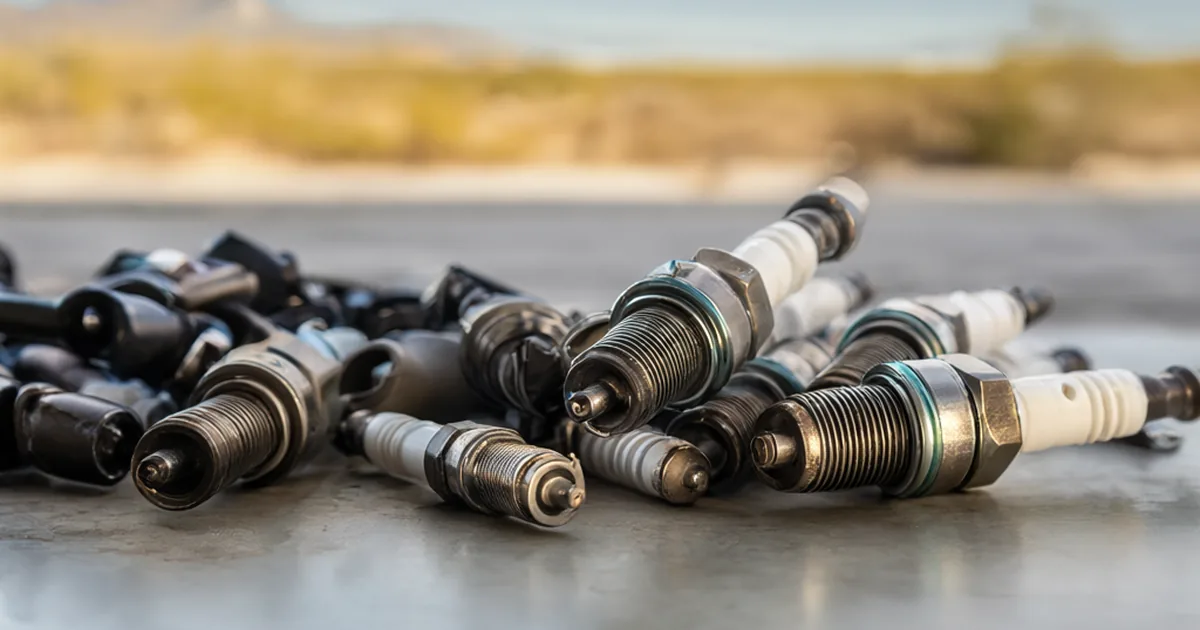
The diagnostic flow: swap coils, swap plugs, watch which cylinder the misfire follows. If misfire moves with the coil, it’s the coil. Moves with the plug, it’s the plug. Stays put — it’s the injector, the compression, or a head gasket / valve issue.
Repair range: $89 (single spark plug + coil) → $349 (full plug + coil set) → $650-950 (injector replacement on DI) → $2,500+ (compression issue / valve job).
Cause #3: Lean Condition (P0171 / P0174)
Frequency: ~9%.
P0171 = bank 1 system too lean. P0174 = bank 2. Fuel trims at long-term >+10% = real lean issue.
Causes ranked:
- Vacuum leak (cracked intake boot, brittle PCV hose — common on BMW N20/N55 above 80K mi)
- Dirty/contaminated MAF (Mass Air Flow) sensor
- Failing fuel pump (low pressure)
- Plugged fuel filter (where serviceable)
- Stuck-closed injector
Smoke-test the intake first. It’s a 10-minute check that solves 60% of P0171 cases.
Repair range: $129 (MAF clean) → $189 (MAF replace) → $349-590 (intake gasket or PCV hose) → $890+ (fuel pump).
Cause #4: EVAP Leak (P0442 / P0455 / P0456)
Frequency: ~8%.
EVAP system contains fuel vapors. A leak triggers small/medium/large leak codes (P0456 / P0442 / P0455 respectively).
In 80% of cases, the cause is the gas cap. Either not tightened, or the seal is degraded. Vegas heat cooks the rubber seal — we replace caps regularly on cars 5+ years old.
Less common: cracked purge valve, leaking charcoal canister, cracked vent valve, perforated fuel filler neck (rare).
Repair range: $25 (gas cap) → $189 (purge valve) → $349-420 (canister or vent valve).
Cause #5: VVT / Cam Timing (P0011 / P0014 / P0021 / P0024)
Frequency: ~7%.
Variable Valve Timing solenoid stuck, oil control issue, or cam timing actually off. Common failure mode on: BMW N20 (chain stretch), Mercedes M271/M276, Audi 2.0 TFSI, Toyota 2GR-FE.
The first diagnostic move: check oil level + condition. Dirty/low oil is the #1 cause of stuck VVT solenoids. Second: scan live data for cam phase offset.
Repair range: $289 (VVT solenoid + oil service) → $890 (VVT actuator replace) → $2,400-4,800 (timing chain on BMW N20/N55) → see engine diagnostics for assessment.
Cause #6: Thermostat / Coolant Temp (P0128)
Frequency: ~6%.
P0128 = coolant temp below thermostat regulating temperature. Thermostat stuck open, won’t let engine reach operating temp. Common on BMW (plastic-housing thermostats fail), Mercedes, VW.
Repair range: $289-549 depending on housing complexity. See cooling system repair.
Cause #7: Cam Sensor (P0340 / P0341 / P0345)
Frequency: ~5%.
Camshaft position sensor failure. Symptoms: hard hot start, intermittent stalling, sometimes a no-start. Vegas heat absolutely kills Hall-effect sensors over time.
Repair range: $189-389.
Cause #8: Transmission Code (P0700 + sub-codes)
Frequency: ~5%.
P0700 is the gateway — it triggers the CEL but isn’t the actual fault. Underneath are codes like P0730 (incorrect gear ratio), P0750-P0758 (solenoid faults), P0731-P0734 (gear-specific slip).
Action: pull transmission-side codes, check fluid (level, color, smell), live-data gear command vs actual.
Repair range: $189 (fluid + filter service) → $890 (solenoid pack) → see transmission service for full repair scoping.
Cause #9: CAN Bus / Module Communication (U-codes)
Frequency: ~4%.
P0600-P0606 family + U-codes for module communication loss. Module failure, wiring damage (rodents — yes, even in Vegas, especially in parked-outside cars), or corrosion.
Repair range: $129 (wiring repair) → $649+ (module replacement and coding).
Cause #10: Injector Issues (P0201-P0212)
Frequency: ~4%.
Specific cylinder injector electrical or balance fault. Direct-injection engines (most modern BMW/MB/Audi) see this from coked-up injector tips and high-pressure injector failures.
Repair range: $389 (single injector) → $1,490 (full set).
Cause #11: Vehicle Speed Sensor (P0500 / P0501)
Frequency: ~3%.
VSS failure or wheel speed sensor mismatch with output speed sensor. Often triggers ABS light alongside.
Repair range: $189-389.
Cause #12: Knock Sensor (P0325 / P0330)
Frequency: ~3%.
Knock sensor signal lost or out of range. Vegas summer + low-octane fuel in cars that want premium = real knock events that hide a failing sensor. We test with an oscilloscope before condemning the sensor.
Repair range: $289-489.
Why “Just Clear the Code” Is a $2,400 Mistake
We get this call weekly: “AutoZone cleared my code, but it came back, can you just clear it again?”
Codes are symptoms. The light came on because a real fault exists. Clearing it without fixing the underlying issue:
- Lets the fault accumulate damage (running lean burns valves and catalysts)
- Erases the freeze-frame data we need to diagnose efficiently
- Resets the readiness monitors — which means your car will fail Nevada smog inspection until 4-8 drive cycles complete (sometimes weeks of normal driving)
If your CEL is on and your smog is due in a month, don’t clear it. Drive it to us first.
Our Diagnostic Process
$49.99 flat fee for engine code diagnostics. Here’s what that gets you:
- Pull all stored, pending, and history codes (manufacturer-level, not just generic OBD-II)
- Read freeze-frame data for each code
- Live data review — fuel trims, sensor outputs, command vs actual
- Bidirectional testing where applicable (commanding solenoids, cycling components)
- Visual inspection of suspect systems
- Written report with root cause + repair estimate
See check engine light service for booking, and our problem guide for symptom-by-symptom triage.
FAQ
Will my car fail Nevada smog with a CEL on? Yes — automatic fail. Nevada requires the MIL off and readiness monitors complete.
Can I drive with a CEL on? Solid light = drive but get it checked soon. Flashing light = pull over now, you’re misfiring and destroying your catalyst at $1,500/mile.
Does AutoZone code reading give the answer? It gives you a code, not a diagnosis. A P0171 could be a $25 vacuum line or a $890 fuel pump. The code is the question, not the answer.
Get to the Root Cause
We don’t sell parts you don’t need. We diagnose, quote, and fix. Call (725) 322-7768 or book a diagnostic appointment. 4350 Arville Street, Suite 490 — open Mon-Sat 9AM-6PM.