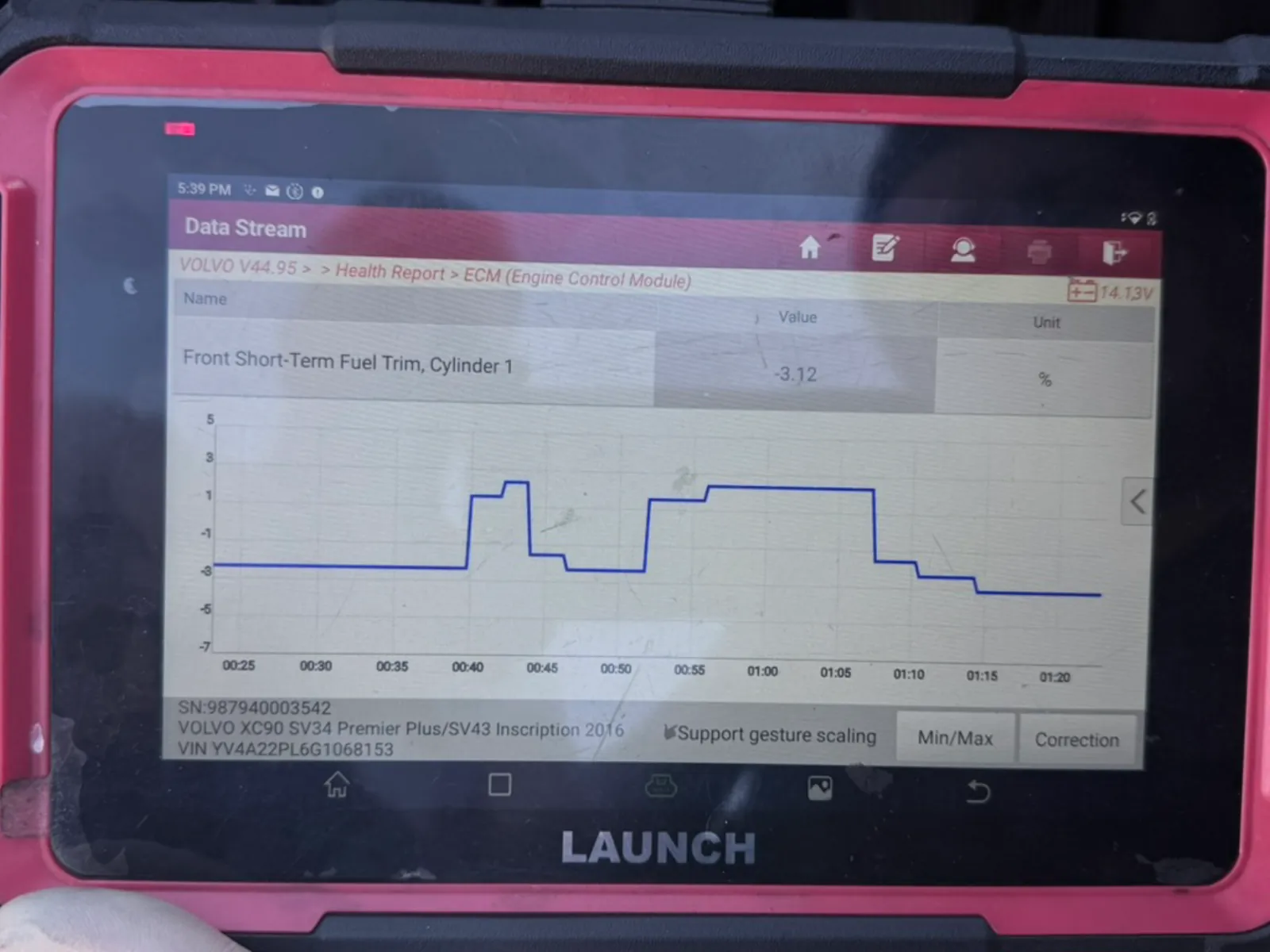
The screenshot above is real customer data — pulled directly off our LAUNCH X-431 scanner during a diagnostic on a 2016 Volvo XC90 T6 Premier Plus that came into our Arville Street shop with a vague “small power dip” complaint. No check engine light. No stored codes. Just a customer who knew their car well enough to know something was off.
To a customer the screen looks like noise. To us it’s a diagnostic story that takes a few minutes to read. This post walks through what that single number — Front Short-Term Fuel Trim Cylinder 1 at -3.12% — actually tells us, and why generic Bluetooth OBD-readers can’t reach this kind of data.
What the Photo Shows
Pictured above: a live data stream from a customer’s 2016 Volvo XC90 on our LAUNCH X-431 PRO 5 scanner. The graphed line on the screen is Front Short-Term Fuel Trim, Cylinder 1, plotted over about 90 seconds of warm-engine idle. Battery voltage reads 14.13V, indicating the alternator is loaded and charging normally. The data source is ECM — Engine Control Module — meaning we’re reading the live decisions the computer is making about how much fuel to inject in real time. This is bidirectional OEM-level data, not the basic generic PIDs you get from a $30 reader.
Fuel Trim 101 — What Is It?
Fuel trim is the engine computer’s correction to the base fuel map. There are two flavors:
- STFT (Short-Term Fuel Trim) — moment-to-moment correction, updated several times per second. Reacts to immediate sensor input (oxygen sensors, MAF, intake air temp).
- LTFT (Long-Term Fuel Trim) — running average of corrections over hours and days. The ECU “learns” your engine and stores LTFT as a baseline.
Both are expressed as a percentage. Positive values mean the ECU is adding fuel because oxygen sensors say the exhaust is running lean (too much air). Negative values mean the ECU is cutting fuel because the exhaust is running rich (too much fuel). Neither is automatically a problem — the ECU is supposed to make small corrections constantly. The question is how big the correction is.
Reading the Graph
In the photo, the STFT line oscillates between roughly -5% and +1% over 90 seconds. That’s a healthy idle pattern. The general rule of thumb:
- ±5% sustained on a warm engine — normal, no action needed.
- ±10% sustained — something is starting to drift; root cause investigation warranted.
- ±25% sustained or trending — the ECU will throw a code (typically P0171 lean bank 1, P0174 lean bank 2, or P0172/P0175 rich) and turn on the CEL.
This Volvo’s Cylinder 1 reading was fine in isolation. The diagnostic decision comes from comparing it to Cylinders 2, 3, and 4 — and to the LTFT history stored in the ECU.
When Fuel Trim Becomes the Whole Story
The customer reported “small power dip” intermittently. No code. No misfire counter increment. We pulled live data on all four cylinders and the LTFT history. Cylinder 1 sat at -3.12% STFT. Cylinders 2, 3, and 4 sat between +6% and +8% STFT, with LTFT slowly trending positive over the last 200 miles of driving (the ECU stores this rolling).
That pattern — one cylinder running slightly rich while the others run progressively leaner — pointed directly at an intake manifold gasket leak on the bank serving cylinders 2-4, with cylinder 1 isolated by the manifold geometry. We confirmed with a smoke test: visible smoke leaking from the gasket flange.
No code yet because the deviation was within tolerance. But it was trending. Another 1,500-2,000 miles and the customer would have seen a P0171, a rough idle, and likely a misfire-related catalyst code cascading from the lean condition.
Why Customer Phone Readings Don’t Catch This
Plug a $30 Amazon OBD reader into the same car and you get: no codes, no problem, send the customer home. The Bluetooth dongle apps can read live data on a few basic PIDs, but they rarely graph bidirectional channels, they don’t sample fast enough to catch transient drift, and they don’t store the long-term ECU adaptation history in a useful format.
Our LAUNCH X-431 reads the same data the manufacturer’s own scanner reads — at the same refresh rate, with the same graphing capability, across all the modules (ECM, TCM, ABS, SRS, BCM, instrument cluster). For a Volvo specifically, this overlaps about 85% of what VIDA — Volvo’s dealer tool — can do. The remaining 15% is module programming and recoding, which we send to dealer-level brand-specific tools.
The Diagnostic Flow From One Number
A single fuel-trim reading is a thread to pull, not a diagnosis. The actual flow:
- Compare STFT across all cylinders (bank imbalance check).
- Compare to LTFT history (drift over time).
- Cross-reference MAF actual versus expected airflow at idle and 2,500 RPM.
- Listen for vacuum leak at intake with a stethoscope.
- Smoke test if leak is suspected but not audible.
- Verify findings with one final live-data run after repair.
Total time on this Volvo: roughly 30 minutes for diagnosis, $189 for intake gasket replacement. If we’d waited for the code, the customer would have paid that plus catalyst stress repairs that compound quickly. Reference engine diagnostics in Las Vegas for our full diagnostic process.
Tools That Matter
The LAUNCH X-431 PRO 5 is our daily-driver scanner — multi-make OEM-level coverage that’s strong on European and Asian platforms. For BMW we cross-check with ISTA when needed. Mercedes goes to XENTRY. Volkswagen / Audi family goes to VAG-COM (VCDS) for coding work. GM gets GDS2. Each tool covers what others can’t, and for serious diagnostics on a BMW, Mercedes, or Audi we use the brand-specific tool. For the live-data exercise above, X-431 was sufficient.
When We Use Brand-Specific Tools Versus LAUNCH
LAUNCH handles code reading, live data, bidirectional actuation, and 80% of programming on most platforms. We move to dealer-level tools when the job requires:
- Module coding or programming (key adaptation, injector coding, transmission learn).
- Brand-specific service resets (CBS / ASSYST / Volvo service indicator).
- Recoding for retrofits or replacement modules.
- Encrypted communication on newer modules (post-2018 BMW, post-2017 Mercedes).
What This Costs You
Our diagnostic is $49.99 flat. That covers code pull, live data review, and a written summary of findings. If the diagnosis leads to a repair, we don’t double-charge — the diagnostic time rolls into the job. The Volvo above paid $49.99 for the diagnosis and $189 for the gasket. Compare to the $890 misfire/catalyst cascade we’d have been looking at a month later, and the math is obvious.
Bonus: Vegas heat accelerates intake gasket failures specifically. The high-temp soak/cool cycle in Summerlin and Henderson driveways works the rubber and silicone gaskets harder than mild climates. We see these intake leaks 2-3 times more often here than the national average.
Mini FAQ
Can I read live data myself? With a good scanner ($300+), yes. The reading is the easy part — the interpretation takes experience. Many DIY readers can pull fuel trim numbers; few owners know what a -3.12% on cylinder 1 means in context.
Why does my Volvo VIDA say something different than your X-431? Generally they don’t, but VIDA includes Volvo-internal interpretation layers and adaptation values that LAUNCH abstracts to generic terms. For live PID data, both read the same thing from the ECU.
What’s the difference between STFT and LTFT? STFT is the immediate correction the ECU is making right now. LTFT is the running average the ECU has learned over hours of driving. If both are positive 10%+, you have a real lean condition. If only STFT is high momentarily, you might have a brief transient (cold start enrichment fading, etc).
For Volvo work specifically, see /brands/volvo/. For any vague drivability complaint, the answer is almost always live data — call (725) 322-7768 or book through /contact. We’re at 4350 Arville Street Ste 490, Las Vegas NV 89103. Monday-Saturday 9 AM - 6 PM.