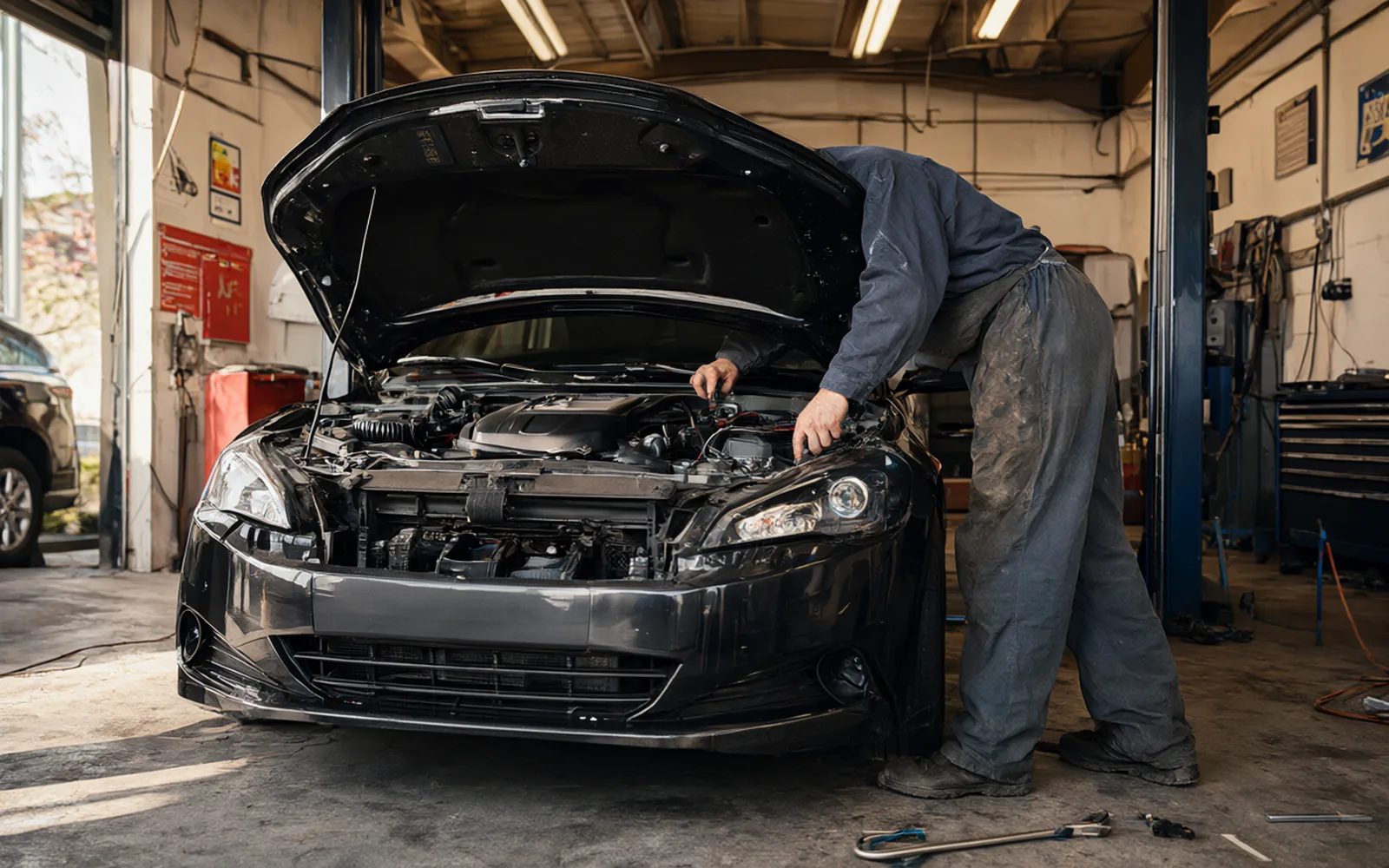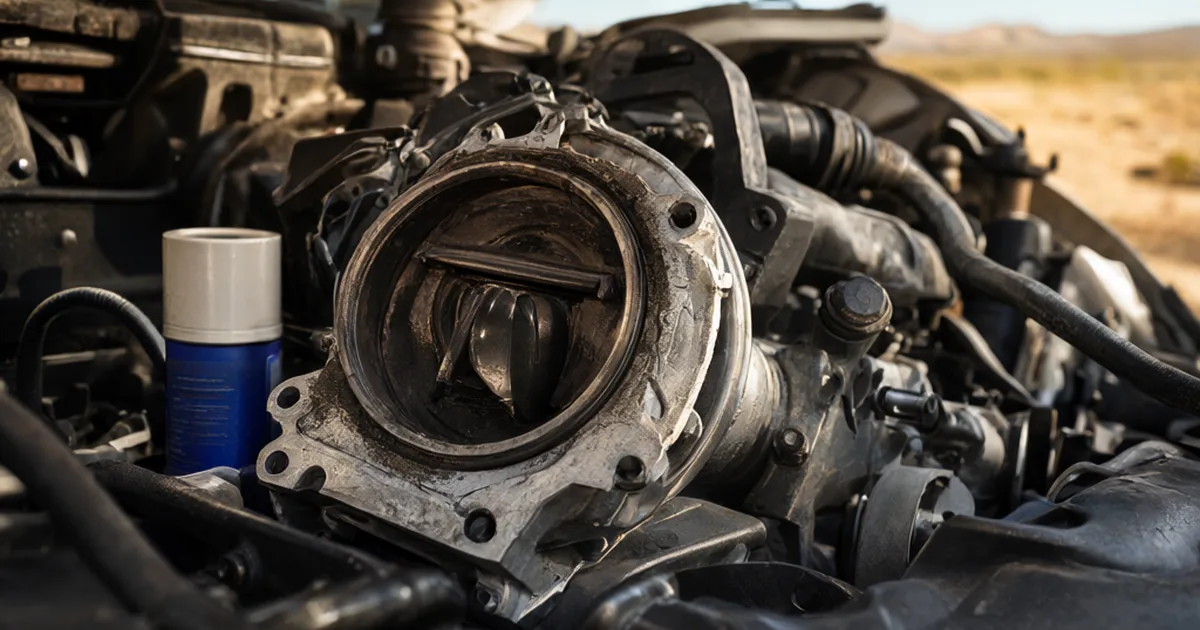
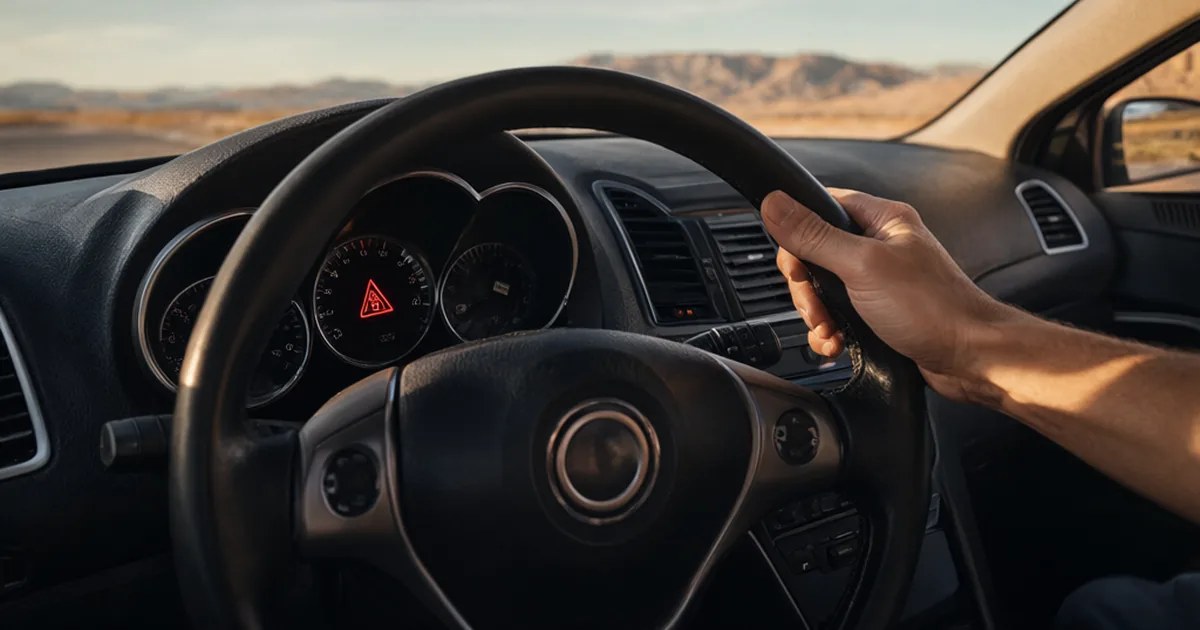
At 9:42 AM on Tropicana, a 2017 Mercedes-Benz C300 driver kept driving with the oil pressure light on. Four miles to get home — that was the plan. By the time the car coasted into our parking lot, the engine was knocking like a diesel and the oil pan was bone-dry. Two minutes more and it would have seized on the road.
Estimate: $7,400 for a replacement engine. The actual problem when she first saw the light? About $49 worth of oil short, plus a $189 valve cover gasket leak that had been weeping for three months.
The difference between a $49 fix and a $7,400 rebuild was 60 seconds of driving with the wrong assumption. The most expensive thing you can do when an oil-pressure warning comes on is keep driving “just to get somewhere safer.”
Two oil warnings — the difference matters more than anything in this article
Modern cars have two different oil-related dashboard warnings. They look similar. They mean very different things.
Yellow or amber oil-LEVEL warning (sometimes a low oil can icon, sometimes the words “Low oil level — add 1 quart”): The oil is below the optimal level in the pan. The engine has oil pressure. The engine is currently safe. You have time — usually days or hundreds of miles — to address it correctly.
Red oil-PRESSURE warning (oil can icon, sometimes with the word “STOP”): The engine has insufficient oil flow to the bearings and rotating parts. This causes catastrophic mechanical damage in less than 60 seconds of continued operation.
If you remember nothing else from this article: red light = engine off, now.
The 60-second rule for the red oil-pressure light
When the red oil-pressure light comes on:
- Within the first 10-15 seconds: signal, move to the right lane, and pull over at the next safe spot. Do not drive past the next exit. Do not “make it to the next gas station.”
- The moment you’re stopped: engine off. Not idle, not “let it cool down” — off.
- Call for a tow. AAA, your insurance roadside, or a flatbed service. We can recommend a flatbed if you call our shop at (725) 322-7768.
- Do NOT restart the engine “to see if it’s still on.” Each cold start with no oil pressure scores the bearings further.
The only exception: if you are stopped in an actively dangerous location (live traffic lane on the 15 at 70 mph), get to the shoulder first, then off. Otherwise, the rule is “engine off within 60 seconds of seeing red.”
Why “just drive home, it’s only a few blocks” kills the engine
The crankshaft, connecting rod bearings, and camshaft bearings inside your engine are not bearings in the ball-bearing sense. They are precision-machined surfaces that ride on a pressurized film of oil — about 0.001 inches thick. The oil pump generates the pressure that keeps the metal surfaces from touching.
When that pressure drops to zero:
- Within 5 seconds, the oil film breaks down
- Within 10-15 seconds, you have metal-on-metal contact at the bearing surfaces
- Within 30 seconds at 2,000 RPM, the bearings are scoring (visible scratch damage)
- Within 60 seconds, crankshaft journal surfaces are damaged
- Within 2-3 minutes, the engine is making knocking sounds — that’s the rod bearings starting to come apart
- Within 5 minutes, you are looking at a rebuild or replacement
The damage is cumulative and irreversible. There is no “I made it home so it must be fine.”
Most common causes of the red oil-pressure light
In order of how often we see them at our engine diagnostics bay:
- Low oil level — by far the most common cause. A slow leak (valve cover gasket, oil pan gasket, rear main seal) drops the level over weeks or months. Owner never checks the dipstick. Oil pickup tube starts pulling air at hard cornering or hard braking. Pressure drops, light comes on.
- Failed oil pump — less common, but it happens. BMW N62, N63, and S65 engines are known for oil pump failures. Mercedes M276 and M278 have a known oil pump drive chain stretch issue.
- Plugged oil filter — happens after going way past the oil-change interval, or after using a cheap aftermarket filter that bypassed. Cold-start pressure is very low until the bypass valve opens.
- Failed oil-pressure sensor or wiring — false alarm. The engine is fine; the sensor is lying. But you cannot assume this — always treat the light as real until proven otherwise.
- Camshaft phaser / VANOS / VVT solenoid failure (BMW) — engine runs without oil pressure to the VANOS units, which can illuminate the warning even though main oil pressure is okay. Still worth treating as urgent.
Diagnosing it correctly once the car is safely at our shop
When a vehicle comes in on a tow for a red oil-pressure light, our diagnostic flow:
- Physical dipstick check first. 60% of the time, the oil is so low it’s not registering on the stick at all. We add oil, prime the pump, and the light goes out.
- Mechanical gauge tap-in at the oil-pressure sender port. Compares actual oil pressure to what the ECU is reading. Catches faulty sensors.
- Scan-tool live data — ISTA for BMW, XENTRY for Mercedes, VAG-COM/ODIS for Audi/VW, GDS2 for GM, IDS for Ford. Look at oil pressure live, oil temperature, VANOS or VVT solenoid feedback, and any related fault codes.
- If pressure is genuinely low and oil level is correct: oil pump testing, possible pan-drop to inspect pickup tube screen, and timing chain area inspection on engines with chain-driven pumps.
Diagnostic cost: $49.99. That’s the same price whether the answer is “you were a quart low” or “your oil pump is failing.” See our check engine light and diagnostics guide for related diagnostic procedures.
The yellow oil-LEVEL light — handle calmly, but handle it
When the yellow oil-level warning comes on:
- You have time. Don’t panic-drive to the nearest gas station and dump in whatever oil they sell.
- Check your owner’s manual for the correct oil viscosity (0W-20, 5W-30, 5W-40, etc.) and specification (BMW LL-04, MB 229.5, VW 502.00, ACEA C3, etc.)
- Buy 1 quart of the correct oil. Add it. Drive 5 miles. Recheck level on a level surface.
- Within the next week, get the leak diagnosed. Common culprits on European cars: valve cover gasket, oil filter housing gasket (BMW N20, N52, N55, B58), oil pan gasket, rear main seal, BMW N62 valve stem seals, Mercedes M272/M273 oil cooler seals.
A slow leak that you keep topping off is a slow leak. A slow leak that you ignore until the level drops below the pickup tube becomes a red oil-pressure light, which becomes the $7,400 engine.
The “I’ll wait until next oil change” trap
We see this often with BMW and Mercedes drivers who got into the habit of “lifetime fluid” thinking. Cars driven 800-1,500 miles a quart low, repeatedly, between oil changes. Each one of those miles is a slightly degraded oil film at the bearings.
The bearings don’t fail right away. They fail at the worst possible moment — usually on a long highway run, often during a road trip to LA or up to Reno, far from help, often at sustained high RPM where bearing load is highest. The car limps for 50 miles with a knock, then quits.
If your car uses any noticeable amount of oil between changes — say, more than a quart per 3,000 miles — get the leak or consumption diagnosed.
Pricing — what the decision tree actually costs
- Engine diagnostic (covers pressure, level, sensor, and basic mechanical assessment): $49.99
- Oil-pressure sensor replacement (when the sensor is the culprit): $189-$329 depending on engine layout
- Valve cover gasket replacement (common BMW/MB leak source): $389-$890 depending on engine
- Oil pump replacement: $899-$1,800 depending on whether the engine has to come out for access
- Engine rebuild or replacement after pressure-related damage: $5,000-$12,000
The 60-second decision when the red light comes on is the entire game. Stop the engine, save the engine.
Mini FAQ
Can low oil pressure damage a turbocharger? Yes — and turbos are the first thing to die on a low-pressure event. They spin at 80,000-200,000 RPM and rely entirely on engine oil for both lubrication and cooling. A turbo will fail on dry oil within 30-60 seconds, often before the engine bearings do. BMW B58, N54, N55, AMG M139, Mercedes M139, Audi 2.0T — all at high risk.
Why did my oil-pressure light come on right after an oil change? Three possibilities: the technician used the wrong viscosity (too thin for the engine), the filter wasn’t tightened properly (oil pumping out from around the seal), or the filter was a cheap unit that’s not sealing correctly. If this happens right after an oil change, do not drive — call us at (725) 322-7768. If we did the oil change, we’ll come look at it. If a chain shop did it, we recommend not restarting the engine to drive back to them.
Is full synthetic less prone to pressure drops? Slightly. Synthetic maintains viscosity better at high temperature, so cold pressure and hot pressure stay closer together. It doesn’t make the engine immune to low-level events. The dipstick is still your friend.
The single most important habit you can build as a vehicle owner: check your dipstick once a month. It takes 30 seconds. It catches the slow leak before it becomes the red light. It saves engines.
If your oil-pressure light is on right now and you’re reading this — do not drive. Call (725) 322-7768 and we’ll help you arrange a tow to our Las Vegas European auto repair shop on Arville. Or book a diagnostic appointment once the car is safely at home.