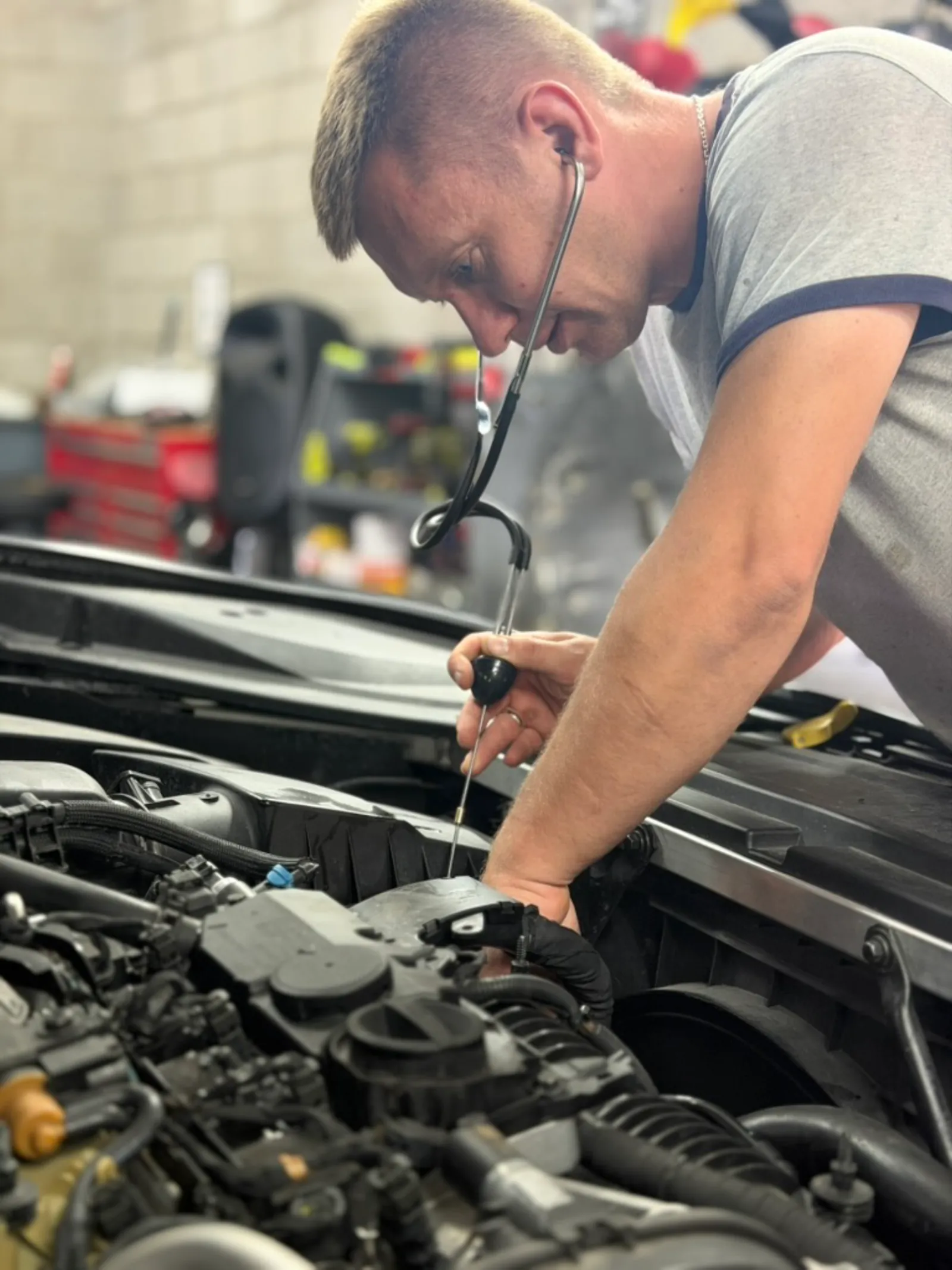
It starts as a faint metallic rattle the moment you turn the key on a cool desert morning — gone in three seconds, easy to dismiss. A customer drove his 2016 BMW 320i from his Summerlin home to our Arville Street shop last spring, convinced the noise was “nothing.” It wasn’t. The N20 timing chain had stretched enough to shred the plastic chain guide, and the engine was roughly 800 miles from jumping time entirely. Catching it when we did saved him an engine. Missing it would have cost him one.
What “Timing Chain Stretch” Actually Means
A timing chain synchronizes your crankshaft and camshaft(s) so valves open and close at exactly the right moment during each combustion cycle. Chains are designed to outlast belts — but they are not indestructible. Over time, the pins and link plates wear, allowing the chain to elongate. Even a few millimeters of slack lets the chain slap against its guide rails, throw off cam timing, and trigger a cascade of mechanical failures.
On BMWs and Audis specifically, this is not a freak occurrence. It is a documented, pattern failure on several high-volume engines, and Las Vegas driving conditions — short trips, idling in 110°F heat, and oil that degrades faster than the service interval suggests — accelerate the wear timeline considerably.
The Engines Most at Risk
| Engine Code | Found In | Known Failure Mode |
|---|---|---|
| BMW N20 | 2012–2016 3 Series, X1, X3, Z4 | Chain stretch + plastic guide cracking, often before 80k miles |
| BMW N47 | 2007–2013 3 Series diesel (UK/EU) | Rear-mounted chain; guide failure causes sudden catastrophic skip |
| Audi/VW EA888 Gen 1–2 | 2008–2013 A4, A5, Q5, Golf GTI | Tensioner seal failure lets oil drain back; chain slack on cold start |
If you own any of these vehicles and haven’t had the timing chain system inspected, read the next section carefully.
Symptoms You Should Never Ignore
Cold-start rattle (the most critical warning sign) A rattling or chattering sound from the top or front of the engine in the first 2–5 seconds after a cold start is the classic indicator. The chain tensioner hasn’t built oil pressure yet, so a worn chain slaps the guide. Once oil pressure rises, the rattle often disappears — which is exactly why owners dismiss it for months.
Check Engine light with camshaft timing codes Codes like P0008, P0009, P0011, P0016, or P0017 indicate the ECU has detected that cam timing is out of spec. These do not always feel dramatic. The car may still drive, but the engine is operating outside its designed parameters.
Rough idle or hunting idle A stretched chain causes inconsistent valve timing, which shows up as an uneven, surging idle — especially noticeable at a long red light on a hot afternoon on the 215 Beltway.
Sluggish acceleration or misfires When cam timing drifts, combustion efficiency drops. You may notice the car feels flat pulling onto I-15, or you see intermittent misfire codes alongside the timing codes.
Oil consumption that seems to have increased On EA888-equipped Audis, a failing timing chain tensioner seal can allow oil to migrate. If you’re topping off oil between changes more than you used to, that’s worth investigating alongside a chain inspection.
Why Las Vegas Amplifies the Risk
Oil viscosity and cleanliness are the timing chain’s primary defense. In our climate, engines soak up ambient heat sitting in a parking lot in Paradise or Henderson before the driver even starts them. Short trips — common in suburban Las Vegas — mean the engine rarely reaches full operating temperature long enough to boil off moisture and fuel dilution in the oil. The result is oil that degrades faster than the mileage suggests. Running a 10,000-mile oil change interval on an N20 or EA888 in this city is a gamble we would not recommend.
We had a 2014 Audi Q5 come in from Green Valley last summer with 62,000 miles — well under the threshold where many owners start worrying — and the chain guide had already cracked in two places. The owner had been following the manufacturer’s extended oil change schedule to the letter. The heat had other plans.
What Happens If You Wait
This is not a “monitor and revisit” situation. A stretched chain can:
- Skip a tooth on the cam sprocket, instantly bending valves into pistons
- Snap entirely, causing immediate, total engine failure at any speed
- Destroy variable valve timing (VANOS/VVT) components that cost thousands to replace on their own
Engine replacement or full rebuild on an N20 or EA888 platform typically runs several thousand dollars. Timing chain service — chain, tensioner, guides, and seals — is a fraction of that cost. The math is straightforward.
What Our Inspection Covers
When a BMW or Audi owner comes to our Arville Street shop with a cold-start rattle or any of the codes listed above, we start with a $49.99+ engine diagnostic to pull stored and pending fault codes. From there, we assess chain slack, tensioner condition, guide wear, and oil health. We’ll tell you exactly where you stand — no pressure, no invented urgency.
FAQ
Q: My car only rattles for a second at startup. Is it really serious? Yes. That one second of rattle is the chain slapping the guide under low oil pressure. It means wear is already present. How much wear determines how urgent the repair is, which is exactly what a diagnostic will tell you.
Q: Can I just replace the tensioner and skip the chain? Sometimes — but only if the chain itself measures within spec and the guide material is intact. We see shops replace the tensioner alone, only for the customer to return six months later needing the full job anyway. We’ll give you an honest assessment of what the chain actually measures.
Q: How long does a timing chain service take? On most N20 BMWs and EA888 Audis, plan for a full shop day — roughly 6–10 labor hours depending on the specific model. It’s significant work, but it’s the repair that keeps a $40,000+ car running the way it should.
Bottom Line
A cold-start rattle on a BMW or Audi is your engine asking for help before things get catastrophic. Given how fast our Las Vegas heat cycles accelerate oil breakdown and plastic guide wear, the window between “early warning” and “bent valves” is shorter here than the factory engineers designed for. Don’t wait for a second opinion that costs you an engine.
Schedule online at /contact or call (725) 322-7768 — our team at 4350 Arville Street specializes in BMW and Audi timing chain diagnosis and repair, and we’ll give you a straight answer on where your engine stands. See our full range of European vehicle services to learn more about what we cover.